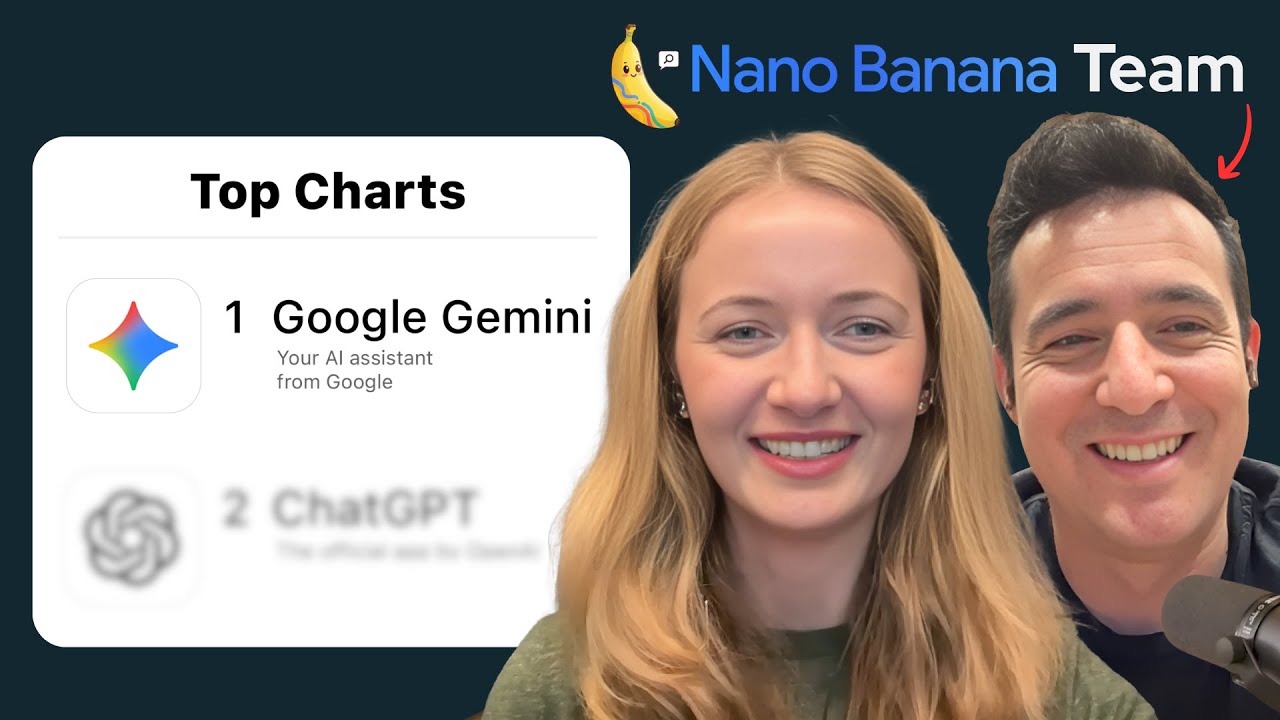
Google’s Nano Banana (officially Gemini 2.5 Flash Image) has become the breakout AI product of the moment, driving Gemini to the top of the app store for the first time and dominating social media with its image generation capabilities. Jacob interviews Nicole and Oliver from the Google team behind the model to discuss what makes it special, how people are actually using it, and where image models are heading next.
What makes Nano Banana stand out
Character consistency is the headline feature: the model can place a person’s face accurately across wildly different scenarios — wanted posters, childhood dream professions, figurines — and Nicole’s own face has become an internal eval set the team uses to eyeball new model versions.
Emotional use cases surprised the team: beyond the fun transformations, people have been colorizing old black-and-white family photos, letting them see what parents or grandparents looked like in color for the first time.
The name came from a 2.30 AM moment: a PM named Nana came up with “Nano Banana” while working late on the release, and it stuck — partly because “Gemini 2.5 Flash Image” is a mouthful, and partly because having an associated emoji makes branding stickier.
Success exceeded expectations: the team knew the model was strong, but the real signal was the surge of users flooding LM Arena to use it, forcing them to keep increasing queries-per-second capacity.
How the model got so good
It is not one breakthrough but the result of tuning many details and a team that has been working on the problem for a long time.
Tight integration with Gemini’s language model is a key differentiator: the model inherits Gemini’s world knowledge, so users no longer need to specify every detail of an image. You can ask open-ended questions like “redecorate my room, give me ideas” and the model can reason about color schemes and plausible suggestions.
This reflects a broader shift from two or three years ago, when users had to write extremely specific prompts (a cat on a table with this exact background and these colors) to get good results.
Popular use cases and user requests
Top requests on Twitter: higher resolution (currently 1K), transparency/PNG support for pro use cases, and better text rendering.
Figurines: turning yourself or others into toy figurines has been a viral use case.
Sophisticated workflows: users are storyboarding AI-generated videos with Nano Banana before moving to video models like V3, and architects are using it to go from blueprints to 3D-looking renders to design iterations, skipping tedious early-stage work.
Vibe coding for UI: people are iterating on website designs visually before committing to code, which feels more natural than going straight from prompt to a coded site.
Product design for different users
Sophisticated users (LM Arena crowd, developers) know what they want and discover unexpected capabilities — like turning objects into holograms — that the team never explicitly trained for.
Casual consumers face the blank canvas problem: they hear about Nano Banana but do not know what to do with it. The team has added banana emojis throughout the Gemini app to make the feature discoverable and partnered with creators to publish prepopulated prompts that link directly into the app.
Social sharing drives adoption: because the model is personalizable by default (try it on yourself, your friends, your pets), people see others’ creations and want to replicate them, which solves the cold-start problem organically.
The “parent test”: Nicole uses her parents as a benchmark — if they can use it without guidance, the product is good enough. By that standard, there is still a long way to go.
The future of interacting with image models
Beyond text prompts: the team is excited about voice as a natural interface, gesture-based editing (erasing an object by scratching it out like on a pad), and multimodal interfaces that blend text, voice, and visual interaction depending on the task.
The intent detection problem: the challenge is figuring out what the user wants and switching between modes seamlessly, while also surfacing what is possible without overwhelming them.
Pro vs. casual workflows: chatbots like Gemini are great for ideation and quick iteration, but pros working in marketing or design still need pixel-level control and integration with tools like Adobe. Both modes will coexist.
Personalization: most personalization will likely happen at the prompt layer — feeding the model context about the user’s closet, style preferences, or past choices — rather than giving everyone their own fine-tuned model, though some aesthetic control at the model level may emerge for pro workflows.
Evaluating image models
Subjectivity makes evaluation hard: unlike legal or coding benchmarks with relatively clear right answers, image quality is subjective. The team combines automated evaluation using LLMs (a virtuous circle where the language model helps evaluate its own image generations) with human eyeballing by team members with strong aesthetic judgment.
LM Arena as the gold standard: real user prompts on LM Arena are considered the best eval because they reflect what people actually want, not synthetic benchmarks.
Community feedback on X is actively incorporated into eval sets to capture both what is working (so they do not regress) and what the community wants improved.
The broader image model landscape
Rapid progress from GANs to diffusion: Oliver, who worked in the space when GANs could only generate narrow distributions (front-facing faces), describes the last few years as a rocket ship. Stable Diffusion’s open release showed the size of the developer community, and friendly competition between labs has driven rapid improvement.
MidJourney’s early lead came from figuring out post-training for stylistic and artistic imagery before anyone else, and from narrowing the domain to only high-quality outputs, which made them look dramatically better.
Expansion to broader image categories: all models, including MidJourney, Flux, and GPT, can now generate much wider categories of images while retaining quality, thanks to better data, scaling, and accumulated engineering knowledge.
Concentration risk: image models have historically been an area where smaller labs could compete, but the importance of world knowledge from large language models may favor the same groups that can do large-scale LLM training. Chinese labs are also emerging as major players in image generation.
Image models and video models
Closely related, sharing techniques: many methods developed for image generation transferred to video generation and vice versa. The teams share learnings, and the models are used together in workflows — ideation in an LLM, iteration in image space (faster and cheaper), then production in video.
Video frontiers: the next problems are longer-form content with coherent characters across scenes, better resolution, and the same level of control that image models now offer.
Omni models: the industry is moving toward models that handle everything — text, image, video — which may eventually consolidate these separate efforts.
Overhyped and underhyped
Overhyped: the idea that one short prompt produces a production-ready result. In reality, even impressive social media posts involve significant iteration and work behind the scenes.
Underhyped: the question of what the UIs of the future will look like — how to make these models easier to use, show people what is possible, and integrate them into specific workflows. Neither Nicole nor Oliver has seen a product that has cracked this yet.
What is next
Factuality in images: a frontier not enough people are paying attention to. Nano Banana can annotate a photo of Niagara Falls, but on close inspection the text is garbled or repeats information. This mirrors the early LLM trajectory of being fun for creative tasks before becoming reliable for information-seeking.
Proactive multimodal responses: just as Google Search sometimes returns an image when that is the best answer, future models should proactively decide when an image, a video, or text is the right modality for a given query rather than always requiring the user to ask.
Image quality still has far to go: the best images today may look as good as the best in a few years, but the worst-case images today break down quickly when prompts require composing multiple unusual concepts. Improving the floor, not just the ceiling, is where the next 10x improvement will come from.
Personal use case: Nicole’s favorite Nano Banana creation is playing with the model alongside her kids — putting them in funny locations or making their stuffed animals come to life — because it is personal, shareable, and something they genuinely enjoy doing together.