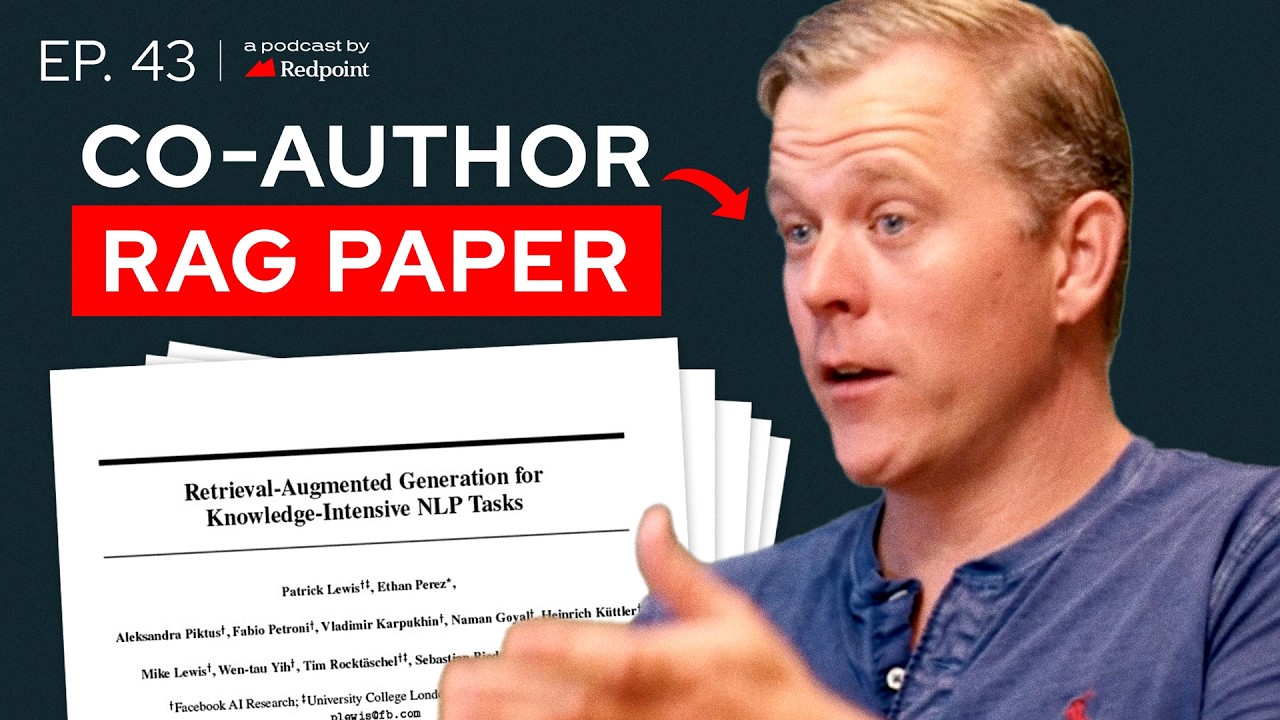
Douwe Kiela is a foundational figure in modern AI: he co-authored the first paper on retrieval-augmented generation (RAG), spent five years at Facebook AI Research (FAIR), led research at Hugging Face, is an adjunct professor at Stanford, and is now CEO and co-founder of Contextual AI—a company that has raised nearly $100 million to build customized, enterprise-grade language model systems.
This episode covers his reaction to OpenAI’s o1 model, the shift from model-centric to systems-centric AI, advances in post-training and alignment (including DPO, KTO, APO, and CLARE), the realities of enterprise deployment, the future of small and open-source models like OLMoE, and emerging trends like multi-agent systems and synthetic data.
OpenAI’s o1 and the Rise of Test-Time Compute
OpenAI’s o1 represents a major step in reasoning by compressing Chain of Thought (CoT) into the model via reinforcement learning (RF), effectively turning the model into a more complex system that “thinks” during inference.
This approach trades off latency for accuracy—making it powerful for math, law, and complex reasoning, but slower and not universally better than older models.
Douwe sees this as validation of a broader industry trend: moving beyond next-token prediction toward integrated systems that combine retrieval, reasoning, and generation.
He notes that while the ideas behind o1 aren’t new (CoT and RF have existed for years), OpenAI deserves credit for exceptional execution and integration.
Contextual AI’s Core Thesis: Systems Over Models, Specialization Over AGI
Contextual AI was founded on the belief that enterprises don’t need generalist AGI—they need specialized, reliable, end-to-end systems tailored to high-value, knowledge-intensive tasks.
Most enterprise AI failures stem from treating the LLM as a standalone component rather than part of a larger system that includes extraction, retrieval, reranking, generation, alignment, and evaluation.
Contextual takes a “vertical slice” approach: tightly integrating all components (retrieval, generation, post-training) and co-optimizing them for specific use cases—contrasting with the common “Frankenstein RAG” approach of bolting together off-the-shelf tools.
This enables higher ROI, better performance, and easier path to production—especially in regulated or high-stakes domains (e.g., finance, HR) where generalist models pose compliance risks.
The Evolution and Limits of RAG
Douwe co-authored the first RAG paper while at FAIR, inspired by grounding language in external knowledge (like Wikipedia) using early vector search (FAISS).
The original vision was more ambitious than what ended up in the paper; Contextual is now building that fuller vision.
RAG became popular because it solved real grounding problems, but most implementations fail at scale due to poor extraction, naive retrieval, and lack of end-to-end optimization.
He jokes they should’ve named it something catchier—ideally with “contextual” in it.
Enterprise AI: Demos vs. Production Reality
Many enterprise AI efforts stall at the demo stage because they’re built on small, curated datasets (e.g., 20 PDFs) and don’t generalize to real-world scale (e.g., 10,000+ documents).
Real deployment requires solving boring but critical problems: robust document extraction, scalable retrieval, security, compliance, and operational monitoring.
Contextual focuses exclusively on production deployments, working closely with customers to define success metrics and keep humans in the loop—especially for high-risk use cases.
Common successful applications include code generation, customer support, and internal search—but even these require careful scoping and integration.
Advances in Alignment and Post-Training
Post-training—especially alignment—is where much of the “magic” happens in making models useful.
RLHF (Reinforcement Learning from Human Feedback) was key to ChatGPT’s success but has drawbacks: it requires expensive reward models and manual preference annotation.
DPO (Direct Preference Optimization) removes the need for a reward model by optimizing directly on preference pairs.
KTO (Kahneman-Tversky Optimization), developed by Douwe’s team, goes further: it works with binary feedback (thumbs up/down) without needing paired comparisons—making alignment cheaper and more scalable.
CLARE (Contrastive Learning from Revisions) improves signal quality by comparing flawed outputs to their corrected versions, reducing ambiguity in preferences.
APO (Anchored Preference Optimization) accounts for the relative quality of the model generating the data vs. the preference data—preventing models from learning from inferior examples.
Together, these methods enable powerful alignment with less human annotation and more control over model behavior.
Small Models, Open Source, and On-Device AI
Contextual collaborated with the Allen Institute to release OLMoE, a high-quality open-source Mixture-of-Experts (MoE) model.
Motivation: lack of strong open-source MoE models for research and edge deployment.
Trend toward smaller, efficient models that can run on-device—especially when combined with techniques like GRIT (Generative Representational Instruction Tuning), which allows the same model weights to serve as both retriever and generator, saving compute.
Future vision: combine OLMoE + GRIT to build powerful, private, on-device RAG systems (e.g., on your phone).
Evaluation: The Missing Standard in Enterprise AI
Evaluation is one of the most underdeveloped areas in enterprise AI.
Most companies rely on ad hoc spreadsheets with too few examples and high variance—leading to unreliable assessments of model quality and risk.
There’s no standardized, principled framework for evaluating end-to-end AI systems in enterprise contexts.
Contextual is working on evaluation tools designed for modern “API-first” AI developers—focusing on usability over statistical rigor—so non-ML experts can reliably test and trust their systems.
Changing Minds: What Surprised Douwe Recently
Synthetic data works better than expected—despite flawed claims that models collapse when trained on their own outputs.
Agentic workflows are more viable than anticipated—even if “agent” remains loosely defined.
Test-time compute (e.g., Chain of Thought) is not a gimmick—it’s a powerful, practical tool that significantly boosts reasoning, especially when distilled back into models via RL.
He admits he was too dismissive of CoT early on, underestimating its real-world impact due to academic bias toward “elegant” ML contributions.
Data: We’re Not Running Out—But Quality Matters
Claims that we’re “running out of tokens” are overblown.
Society produces vast amounts of data daily; the issue is quality, not quantity.
Lower-quality data can still be useful—but requires more of it and smarter algorithms.
Multimodal data (especially video) is vastly underused: training on cat videos teaches “cat” far better than text alone.
Synthetic data, when done right, is powerful—especially when paired with advanced alignment methods like KTO and APO.
Reasoning: Beyond Math Puzzles
Models have had reasoning capabilities for a while; o1 didn’t invent them.
Real progress will come from better data (e.g., step-by-step reasoning from domain experts) and systems that combine reasoning with retrieval and verification.
Douwe is excited about meta-reasoning: e.g., self-referential tasks like “How many words are in this sentence?”—which require models to reason about their own structure.
His paper I Am a Strange Dataset explores this, inspired by Douglas Hofstadter’s theory that consciousness arises from self-referential loops.
Multi-Agent Systems: The Next Frontier
While still early, multi-agent systems are already emerging in practice (e.g., synthetic data pipelines, tool-using agents).
Douwe’s early FAIR work on multi-agent communication showed that network topology affects emergent “dialects”—a metaphor for organizational culture.
Future systems will likely involve humans and AI agents collaborating in shared workflows—with AI agents deciding when (and when not) to involve humans.
Hugging Face and Meta’s Open-Source Strategy
Hugging Face has become the central hub for model publishing—a role GitHub missed for code.
Its success depends on the open-source ecosystem (including Meta’s Llama), but it has carved out a unique, beloved position.
Meta’s decision to open-source PyTorch, React, and Llama reflects Mark Zuckerberg’s strategic vision: control the platform layer to avoid dependency on rivals.
This has also rehabilitated Meta’s public image and boosted its AI hiring.
Building Contextual: Pragmatism Over Hype
Contextual has raised significant capital but avoids overfunding relative to needs—preparing for a potential AI hype downturn.
They don’t train base models (relying on Meta and others), staying capital-efficient.
Current product is “white-glove”: high-touch, customized deployments (like selling Tesla Roadsters with engineers included).
Long-term goal: build the “Model S assembly line”—a turnkey, scalable platform for enterprise AI.
Infrastructure (e.g., reliable GPU clusters) is harder than expected—even top labs like Meta face constant hardware failures.
Quickfire Round
Overhyped & underhyped: Agents—they don’t work reliably yet (overhyped), but show real promise (underhyped).
Biggest surprise in building Contextual: How hard it is to maintain a stable, high-performance research cluster.
Open vs. closed models: The future is a mix—but the sweet spot is in the middle: open-source models enhanced with strong post-training to balance cost, performance, and control.
Most exciting non-Contextual AI company: AI-driven personalized entertainment (e.g., Suno, video generation)—moving faster than expected toward infinite, personalized media.
Most interesting company to run AI at: A traditional enterprise like JPMorgan—where AI can transform deeply entrenched workflows if deployed wisely.
If not building Contextual: He’d still focus on transforming work through AI—but might explore entertainment applications.
Where to learn more: contextual.ai, and Douwe on Twitter (he’s the only one with his name).