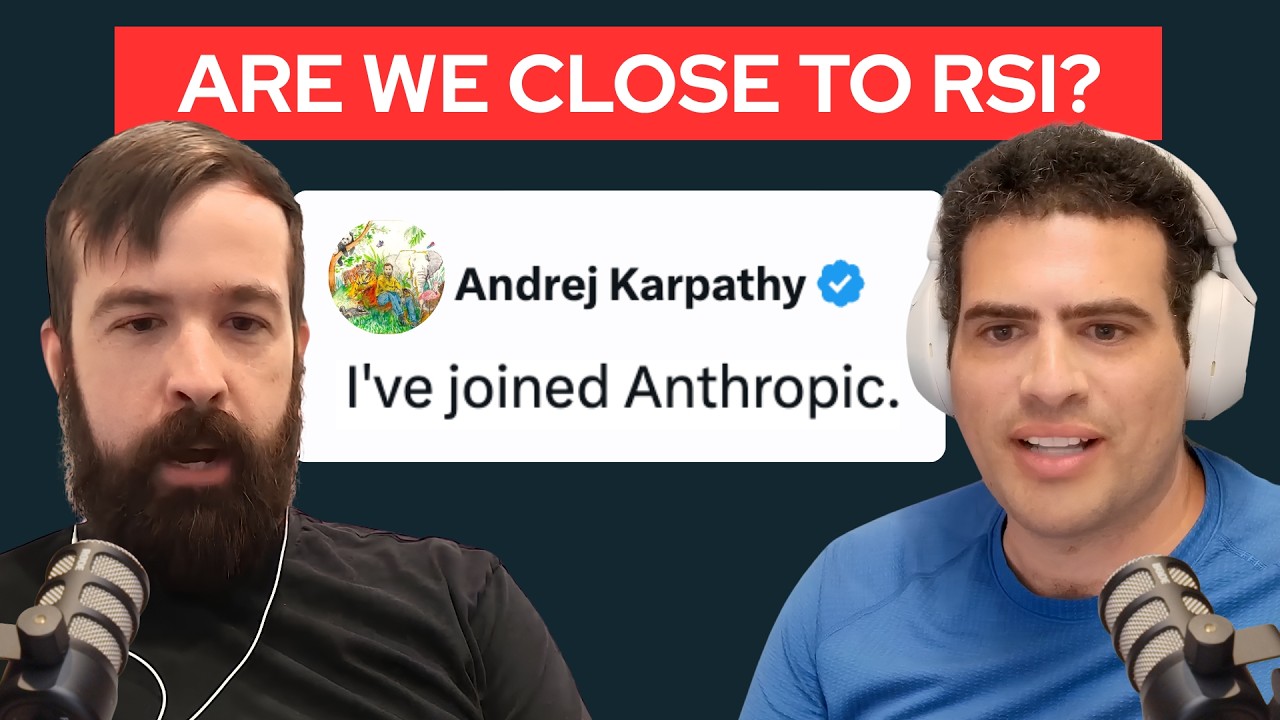
Jacob Efron hosts an AI “vibe check” roundup with Ari (co-founder of Datology, former DeepMind and Meta researcher) and Rob (investor at Radical Ventures), covering the major shifts in the AI landscape over the past six months. The conversation spans coding agents, the future of open-weight models, the Anthropic–OpenAI rivalry, compute constraints, hardware disruption, robotics, and life sciences.
Coding agents have crossed a threshold
Over the past six months, coding agents have become reliable enough to operate over longer time horizons, fundamentally changing how engineers work.
At Datology and elsewhere, engineers are increasingly acting as managers of agents rather than individual contributors writing code themselves.
This shift has driven massive increases in token spending and popularized the idea of “token maxing” — letting models think longer to solve harder problems.
Productivity gains are real but overstated: bottlenecks have shifted to code review, and the ease of producing large volumes of code has introduced an “understanding gap” and more low-quality “slop” in codebases.
Open-weight AI may be falling behind
Rob raises the possibility that near-frontier open-weight models may cease to be a meaningful force in the ecosystem.
Meta, historically the open-weight champion in the West, appears to be pulling back from its open-source strategy.
Chinese labs like Quen and DeepSeek are keeping their highest-performing models proprietary behind APIs and only open-sourcing smaller, less capable versions.
The economics are driving this: serving large open-weight models is extremely expensive with no direct revenue, and once a lab has earned credibility through an open release, the incentive shifts to monetizing hosted inference.
Ari agrees the number of open models likely peaked in 2025 and will decline, though he notes that strong open models will still exist — just fewer of them.
There is no clear sustainable business model for an open-source model company; the Red Hat-style enterprise premium approach doesn’t translate well given the massive upfront training costs.
One possible hybrid model: open-source the model weights but keep the harness and scaffolding proprietary, monetizing the full system through an API (similar to what Moonshot/Kimi is doing).
The apps-are-cooked narrative is overblown
Rob argues that while some traditional software categories face existential risk from frontier labs, the “apps are dead” narrative swung too far.
Horizontal, cross-cutting areas like coding are natural fits for labs to dominate, but vertical and niche applications still offer opportunities for startups.
Startups win because large companies cannot execute excellently across every category — as evidenced by OpenAI suspending its video efforts despite effectively infinite capital and talent, likely due to compute constraints and the need to focus.
Hard tech and hardware investing has become more popular in VC, but those categories have high failure rates and many unsolved problems.
OpenAI’s leadership under pressure; Anthropic’s vibe run
Rob’s December prediction that Sam Altman could be out as OpenAI CEO by end of 2026 has become more plausible. The “vibes have shifted” against OpenAI this year, with increasing questions around Altman’s leadership, damaged trust from the Elon Musk trial, and a sense that OpenAI tried to do too much.
Dario Amodei was Rob’s originally predicted successor, but health concerns have changed that calculus. Brett Taylor (chairman of OpenAI’s board, CEO of Sierra) is now a plausible candidate — an acquisition of Sierra and appointment of Taylor as CEO could be transformative for OpenAI’s reputation and fortunes.
An Alphabet-like restructuring is also plausible, with Sam staying CEO of a holding company while ChatGPT or other products get separate leadership.
Anthropic has had an unprecedented run of positive sentiment, seen as the consensus leader, but early cracks are appearing — particularly around the Fable release.
Fable and the silent limitation controversy
Anthropic’s Fable model appears to silently limit its usefulness for AI development tasks — it doesn’t refuse, it just performs poorly without the user knowing.
Ari sees this as competitive positioning rather than a safety measure, noting that open models with good harnesses have reproduced similar vulnerability-finding capabilities.
The move has angered even strong Anthropic supporters and could drive AI developers toward OpenAI’s Codex.
On distillation concerns: Ari argues the threat is overblown — you can build powerful models without distilling from closed APIs, as demonstrated by models like MAI that avoided synthetic data from closed models entirely. The claim that open models can only catch up via distillation reads as “copium.”
On Fable’s capabilities: Ari sees it as a meaningful step change that undermines the narrative that pre-training has hit a wall. Gains are continuing to come from pre-training, and there’s no good reason to expect a plateau soon.
Google’s position and the coding model race
Rob pushes back on the idea that Google has fallen behind — they have deep talent, a massive revenue engine, full-stack chip-to-cloud vertical integration, and structural advantages over OpenAI and Anthropic.
Google’s relative weakness in coding reflects prioritization, not capability. Anthropic made coding its north star for years; OpenAI has recently quadrupled down with Codex.
Ari is surprised Google hasn’t improved more since Gemini 3.1 and expected a bigger launch at IO.
On consumer models, Ari argues models will be commoditized for most consumer use cases (answering questions, tutoring), and Google is well-positioned as the default provider on Android and iOS.
Codex is an amazing product but hasn’t dented Claude Code’s dominance because the models are close enough that there hasn’t been a compelling enough reason for most developers to switch — though Fable’s limitations may now drive AI developers toward Codex.
Compute constraints could kill the API business
Both Ari and Rob see a real possibility that frontier labs suspend or heavily limit public API access — not as a business strategy but because of compute scarcity.
Anthropic would prefer routing users through Claude Code (higher margin) over serving API customers. OpenAI has already started selling “futures” guaranteeing inference token access.
This would be an existential threat for companies building on top of these models and was not plausible six months ago but now feels very real.
The compute bottleneck is unlikely to resolve before 2030. Multiple efforts to break the semiconductor supply chain (new fabs, challenging ASML and TSMC) are underway but are at least five years from commercial viability.
Hardware disruption on the horizon
ASML’s extreme ultraviolet (EUV) lithography is hitting physical limits. Two promising research directions are emerging:
Atom lithography: using beams of atoms instead of light to print features on chips, enabling much lower resolution with simpler, cheaper, smaller machines.
X-ray lithography: moving further out on the electromagnetic spectrum past EUV to X-rays for even shorter wavelengths.
Several well-funded startups are pursuing both approaches, though all are still in development.
Alternative chip providers (AMD, Amazon Trainium, Cerebras) benefit from the compute constraint not by increasing total chip supply but by capturing demand that Nvidia can’t fulfill. TSMC also doesn’t want a Nvidia monopoly.
Older chips like H100s are seeing price increases after years of decline, suggesting even legacy hardware remains valuable in a supply-constrained world.
XAI, SpaceX, and the Cursor question
Rob is not optimistic about XAI becoming a top-tier frontier lab. The massive compute rental deals SpaceX signed with Anthropic and Google signal that frontier AI research is not the top priority — if it were, those chips would be used for training.
XAI’s durable advantage is in operationally intense, atoms-not-bits undertakings — standing up massive data center clusters quickly. This could make them the world’s world’s biggest cloud, especially as SpaceX puts compute into orbit.
The potential Cursor acquisition is about getting coding traces to compensate for XAI’s struggles in coding models. The deal is structured as an option, maintaining optionality for several years.
SpaceX’s S-1 included an absurd TAM chart with “all of space” at $28 trillion, reflecting the IPO narrative around enterprise AI.
Recursive self-improvement is closer but won’t cause runaway takeoff
Ari has become more bullish on recursive self-improvement (RSI) over the past six months, though he remains skeptical of the “one player runs away” takeoff narrative.
The bottleneck is fundamentally compute — ideas and execution are not the limiting factors, but running experiments requires massive compute.
Models are reaching the point where they can act as junior AI researchers, and experiments with agents doing data curation have shown promising results.
Ari expects at least ten companies have the funding, talent, and know-how to pursue RSI, so it won’t be limited to one player.
Anthropic slowing hiring of junior researchers is a signal that leadership believes AI-driven R&D is becoming viable.
Progress will be slower than the most aggressive predictions, but the direction is clear.
Robotics has crossed a commercial viability threshold
Rob has significantly pulled in his timelines for robotic AI. Six months ago he would have said the GPT-3 moment for general-purpose robotics could be 18 months to five years away.
Robotic foundation models have now reached a point where they are commercially viable across many use cases. As they get deployed with customers and the data flywheel spins, progress will accelerate.
The feedback loop in robotics is faster than in biology — you can immediately see whether a robot succeeded or failed.
Spicy predictions for the second half of 2026
Ari: Anthropic (or OpenAI) will suspend or heavily limit API access for a period of time due to compute constraints — a precursor to this happening more frequently. He’s more confident this happens by end of 2027 but sees a reasonable chance in 2026.
Rob: By end of 2026, it will be obvious that Anthropic is becoming a “fledgling juggernaut” in life sciences and biology, just as it dominated coding. Dario Amodei has a neuroscience PhD and long-standing passion for biology. The open question is how far down the value chain Anthropic will go — potentially setting up wet labs and eventually developing their own drug assets. Rob also predicts Anthropic and Isomorphic Labs will become two of the most important life sciences companies.
Rob’s meta-prediction: Dario Amodei will still be at Anthropic at the end of the year.
What they disagree with in the broader discourse
Rob most disagrees with the idea that current AI capex and data center buildouts represent permanent infrastructure. He believes we’ll look back in 5–10 years and laugh at how resource-inefficient today’s systems are, comparing 2-gigawatt data centers to the human brain running on 20 watts. Breakthroughs in analog computing (e.g., Naveen Rao’s work), algorithmic optimization, and hardware efficiency will dramatically reduce energy requirements.
Ari most disagrees with the notion of a permanent underclass and the idea that AI will take all human jobs within a decade. He argues that humans are slow at dissipating change through the economy, that much of business depends on human-to-human interaction and trust, and that technocrats underestimate how slow the world can be.