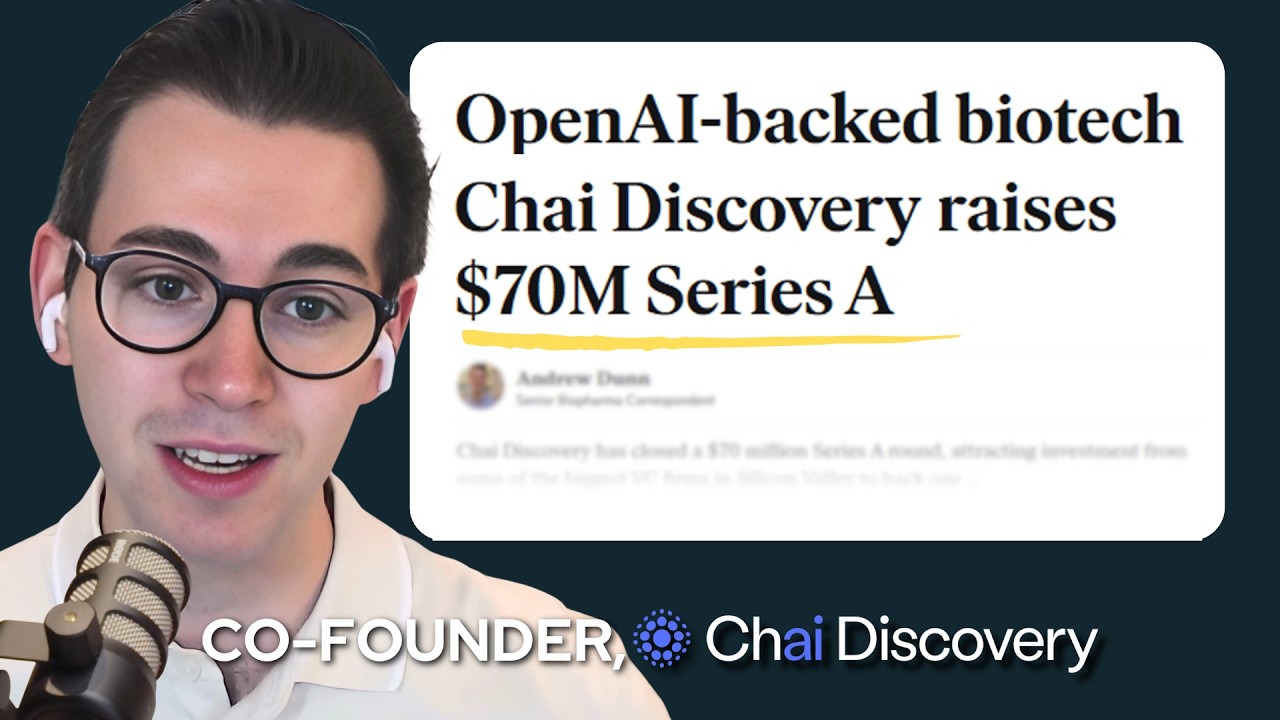
Joshua Meier, co-founder of Chai Discovery and former Chief AI Officer at Absci, discusses how AI foundation models are transforming drug discovery, moving from predicting single protein structures to designing entire molecular complexes, and what this means for the future of pharma and biotech.
The Evolution of AI in Drug Discovery
Early deep learning era (2015): Researchers began applying neural networks to protein structure prediction and design, using mathematical approaches that were essentially early versions of language models—biologists had been doing masked-sequence prediction for decades before NLP adopted it.
Wave 1 companies (data-focused): Startups like Recursion Pharmaceuticals focused on generating massive experimental datasets, using phenotypic screening—throwing random molecules at cells and using neural networks to interpret results.
Wave 2 companies (molecule modeling): AI small molecule companies tried to predict molecular properties and design better ones, but many were founded pre-GPT-1/3, meaning they lacked the ML technology to truly succeed.
Wave 3 companies (foundation models): Post-GPT-3/4 companies like Chai Discovery borrow lessons from NLP, computer vision, and video generation to build models with dramatically higher reliability—success rates of 10–20%+ on first-try molecule design.
Current State: What Works Today
Clinical trial optimization: LLMs are being used to write regulatory documents faster; the FDA is also adopting AI to review submissions—creating a dynamic where AI writes and AI evaluates.
Drug discovery (Chai’s focus): Given a therapeutic hypothesis (e.g., target GLP-1R for diabetes/weight loss), AI models learn how atoms interact at the fundamental level to design life-saving drugs.
From structure prediction to design: AlphaFold (2018/2021) predicted single protein structures. The field has since graduated to predicting macromolecular complexes—how proteins interact with other proteins, small molecules, DNA, and RNA—enabling true de novo drug design.
This is described as building an “atomic-level microscope” and then designing “atomic-level drugs” under it.
Modalities and Generalization
Two main therapeutic classes: Antibodies/biologics (proteins created by biology) and small molecules (chemically synthesized). Gene therapies and CRISPR-based approaches are also emerging.
Models are modality-agnostic: Chai’s models operate at the atomic level and work across small molecules, proteins, DNA, and RNA. There’s no fundamental reason the AI needs to specialize—similar to how LLMs generalize across text, code, and video.
Generalization debate: On base models trained on public data, performance is relatively even across domains. Some areas (like DNA/RNA structure prediction) may be harder due to less available 3D structural data or inherent molecular dynamism, but this could change with new datasets.
Data Generation and the Experiment Loop
Volume vs. quality: There are double-digit petabytes of DNA base pairs available online—more than some LLMs train on. The bottleneck is data quality and diversity, not volume.
Pre-training vs. post-training analogy:
Pre-training on public biological data (e.g., academic studies, environmental sequencing like NYC subway swabs) teaches models what makes a protein a protein.
Post-training on proprietary pharma data (e.g., specific molecule classes a company specializes in) teaches models what makes a protein a drug.
Pragmatic data strategy at Chai: Rather than building everything in-house, Chai leverages underutilized industry lab capacity for experiments. They partnered with multiple external labs for the Chai 2 study both for credibility/validation and elastic scalability.
The trend has shifted from “everything in house” to lean, focused teams that build in-house only what’s truly unique (e.g., novel disease models or data generation strategies).
Open Source Strategy
Chai 1 (open source, late 2024): An “atomic-level microscope”—predicts how atoms interact at the atomic level. Open-sourced because Chai expected this capability would become open anyway, and they wanted to be the ones to do it.
Chai 2 (recently announced): “Photoshop for molecules”—a system where you prompt with a target protein, a binding site, and desired properties, and it outputs molecules to build and test in the lab.
Breakthrough success rate: 1 in 5 (20%) of tested molecules bound to the target as expected. The team’s original target for the year was 1%, which they had considered transformative.
They tested across 50 different targets (vs. the typical 1–5) because they didn’t believe the results initially.
The team now operates in a state of “suspended disbelief”—expecting bold ideas to work in the lab.
How the Models Think Differently
Diffusion models enable creative hypothesis generation: Unlike earlier models that collapsed predictions to a single average structure, diffusion models sample multiple distinct hypotheses, which other models then evaluate. This mirrors how traditional drug hunting works—generating many diverse candidates rather than averaging them.
Models produce counterintuitive but effective solutions: Researchers have found the model’s designs creative and surprising, yet they work when tested in the lab—analogous to AlphaGo’s Move 37.
The real breakthrough isn’t creativity—it’s efficiency: The models solve previously intractable problems or achieve in two weeks what took companies 5 years and $5–10 million.
Hypothesis Generation vs. Validation
Validation is easier than generation in biology: Pre-AI, drug discovery involved screening billions of random molecules to find one with the desired function—an enormously slow and inefficient process (the search space for possible protein molecules exceeds the number of atoms in the universe).
AI inverts the bottleneck: With AI handling generation, the new bottleneck becomes biological hypotheses and ideas. But this is also being addressed—teams can now brute-force test many biological hypotheses quickly in the lab.
More lab experiments, not fewer: Counterintuitively, AI is increasing the number of lab experiments because it’s now feasible to test many more ideas rapidly.
Using Chai 2 Today
Two no-brainer use cases:
Speed up projects where you’re already confident you can design the drug—explore better versions faster.
Solve previously intractable problems—companies that spent years failing to discover a drug for a therapeutic hypothesis may now find one “at the click of a button.”
The Broader Landscape
Three strategic approaches to monetization:
Fully own a drug (long shot, highest reward).
Partner on drug development.
Build tooling that makes it easier for others to discover drugs.
Why this wave is different: Previous AI attempts (e.g., building businesses around GPT-2) didn’t work well enough to be competitive with existing methods. Current models are genuinely competitive, which changes the value proposition.
Key metric to watch: How much of the discovery process moves from the lab to the computer. Success rates above 1% enable brute-forcing hypotheses computationally, which is far more scalable than wet lab screening.
Chai 2 achieved ~20% success rates, crossing this threshold decisively.
What Matters for Measuring Progress
Less important: “First AI-designed drug approved”—there are already therapies using computational methods in their development; the distinction between AI and software is blurry.
More important: Are we solving problems that were previously unsolvable? Are we creating drugs that couldn’t have been discovered before?
Tight feedback loops are critical: Traditional drug discovery feedback loops take months (testing 100,000 antibodies). With high-success-rate models, you test 20 molecules and get answers in two weeks—dramatically accelerating iteration.
Critiques and Responses
“You’re just rediscovering known drugs”: Fair critique. The real value is upleveling the kinds of molecules that can be made—e.g., creating biparatopic antibodies (binding multiple sites on a target simultaneously) that were previously too difficult to discover.
“Show me full battery of studies”: This is being resolved faster than expected, but the deeper question is whether these methods change the game for what’s possible, not just replicate existing results.
The Future of Pharma and Biotech
Pharma as capital allocator: About two-thirds of pharma revenue comes from in-licensed drugs and acquisitions, one-third from internal pipeline. AI could go either direction:
Pharma does more discovery internally (it’s easier now).
Pharma leans even more heavily on biotech for early discovery and acquisition.
Change management will be hard: The discovery process hasn’t changed meaningfully in 20–30 years, unlike tech which has gone through mobile, AI, etc. But competitive pressure will drive adoption—if Pfizer gets access to Chai-level tech, others can’t afford to be left behind.
Patients win, pharma wins: Better molecules reach patients; pharma creates better medicines. The interesting question is what happens to biotech’s competitive advantage if molecule discovery becomes easy.
What Gets People Excited
Killer demo: Show hard challenges—canonical problems that were previously intractable. If a company spent 5 years and $5–10 million on a project and the AI solves it in two weeks, that’s compelling.
Quickfire
Underhyped: Discovery of molecules—this is working really well now and deserves attention.
Overhyped: “AI-designed molecule in the clinic”—what matters is whether the industry actually improves and delivers better drugs to patients, not the label on how a molecule was found.
Eroom’s Law (reverse Moore’s Law): The trend of declining efficiency in drug discovery could reverse in the next 5 years, though Joshua emphasizes the goal should be ambitious, risky projects that change the standard of care rather than optimizing probability of success metrics.
Most relevant non-bio research areas: LLMs, video modeling (for protein dynamics), and physics/chemistry (understanding atomic interactions at the fundamental level).
Where to Learn More
Website: chaidiscovery.com (links to breakthroughs, Chai 2 video and technical report)
GitHub: Open-source Chai 1 model available on their repo