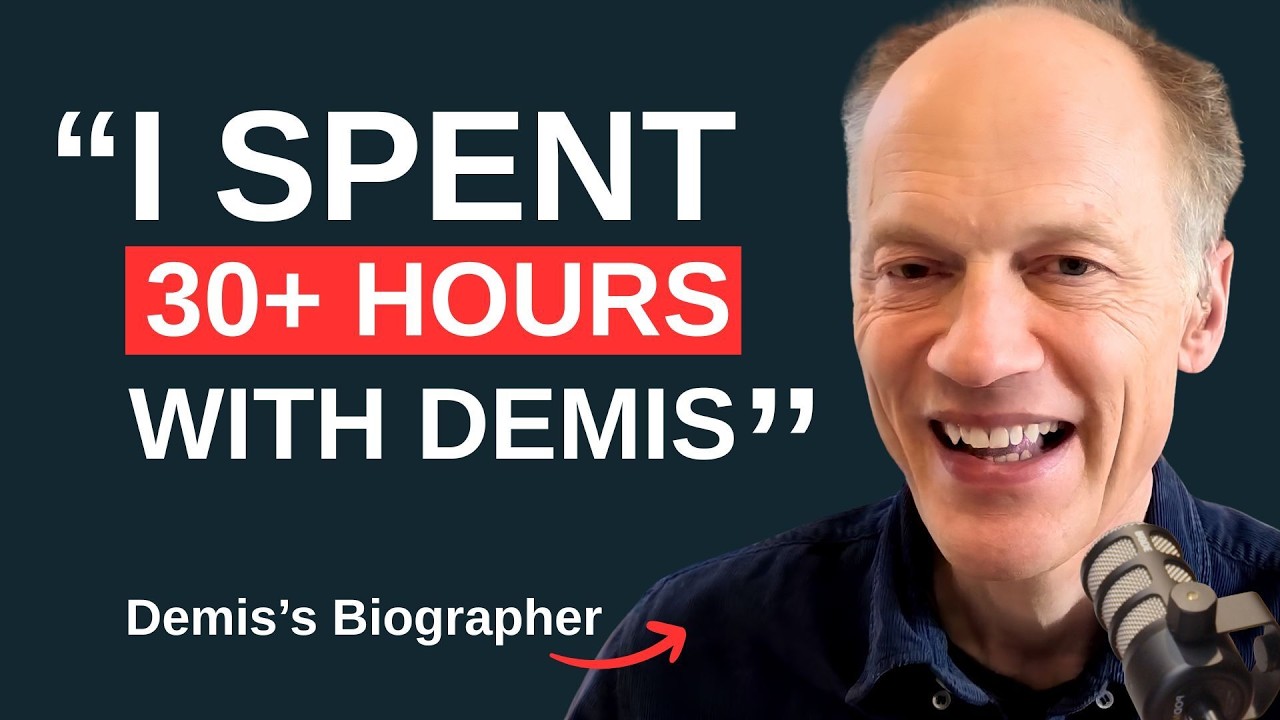
Sebastian Mallaby spent three years writing The Infinity Machine, a biography of Demis Hassabis, co-founder and CEO of DeepMind, conducting over 30 hours of interviews in the back of a British pub; the conversation covers Hassabis’s unusual background, the founding and trajectory of DeepMind, the meaning of AlphaGo and AlphaFold, the race toward AGI, and the broader implications of AI for science and society.
Who is Demis Hassabis and why he matters
Demis Hassabis is the co-founder and CEO of DeepMind, the London-based AI lab acquired by Google in 2014, widely regarded as one of the most important figures in modern AI; his career bridges competitive chess, video game design, neuroscience, and artificial intelligence, giving him a rare interdisciplinary perspective on intelligence itself.
He was a chess prodigy who represented England as a child, then studied computer science at Cambridge, worked at Lionhead Studios with Peter Molyneux, and earned a PhD in neuroscience from UCL, studying memory and imagination—work that directly informed his approach to building AI systems that can plan and reason.
His central thesis, repeated throughout the episode, is that understanding intelligence is the key to solving everything else: if you can build a system that truly understands and reasons, you can apply it to science, medicine, climate, and virtually every domain.
The founding of DeepMind
DeepMind was founded in 2010 by Hassabis, Shane Legg, and Mustafa Suleyman, with the explicit mission of “solving intelligence” and then using that intelligence to solve everything else; the name itself reflects this ambition—“deep” for deep learning and “mind” for understanding cognition.
The early pitch was radical: build general-purpose learning systems that could learn to do anything from scratch, rather than hand-coding narrow solutions; this was before the deep learning revolution had fully taken off, and most investors and even AI researchers were skeptical.
The company struggled to raise money initially; Hassabis pitched to dozens of VCs and was repeatedly turned down because the vision sounded like science fiction; Peter Thiel was an early believer and provided crucial seed funding.
Google acquired DeepMind in 2014 for roughly $500 million, a deal that shocked the AI world; the acquisition gave DeepMind access to massive compute resources while (in theory) preserving its independence and London-based culture.
AlphaGo and the Go milestone
AlphaGo’s victory over Lee Sedol in 2016 was a watershed moment for AI and for DeepMind’s reputation; Go had been considered a grand challenge for AI because of its vast search space and the intuitive, pattern-recognition nature of expert play.
The match was watched by hundreds of millions of people, particularly in Asia, and the moment when AlphaGo made its famous “Move 37”—a move no human would have played—became iconic; Lee Sedol later described it as the moment he realized the system was genuinely creative, not just computationally powerful.
Hassabis emphasizes that AlphaGo was not just a game-playing system; it demonstrated that deep reinforcement learning combined with Monte Carlo tree search could produce genuinely novel strategies, suggesting the approach could transfer to real-world scientific problems.
The victory also had a profound cultural impact in South Korea and China, where Go is deeply embedded in intellectual tradition; it signaled to governments and corporations worldwide that AI had crossed a threshold.
AlphaFold and the science mission
AlphaFold, which solved the protein-folding problem, is what Hassabis considers DeepMind’s most important achievement; predicting a protein’s 3D structure from its amino acid sequence had been an open problem in biology for 50 years.
The system’s results in the CASP14 competition in 2020 were so accurate that many structural biologists initially refused to believe them; the breakthrough effectively rendered large parts of experimental structural biology obsolete for certain classes of problems.
DeepMind released the AlphaFold Protein Structure Database, making predictions for virtually all known proteins freely available to the scientific community; Hassabis frames this as proof that AI can be a tool for accelerating fundamental science, not just a commercial technology.
The episode discusses how AlphaFold emerged from the same general principles that powered AlphaGo—deep learning, reinforcement learning, and the ability to find patterns in complex data—applied to a completely different domain, validating the “solve intelligence, then solve everything” thesis.
The path to AGI
Hassabis believes artificial general intelligence—systems that can reason, plan, and learn across arbitrary domains—is achievable and likely within years rather than decades, though he is careful to avoid precise timelines.
He distinguishes between narrow AI (systems that excel at specific tasks) and general AI (systems that can transfer learning and reasoning across domains); DeepMind’s research agenda is explicitly aimed at the latter, with projects like AlphaZero (which learned chess, shogi, and Go from scratch with a single algorithm) as stepping stones.
The conversation touches on the debate within DeepMind and the broader AI community about how close AGI really is; Hassabis is more optimistic than many but insists that safety research must advance in lockstep with capability research.
He argues that the scaling of large language models alone will not produce true AGI; what’s needed are systems with better world models, causal reasoning, and the ability to plan over long time horizons—areas where DeepMind is actively researching.
AI safety and governance
Hassabis is one of the most prominent voices arguing that AI safety must be taken seriously now, not after powerful systems are deployed; he signed the 2023 statement that mitigating AI extinction risk should be a global priority alongside pandemics and nuclear war.
He describes DeepMind’s internal safety research, including work on alignment (ensuring AI systems do what humans intend), interpretability (understanding what AI systems are doing internally), and robustness (ensuring systems behave reliably in novel situations).
The episode explores the tension between competition and safety: DeepMind competes with OpenAI, Anthropic, and others, and there is pressure to move fast, but Hassabis insists that being slightly slower and safer is preferable to winning the race catastrophically.
He advocates for international governance frameworks for AI, comparing the situation to nuclear nonproliferation, and has been involved in policy discussions at the UK and international level, including the UK’s AI Safety Summit.
The relationship with Google
The Google acquisition gave DeepMind resources but also created ongoing tensions around independence, commercialization, and the direction of research; Hassabis has had to navigate between DeepMind’s pure-research culture and Google’s product-driven priorities.
The merger of DeepMind with Google Brain into Google DeepMind in 2023 was a significant organizational change; Hassabis frames it as a way to consolidate talent and compute, but it also raised concerns about DeepMind’s autonomy being further eroded.
Mallaby probes whether DeepMind’s original mission has been diluted by corporate pressures; Hassabis pushes back, arguing that being inside Google actually amplifies DeepMind’s impact by giving its research a path to billions of users.
Neuroscience and AI: a two-way street
Hassabis’s neuroscience background is central to his approach; he studied how the brain forms and retrieves memories and how imagination works, and he has consistently argued that insights from neuroscience can inspire better AI architectures.
He points to examples where neuroscience informed AI: attention mechanisms were partly inspired by how the human visual system focuses on relevant parts of a scene, and episodic memory research influenced how AI systems store and retrieve past experiences.
The reverse is also true: AI systems are becoming tools for neuroscience, helping researchers model brain function and analyze neural data; Hassabis sees this as a virtuous cycle where each field accelerates the other.
Personal qualities and leadership style
Hassabis is described as intensely focused, intellectually restless, and unusually broad in his interests; he reads widely across physics, biology, philosophy, and history, and he brings this breadth to strategic decisions at DeepMind.
Mallaby notes that Hassabis can be difficult to pin down in interviews—he is precise and careful with language, sometimes to the point of evasiveness, particularly on timelines for AGI and on internal Google politics.
Despite his reserved public persona, colleagues describe him as deeply passionate about the mission and willing to fight internally for resources and independence; he is seen as the intellectual anchor of DeepMind in a way that complements Suleyman’s more outward-facing, product-oriented role.
The broader significance
The episode positions Hassabis and DeepMind at the center of one of the most consequential technological shifts in human history; whether or not AGI arrives on the timeline Hassabis suggests, the systems being built now are already transforming science, medicine, and industry.
Mallaby’s biography and this conversation together paint a picture of a figure whose ambition is matched by unusual intellectual range, and whose work may determine whether AI becomes humanity’s greatest tool or its greatest risk.
The underlying tension throughout the episode is between the extraordinary promise of AI—curing diseases, solving climate change, unlocking scientific mysteries—and the genuine uncertainty about whether humanity can control systems that may eventually surpass human intelligence.