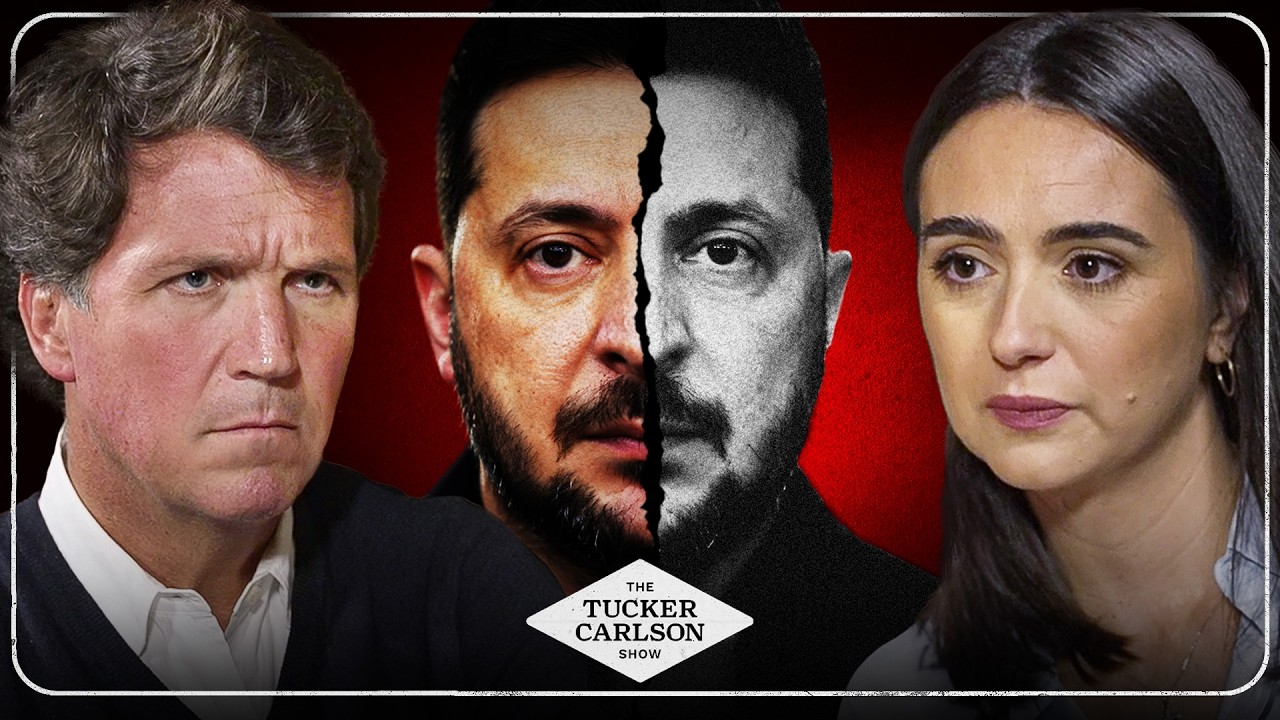
Yulia Mendel, who served as Volodymyr Zelensky’s press secretary from 2019 to 2021, came forward as a critic of the Ukrainian president, arguing that he has become one of the greatest obstacles to ending the war with Russia. She describes a leader who is emotionally volatile, manipulative, corrupt, and fundamentally detached from the suffering of his own people, despite projecting an image of democratic heroism to the West.
Who Zelensky Really Is Behind the Camera
Mendel says Zelensky is “emotionally uncontrollable,” often hysterical, and treats every person as disposable. His empathy is performative, and his public statements are largely manipulation, lies, or facts stripped of context.
She describes him as an “absolutely insanely great actor” whose performance won Ukraine enormous Western support in 2022 but whose rhetoric has no substance.
Zelensky privately told his communications team that “Ukraine is not ready for democracy” and that “dictation is an order,” statements Mendel says reveal his true authoritarian instincts.
He has hollowed out democratic institutions, canceled elections under martial law, persecuted critics, and used the war as a tool of political punishment, sending opponents to the front lines.
Ukraine’s Demographic and Humanitarian Catastrophe
Ukraine’s population has collapsed from an estimated 34–37 million before the war to roughly 25 million today, with over 10 million having fled as refugees.
Of those remaining, approximately 11 million are retirees living on pensions of $75–$200 per month, an amount Mendel says is impossible to survive on.
She recounts a recent case in which a retired film director died at home from hunger and cold during severe winter temperatures, with no one to help her.
The working-age population may be as low as 10 million, and the country is experiencing massive brain drain and demographic collapse.
Civilian death tolls are officially around 15,000 (UN verified), but Mendel believes the true number of military and civilian dead is in the hundreds of thousands, citing mass graves in Mariupol alone holding around 20,000 bodies.
She describes soldiers dying from frostbite because they lack proper uniforms and gloves, despite hundreds of billions in Western aid, with ordinary Ukrainians forced to crowdfund basic supplies.
Zelensky’s Corruption and Money Laundering
Mendel alleges that Zelensky personally approves money laundering schemes. A friend of hers was shortlisted for Minister of Social Policy and told he would need to devise ways to launder money through the ministry responsible for pensions.
She describes a meeting in which a minister was offered a $5,000 monthly official salary by Zelensky, only to be presented with a bag of cash and told he would receive $5,000 in untraceable “dark money” instead.
Another minister told Mendel that Zelensky’s inner circle was taking illegal percentages from government programs, and when informed, Zelensky smiled and said “good job, guys,” apparently pleased rather than disturbed.
Zelensky dismissed the independent board of Ukraine’s state oil and gas company Naftogaz and installed his own people, enabling corruption. The U.S. was so angered that it declined to renew sanctions on Nord Stream, effectively allowing Russia to complete the pipeline.
A recent scandal revealed that Ukraine’s former energy minister helped launder $12 million meant for shielding the energy sector, with the scheme linked to someone with Russian mafia connections.
Zelensky’s Relationship With the West
With Biden: Mendel cites a book by an American journalist describing Zelensky as viewing Biden as weak and emotionally manipulative, while Biden’s team viewed Zelensky as emotionally manipulative. Zelensky gave interviews designed to pressure Biden that American diplomats found “stupid or unprofessional.”
With the IMF: In 2020, Zelensky pushed through two difficult reforms to unlock a $5.5 billion IMF loan, then immediately violated the first reform by firing the head of the National Bank for political reasons. He proceeded to dismantle every subsequent reform one by one.
With NATO: In a private 2019 meeting with Putin in Paris, Zelensky personally promised that Ukraine would never join NATO. Yet by 2022, he made NATO membership the centerpiece of his “victory plan,” knowing it was impossible, using it as a precondition for peace that he knew could never be met.
With Orban and Hungary: At the Munich Security Conference, Zelensky publicly assaulted Hungarian Prime Minister Viktor Orbán, who then blocked a €90 billion loan Ukraine desperately needed. Mendel calls this irrational and self-destructive.
With Trump: Zelensky’s confrontational behavior toward Trump in the Oval Office is described as consistent with his pattern of emotionally uncontrolled, self-defeating escalation.
The War Could Have Been Ended — Zelensky Chose Otherwise
Mendel identifies at least seven moments when peace was possible and Zelensky backed away:
Istanbul negotiations, 2022: Ukraine and Russia agreed on nearly everything, including territorial concessions. Zelensky personally approved giving up Donbas. Then Boris Johnson visited Kyiv and persuaded Zelensky to continue fighting, promising weapons, influence, and fame. Zelensky reversed course.
Late 2022: The Biden administration, advised by Antony Blinken, encouraged Ukraine to keep fighting despite evidence that victory was impossible.
June 2024 peace summit in Switzerland: 160 delegations attended to discuss peace, but Zelensky’s office opposed inviting Russia and organized a media campaign against negotiating with Putin — even as Ukraine was secretly planning the Kursk region invasion.
Zelensky has repeatedly changed his preconditions for peace, sometimes demanding ceasefire first, sometimes calling ceasefire “irresponsible,” sometimes offering temporary occupation in exchange for NATO membership, then claiming he was misinterpreted.
Mendel’s conclusion: Zelensky prolongs the war because ending it would mean political suicide. He thrives on the conflict, which sustains his power, image, and access to Western money.
Yermak: Zelensky’s Chief Enabler
Andriy Yermak, Zelensky’s chief of staff and closest adviser, began his career as a lawyer at a strip club frequented by future pro-Russian politicians, then worked at a luxury goods store involved in smuggling.
Mendel describes both Zelensky and Yermak as “malignant and very paranoid narcissists” operating in defensive mode, creating a chaotic environment where strategies and positions change constantly and nothing substantive gets done.
Yermak serves as the operational arm for Zelensky’s desires, finding ways to implement whatever Zelensky wants, often through corrupt or extralegal means.
Zelensky’s Authoritarian Rule
Ukraine’s borders have been closed for four years, illegally under martial law. Critics are jailed on fabricated treason charges. A member of parliament who posted on Telegram calling for an end to the war was imprisoned within three days and remains in jail.
Mendel describes Ukrainian jails as horrific: overcrowded, disease-ridden, with terrible food and cold.
Zelensky has developed a “culture of banning,” canceling artists, churches, poets, writers, bloggers, and journalists — anyone he can connect to Russia, however tenuously.
He has sanctioned his own citizens, freezing their assets and closing their businesses on accusations of “working for Russia,” a practice Mendel calls unconstitutional.
She compares the atmosphere to the USSR, noting that treason cases have multiplied and are used purely as political punishment.
Allegations of Cocaine Use
Mendel says Zelensky’s cocaine use is an “open secret” in Ukrainian political circles. She has never personally witnessed it but spoke to multiple people, including doctors and longtime associates, who confirmed it.
During his 2019 presidential campaign, allegations of drug use surfaced. Zelensky challenged his opponent Poroshenko to take a drug test, but when Zelensky’s own test results were presented, they were dated differently than when the sample was actually given, causing a scandal.
Mendel noticed a pattern: before interviews, Zelensky would spend 10–15 minutes in the bathroom and emerge as a “different person” — energized, sniffing, ready to perform.
She met a member of Zelensky’s entertainment company “95th Quarter” at the presidential office whose behavior — sparkling eyes, slow speech, strange jokes — she later came to understand was consistent with drug use, and who she learned was Zelensky’s supplier.
Why the West Hasn’t Acted
Mendel believes Western governments gave so much money and political capital to supporting Zelensky that they cannot now admit they backed a dictator without damaging their own credibility and ratings.
She says European officials have privately told Ukrainian MPs that Ukraine is “undermining them” because of corruption, but no one is willing to act.
Western media coverage of Zelensky’s corruption has been minimal because proving it is difficult and because of an unofficial consensus that supporting Zelensky meant supporting Ukraine.
She credits Donald Trump’s return to power with improving freedom of speech in Ukraine slightly, as more critical reporting has emerged.
Zelensky’s Wife
Olena Zelenska is described by many who know her as the only human element near Zelensky. She publicly said she did not want him to run for a second term.
Mendel believes she may have changed over time and is no longer a positive influence. Zelensky, she says, does not view women as truly equal.
In a telling anecdote, Zelensky laughed along as a friend joked that Olena “chased him for eight years” to get him to marry her, suggesting he enjoyed the power dynamic.
Mendel’s Personal Experience
Mendel lived through the war in Ukraine, experiencing shelling and bombardment. Her husband went to the front lines. She describes living in a “closed cage” — unable to leave, under constant threat of Russian drones and missiles, with no economic opportunities, no freedom of speech, and surreal rules like mandatory stopping of cars at 9 a.m. to listen to the national anthem.
She says she cannot return to Ukraine after this interview and is risking everything by speaking out.
She notes that people who work for Zelensky believe they could be killed or jailed for criticizing him, citing suspicious deaths including a former governor of Kherson region who allegedly committed suicide by poisoning behind garages while Zelensky was traveling to meet Biden — a man described as rich, strong, and not depressed, who had been negotiating with Russians on Yermak’s orders.
Why This Matters
Mendel’s core argument: supporting Ukraine today means pushing for a peace deal, not continuing to arm Zelensky. She believes Ukraine is on the verge of extinction — demographically, economically, and as a functioning society.
She emphasizes that she is not justifying Russian invasion or Putin’s crimes, but insists the war is no longer black and white: “Zelensky is also an evil. He’s just a hidden one.”
She notes that Russia, with 140 million people and no war debt, cannot be defeated by Ukraine, with perhaps 10 million working-age people and a debt-to-GDP ratio of 100%. The war of attrition is unwinnable.
Ukrainians are expressing desperation through dark humor on social media: burning Zelensky’s speech books for warmth, and viral jokes about voting for Zelensky making you “mentally disabled.”
Her message: Zelensky will never end the war voluntarily. The only way to save Ukraine is to remove him from power and negotiate peace, but how to do so legally remains an open and deeply difficult question.