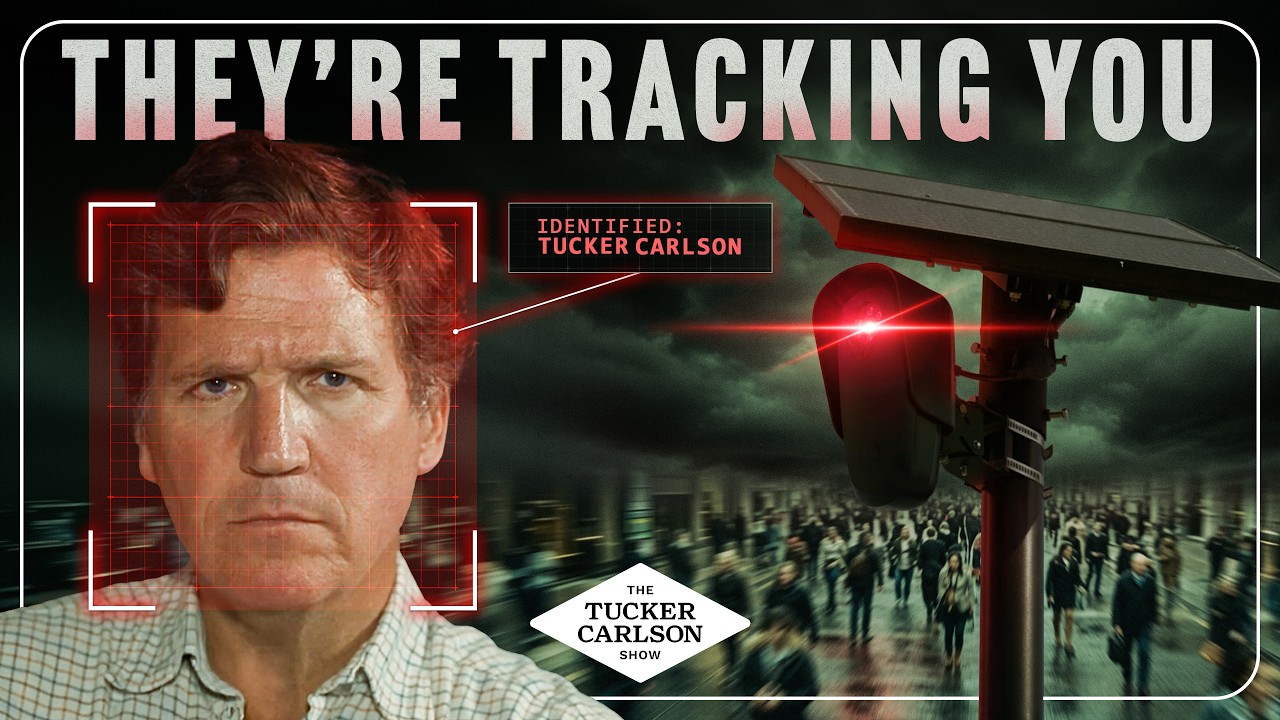
This episode examines the rapid expansion of automated license plate readers and AI-powered surveillance cameras — primarily from Flock Safety — across the United States, revealing a privately operated, government-funded mass surveillance network that operates without public consent, legal safeguards, or evidence of crime reduction, and the retaliation faced by whistleblowers who challenge it.
The surveillance state has arrived beyond Orwell’s imagination
George Orwell’s 1984 depicted a state that controls through pervasive watching — telescreens that listen, record, and bombard citizens with propaganda — making intimacy and independent thought impossible because privacy is their prerequisite.
The panopticon concept (Bentham) envisioned architectural surveillance where inmates self-regulate because they never know when they’re watched; modern technology has realized this at societal scale.
Today, in metropolitan America, there is virtually no public space — bedroom to grocery store to sidewalk — free from 24/7 camera surveillance that captures biometrics, gait, face, and audio, with no legal framework governing data use or retention.
This transformation occurred without public consultation, legislative debate, or democratic input; most Americans remained unaware until recently.
Flock Safety and the license plate reader explosion
Automatic license plate readers (ALPRs) — cameras on poles, buildings, and drones — have proliferated under the misleading premise of tracking “child traffickers” and solving crime.
Flock Safety is the dominant provider; its cameras cost ~$2,500/year versus ~$100,000+/year for a police officer, creating a powerful financial incentive for cash-strapped cities to automate surveillance.
The tradeoff is framed as privacy for safety, but the safety promise has not materialized: Harris County, TX (Houston) has ~3,700 Flock cameras yet recorded 500+ murders in 2025, with murder rates rising alongside surveillance intensity.
If surveillance created safety, prisons would be safest; they are among the most dangerous places — demonstrating that watching does not equal protecting.
The corporate-government surveillance partnership
Flock is a private, venture-backed startup (investors include a Cambridge Analytica-linked firm) whose sole fiduciary duty is profit, not public safety; it markets directly to police chiefs and city councils with self-funded “studies” claiming effectiveness.
A revolving door exists: former police officials who signed Flock contracts later join Flock as employees (e.g., head of communications was a Dallas officer who recommended the contract).
City councils often approve contracts in rushed, low-visibility meetings before the public learns of them; citizens who object at meetings are dismissed as “cranks” or “anti-science.”
Congress mandated driver-facing cameras in all new vehicles (ostensibly for drunk driving detection), eliminating privacy inside personal cars — while simultaneously downplaying drunk driving by illegal aliens.
Ben Jordan’s investigation: scope, data flow, and vulnerabilities
Ben Jordan, a musician/scientist turned whistleblower, has spent a year investigating Flock, visiting communities, polling citizens, and uncovering technical and contractual details.
Data capture: Flock “Falcon” cameras photograph every passing vehicle, store data for 30 days, and use AI to identify vehicle attributes (color, bumper stickers, damage) — enabling warrantless tracking of anyone’s movements.
Hot lists: Police can place any license plate on a “hot list” and receive real-time alerts whenever that vehicle passes a camera — functionally a GPS tracker without a warrant, despite Supreme Court precedent (Carpenter v. US) ruling long-term location tracking requires a warrant.
Drone expansion: Flock operates a secret drone facility (under a shell construction name) developing persistent aerial surveillance — drones that relay continuously, creating a war-zone-style panopticon over civilian populations.
Data security failures: Jordan found Flock law-enforcement accounts for sale on the Russian dark web without multi-factor authentication; Senators Wyden and Krishnamoorthi urged FTC investigation — no action taken.
Data monetization: Flock claims not to sell data, but Jordan has seen PDF price sheets listing data sale amounts; the company is positioning for an IPO.
Internal abuse: Flock employees (all adult males) accessed private community-center cameras — including a daycare, children’s gymnastics room, and pool — over 1,000 times; Flock called it a “product demo.” No employees were fired; they scrubbed social media profiles instead.
Legal landscape: Only a few states (IL, CA) have data privacy laws; Flock can route data through permissive states. No federal law governs ALPR data use, retention, or sharing.
Community resistance and the “terrorist” label
Overwhelming bipartisan public opposition exists once people learn of the cameras; polling shows Americans across the political spectrum reject them.
Deflock.org — a citizen-run map of Flock camera locations — is labeled a “terroristic organization” by Flock founder Garrett Langley (who compares it to Antifa), though Deflock only publishes publicly available locations and advocates Fourth Amendment rights.
Citizens destroying cameras (cutting poles, lasers, spray paint) are prosecuted; the American-flag-shirted man in the episode was charged with larceny and evidence tampering for disabling three cameras.
The asymmetry: government/corporations know everything about citizens; citizens who try to learn about the surveillance are called terrorists.
Noel Pardo: a police officer fired for conscience
Noel Pardo, a decorated Pawtucket, RI patrolman, was trained on Flock in 2021; his own captain called it “sketchy.” The city initially rejected it for cost.
In 2023, cameras appeared in his district without notification to officers or the public. Pardo spoke to a local reporter (Valley Breeze) and later testified at a Government Oversight Committee hearing.
Retaliation: four suspensions totaling 72 days without pay (~$20k lost), denied detective promotion twice, barred from sergeant’s exam, forced to surrender gear (normally only for criminal arrests), given pretextual disciplinary reasons.
In July 2025, the department moved to terminate him; fighting it would cost $30k (union covered $10k). He resigned rather than sign an NDA barring him from speaking about his experience — and has been unable to find law-enforcement work since.
Pardo’s wife and family supported him; colleagues and friends universally warned him he would lose his career — a normalized expectation that speaking up destroys you.
He acted because he could not face his future sons and teach integrity while having stayed silent. “If I ignored this, I wouldn’t be able to look him in the eye.”
Crime in Pawtucket did not decrease; sophisticated criminals adapt (switch cars, counter-surveillance), while law-abiding citizens are tracked everywhere — in a state where a car is necessary for mobility.
The deeper logic: dehumanization and control
Body cameras on police (post-2020) dehumanized officers; now the state returns the gaze onto the public — a Freudian projection: “You did it to us, now we do it to you.”
The surveillance apparatus treats all citizens as potential enemies — military technology (persistent drones, biometric AI) deployed domestically against a population that has not consented.
Historical precedent: during COVID, quarantine enforcement via cameras was imaginable; future crises (energy, war) could trigger movement restrictions enforced by the same infrastructure.
Privacy is not a political right but a human right; its loss eliminates intimacy, independent thought, and freedom — the definition of a slave state.
The system is unsustainable: a private billionaire (Langley) profits from tax dollars, spies on the public, and brands dissent as terrorism — while elected officials, police chiefs, and federal agencies enable it without accountability.