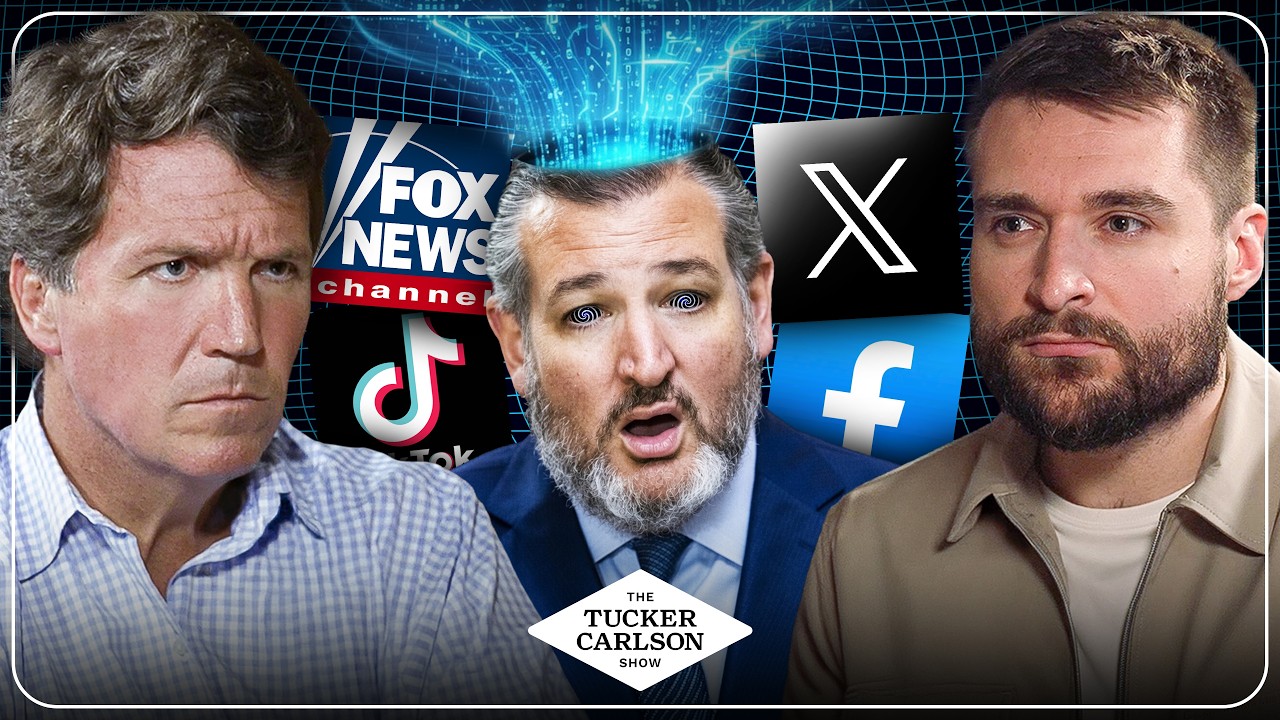
Alex Bruesewitz, a 29-year-old social media strategist who serves as Donald Trump’s top social media advisor, explains what he sees as a coordinated online campaign — including possible foreign influence — to pressure the Trump administration into continuing the war in Iran, and discusses the broader problem of paid influence operations distorting American political discourse online.
The Iran War and the Online Backlash
After Trump decided to end the Iran conflict and Vice President JD Vance articulated the exit plan, Bruesewitz observed a sudden, coordinated wave of attacks — mostly targeting Vance — from pro-war voices offering no alternative plan.
He believes the campaign is at least partly coordinated and potentially involves foreign influence, noting that millions of dollars have flowed from countries that benefit from a prolonged conflict into right-wing influencer marketing companies.
Bruesewitz highlights that 67% of Americans support the Trump-Vance Iran agreement, yet social media creates the impression that nobody is in favor of it — a gap he attributes to coordinated influence operations.
He also points out that some anti-war voices spread misinformation about the deal, such as the false claim that U.S. taxpayers would give $300 billion to Iran (the money is Iran’s own funds that can be unlocked over time, not taxpayer money).
Foreign Influence in Social Media
Bruesewitz says he has personally rejected close to $20 million in foreign contracts over the past 15 months, including offers from Gulf countries, India, Russia, and China.
In June 2025, shortly after the first Iran strike, he was contacted by a friend on behalf of an Israeli foundation that had “budget for the American market to make a strategy and social network against Iran” and wanted to work with him. He declined.
Two months later, Brad Parscale — Trump’s former campaign manager, whom Trump hasn’t spoken to in over six years — filed a FAR (Federal Acquisition Regulation) contract with the state of Israel for $1.5 million per month (later reported to have grown to $46 million per year) to produce social media content targeting Gen Z audiences across platforms including TikTok, Instagram, YouTube, and podcasts.
The initial FAR filing explicitly states that the contract includes “integration of narrative messaging into Salem Media Network properties” — a network that hosts Josh Hammer, Larry Elder, Hugh Hewitt, and others, many of whom became vocal critics of the Iran deal.
Bruesewitz notes that Salem Media also owns Red State, the Town Hall podcast network, and an influencer network, and that Parscale’s company Clocktower X’s website advertises services including “influencer ecosystems” and “managing networks that amplify narratives through credible distributed voices.”
Parscale responded to Bruesewitz’s public questions by saying the original draft plan was never executed and that they never paid hosts or influencers to say anything — but Bruesewitz points out the only public receipt still shows the original contract language, and asks what Parscale is doing with $46 million if not that.
He emphasizes that this is not just an Israel problem: Ukraine, Russia, Qatar, and China have also engaged in paid influencer activities in the U.S., and he believes there should be disclosure requirements for any foreign country paying to influence American political discourse.
The Coordinated Attack Campaign Against Anti-War Voices
Bruesewitz describes a pattern of organized online attacks against anyone who criticizes the continuation of the Iran war, including himself, Tucker Carlson, and JD Vance.
He identifies specific accounts — such as “Eel Yakobe,” who tweeted negatively about him over 1,200 times in eight months — as appearing to operate in a coordinated fashion and potentially receiving payment.
He also names Aryan Wexler, a figure who “came out of nowhere” in 2023-2024 with a large following, immediately sought involvement with the Trump 24 campaign (he turned her down), and is now one of his biggest online critics. He texted friends asking if she might be a federal plant, though he has no evidence of that.
He notes that many of the same accounts pushing for endless war are also promoting specific commercial products like car insurance, which he finds suspicious.
Marjorie Taylor Greene’s Social Media Rise and Pivot
Bruesewitz helped grow Marjorie Taylor Greene’s Twitter following from 2,000 to over 800,000 in roughly nine months during the 2020 campaign cycle, making her one of the most-followed Republican congresswomen.
The key viral moment was a cell-phone video of Greene standing on her porch with a gun after the 2020 Antifa riots, saying “My message to Antifa terrorists, stay the hell out of Northwest Georgia.” Twitter and Facebook banned it, Fox News covered the censorship, and she gained roughly 300,000 followers from that single moment.
He believes Greene’s later pivot away from being Trump’s “number one cheerleader” stemmed from feeling slighted when the president didn’t support her ambitions for higher office (governor, senator, vice president), getting bored with the limited power of being one of 435 members of Congress, and genuine policy disagreements on the war and Epstein.
The Epstein Files and the Cover-Up Question
Bruesewitz pushes back on the idea of an Epstein cover-up, arguing that Trump arrested Jeffrey Epstein in his first term, that the Biden DOJ sat on the files for four years without criticism from figures like Thomas Massie, and that Trump is “the only reason” the documents are now public.
He notes that 3 million documents have been released and no one has pointed to wrongdoing by Trump, though he does say figures like Reid Hoffman (who financed E. Jean Carroll’s lawsuit against Trump) should be brought in for questioning.
He criticizes the “binders” rollout as poorly handled but insists the president did not participate in a cover-up.
He argues that giving in to “a handful of hysterics on social media” on Epstein — or on Iran — is a bad idea, and that the president should not be governed by online pressure campaigns.
Trump’s Decision-Making and the Iran War
Bruesewitz believes Trump launched the Iran strikes because of his long-standing instinct — consistent since at least 1987 — that Iran should never have a nuclear weapon, and because he felt the mission was accomplished after roughly 90 days (navy, air force, missile program eliminated, Iran at the negotiating table).
He disputes the idea that Trump is “a slave to Israel,” noting Trump’s historically complicated relationship with Netanyahu (Netanyahu was the first world leader to congratulate Biden after the 2020 election) and arguing the president acted on his own instincts.
He is skeptical that U.S. intelligence agencies assessed Iran as on the brink of a nuclear weapon, believes the intelligence came from Israel, and told Trump before the war started that Israel was lying — a concern he says proved valid given American casualties and rising gas prices.
He speculates that Trump’s public praise of Mark Levin’s show right after the Iran pivot may have been Trump’s way of messing with people rather than a genuine endorsement.
Mark Levin, Ted Cruz, and the Pro-War Pressure Campaign
Bruesewitz is bluntly critical of Mark Levin: he notes Levin opposed Trump in 2016 (telling his audience to stay home), supported DeSantis in 2024, and is now coordinating attacks on the Iran deal despite offering no alternative. He calls Levin part of a Republican Party “left in the past” trying to stay relevant through conflict.
He is equally critical of Ted Cruz, whom he calls a “joker” whose stated priority of being “Israel’s number one defender” in the Senate actually hurts Israel by driving young Republicans away. At the Jerusalem Post conference in June 2025, Bruesewitz said Cruz “should shut the hell up” if he truly wants to help Israel — and received cheers from the Jewish audience.
He recounts a story of Cruz chasing Nicki Minaj down a hallway at a Trump event begging for a picture, with Bruesewitz blocking the photo — after which a Cruz staffer told him “we’ll remember this, Alex Bruesewitz.”
Social Media Is Not Reality
Bruesewitz repeatedly emphasizes that X (Twitter) and social media in general do not reflect American public opinion, noting that people don’t change their minds on X — it’s a “war of ideas” where some participants cheat using bots, coordinated campaigns, and paid influencers.
He advises his clients to ignore the comment section and warns that the appearance of consensus or outrage on social media is often manufactured.
He gives the example of influencer Eel Yakobe posting tweets that were verbatim identical to a company’s talking-point memo — a company that happens to be associated with Brad Parscale — as evidence of how paid operations can be disguised as organic commentary.
Charlie Kirk’s Assassination and the Information Vacuum
Bruesewitz confirms he did not say Israel killed Charlie Kirk, though he knows people in the Trump administration who believe that. He says there is no proof.
What he actually said is that the FBI should be investigating all leads — including TikTok and Twitter posts that appeared to predict Kirk’s death — and that it is irresponsible to foreclose the possibility of additional involvement simply to declare the case solved.
He called the FBI directly to ask whether people who posted threats on TikTok had been interviewed and could not get a satisfactory answer, noting that if he threatened a federal official on TikTok he would receive an immediate FBI visit.
He criticizes the way Kirk’s murder became a proxy war in the foreign policy debate, with neocons insisting it was only about transgenderism while others claim it was about Israel — and argues everyone should instead be demanding the most rigorous, exhaustive investigation possible.
He also notes disturbing details: Tyler Robinson’s lover is being given spousal privilege and not testifying, a person who claimed credit for the murder was later arrested on kitten-porn charges, and footage of Robinson pulling the trigger has reportedly not been seen by high-level people who have requested it.
The Broader Problem of Discrimination Against White Americans
Bruesewitz expresses frustration that the administration and the left focus heavily on anti-Semitism while, in his view, ignoring or even endorsing anti-white discrimination in college admissions, federal contracting, and hiring.
He notes that court-documented data shows it is harder for white Christian males to get into Ivy League schools than Jewish applicants, and that the DOJ’s civil rights division under both parties has not made anti-white discrimination a priority.
He argues the core American principle should be that every individual is judged on their own merits, not their group identity — and that this principle applies universally, including to how Israel treats Palestinians.
Voter ID and the Republican Senate
Bruesewitz shares frustration that the Republican-controlled Senate has failed to pass the Safe America Act to enforce voter ID, calling it the most common-sense piece of legislation imaginable.
He blames Senate leadership for not making it a priority and argues that Republicans often forget the only reason they have power is because of Donald Trump and the MAGA movement.
He says his organization is focusing on primary challenges to weak Republicans — they helped take out Tillis, Cornyn, and Cassidy — and encourages voters to get involved in primaries.
James Fishback vs. Byron Donalds
Bruesewitz says he has personal grievances with James Fishback, who approached him asking for $50,000 for an investment fund before launching a gubernatorial campaign, then shut down the fund two weeks later.
He also objects to Fishback on principle: “I don’t think that the state of Florida should be limiting the First Amendment, the God-given First Amendment rights of Floridians because Israel demands it,” referencing legislation Fishback supported.
He contrasts Fishback with Byron Donalds, whom he considers a far better candidate, and questions why there can’t simply be a debate between the two so voters can decide.
Fox News vs. Podcasts
Bruesewitz questions why the Trump administration continues to prioritize Fox News — which he says has a tiny audience and is controlled by people who fundamentally oppose Trump’s agenda — over podcasts, which reach larger and more engaged audiences.
He notes that many podcasters who have been critical of the administration (including Tucker Carlson, Joe Rogan, and Andrew Schulz) are still liked personally by the president, but administration officials are not being sent on these shows.
He argues that once Trump is gone, Fox News and CNN will likely cease to exist in their current form, and the administration should be building relationships in new media now.
The Future of the Trump Presidency
Bruesewitz says there are two years left of the “Donald Trump experiment” and that people will miss it when it’s over, especially if Democrats win and begin impeaching.
He wants the final two years focused on domestic issues — gas prices, jobs, the economy — rather than on Netanyahu’s concerns or any foreign leader’s concerns.
He encourages Trump to stop listening to people who do not have his or the nation’s best interests at heart, while acknowledging that Trump’s willingness to hear from everyone — even the janitor — is one of his greatest strengths.
He closes by urging voters to get involved in primaries, watch Trump rallies while they still can, and remember that despite disagreements, Trump genuinely cares about the American people.