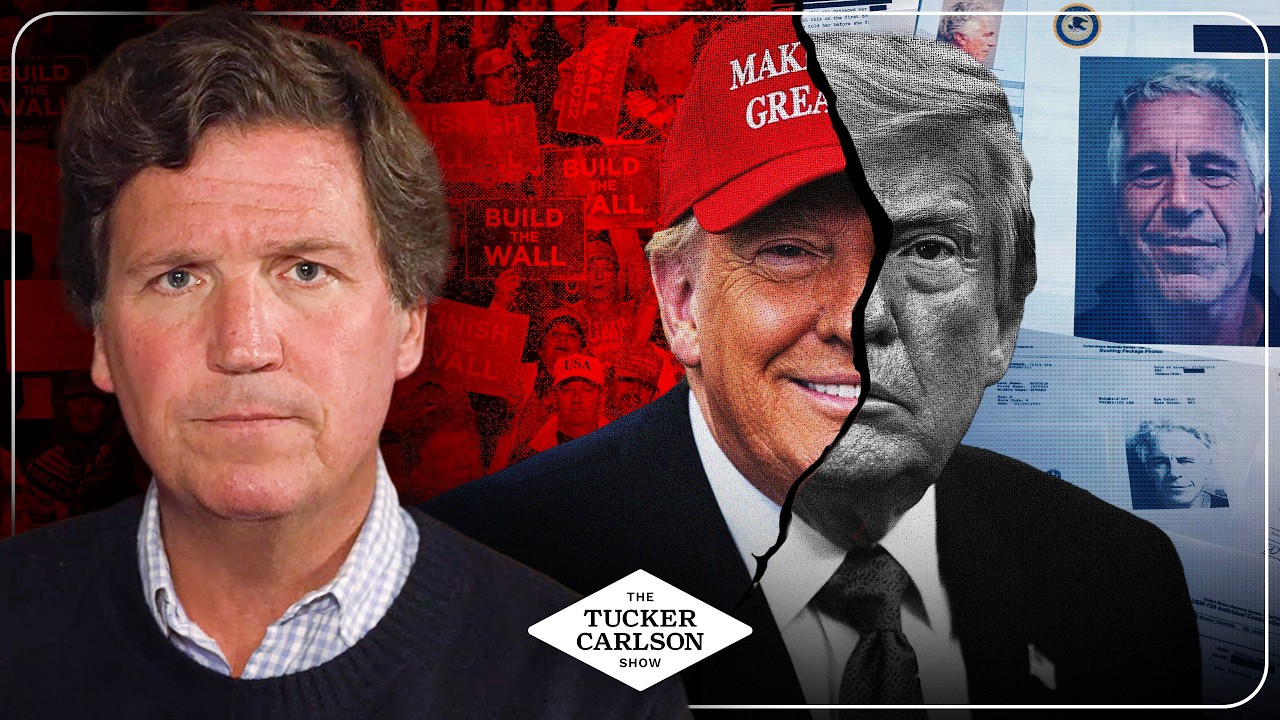
This episode argues that Republicans will lose the 2026 midterms because Donald Trump betrayed his voters by prioritizing a foreign country (Israel) over American interests, reversing nearly every major campaign promise within two years of his second term.
The predicted electoral collapse and its consequences
Polling indicates Republicans will likely lose both the House and Senate in November 2026, giving Democrats full control of Congress.
A Democratic Congress will almost certainly launch investigations, subpoenas, and potentially impeachment proceedings against Trump and his administration.
The second half of Trump’s term will be consumed by domestic political warfare, as Democratic voters will demand retribution.
Trump will likely respond by turning attention abroad — doubling down on the ongoing wars against Russia and Iran — because Democrats will not restrain presidential war powers they fundamentally support.
The core argument: betrayal, not mere failure
Trump won the largest Republican popular vote share in decades and entered office more popular than any recent GOP president; his current unpopularity stems from deliberate betrayal, not incompetence.
Betrayal — doing the opposite of what was promised, by choice, not necessity — is uniquely destructive because it reveals an ally was working against the voter’s interests all along.
The episode frames this as treachery: the system Trump vowed to destroy (the “deep state”) is the system he now serves.
The “deep state” thesis that powered Trump’s rise
The real problem is not partisan disagreement but bipartisan consensus on economics and foreign policy: both parties serve an oligarchy that exempts itself from laws and accountability.
Academic studies confirm voters have near-zero influence on government policy; the system functions as a one-party state disguised as two.
Identity politics and separate legal standards for protected groups (the “Epstein class”) destroy rule of law and social trust.
Trump’s 2023–2024 rhetoric named this system accurately: “Either the deep state destroys America or we destroy the deep state.”
Broken promise: transparency and declassification
Trump promised to release the Epstein files, JFK assassination records, and other classified documents to expose government corruption.
In a 2024 interview with Lex Fridman, Trump said he had “no problem” releasing the Epstein files and was “inclined to do it.”
As president, he has not released the full Epstein cache; what was released came only after Congress mandated it, and key periods (around 9/11) remain missing.
The JFK files remain partially withheld by the CIA 61 years later, suggesting foreign government involvement.
The DOJ ignores obvious leads in the Epstein documents (e.g., coded messages about “pizza and grape soda”) while aggressively pursuing critics of Israel.
Broken promise: the drug crisis
70,000 Americans died of illegal drug overdoses in 2025 (Trump’s first full year), mostly young people; prescription drug deaths and permanent brain damage add to the toll.
Trump campaigned on executing drug dealers and stopping the crisis in “one week,” noting the country was “way past ready.”
The administration has not indicted a single nonprofit distributing meth pipes and needles to addicts in major cities — effectively subsidizing addiction.
The Sacklers (Purdue Pharma) remain free billionaires with their name on a DC art museum despite knowingly addicting Appalachia.
DOJ resources have been redirected to “anti-semitism” enforcement — defined as criticism of Israel — rather than drug enforcement.
Broken promise: energy costs
Trump pledged to cut energy costs in half within 12 months, including gasoline, diesel, heating, and electricity.
Diesel hit nearly $8/gallon in California (up from $4.96 at inauguration), a historic high that drives up prices for all transported goods.
Trump privately acknowledged the Iran war would spike energy prices but chose to follow Israel into a regime-change war anyway.
The war with Iran (and continued war with Russia) was the predictable cause of the energy-price surge.
Broken promise: ending the Russia-Ukraine war
Trump repeatedly promised to settle the Russia-Ukraine war in “24 hours” before even reaching the Oval Office, calling it “easy.”
He correctly identified that Ukraine cannot fight without US targeting intelligence and that the war risks pushing Russia into a decisive alliance with China.
Two years later, US involvement has deepened: assassination attempts on Putin, US-supplied targeting for strikes inside Russia, and no peace initiative.
The same faction pushing war with Iran also pushes escalation against Russia; Trump has been unable or unwilling to resist.
Nuclear brinkmanship: the gravest reversal
Trump campaigned as the only leader who understood nuclear horror: “A nuclear weapon that hits New York would destroy Miami,” “I will keep you out of World War III.”
As president, he openly threatens nuclear strikes on Iran (a non-nuclear state) on Truth Social and in Pentagon doctrine changes.
The administration is rewriting nuclear doctrine to expand first-use options, not constrain them.
Prominent supporters (e.g., Victor Davis Hanson) now defend Hiroshima-style incineration of civilians as a model.
Offensive nuclear use against a non-nuclear state guarantees a nuclear exchange and civilizational end — a crime that should land its architects in prison.
The turning point: Netanyahu’s visit, eight days in
On February 4, 2025 (8 days after inauguration), Benjamin Netanyahu became the first foreign leader to visit the White House.
Trump declared an “unbreakable bond” with Israel, withdrew from the UN Human Rights Council, defunded UNRWA, and reimposed “maximum pressure” on Iran.
Trump had previously despised Netanyahu for congratulating Biden in 2020; the rapid embrace signaled a pre-decided agenda hidden from voters.
Critics who warned of an Iran regime-change war were attacked as hysterical; the war followed anyway.
Broken promise: immigration enforcement
The first high-profile immigration enforcement targeted legal green-card holders (students, workers) for criticizing Israeli policy — not illegal aliens, cartel members, or criminal migrants.
Secretary of State Rubio framed criticism of a foreign government as a visa violation and “hate crime,” equating dissent with antisemitism.
This inverted the rule of law: tens of millions of illegal entrants remain while legal residents are deported for political speech about a country 6,000 miles away.
It instantiated the identity-politics hierarchy Trump ran against: one group receives special federal protection; everyone else gets equal treatment only in theory.
The Ted Cruz convergence: the GOP as an Israel-first party
Ted Cruz openly stated he entered the Senate “with the stated intention of being the leading defender of Israel” — a foreign power — and called AIPAC his model.
In 2016, Trump ran against Cruz precisely as the embodiment of donor-serving, slogan-repeating, foreign-war Republicanism.
By 2026, Cruz is a featured speaker at the midterm Republican convention; Trump, as party head, approved the lineup.
No material daylight remains between Trump administration policy and Cruz’s Israel-first, neocon worldview.
Why Republicans will be crushed
The midterm defeat will not be about Trump’s style but about the substance: voters recognize that putting a foreign country before their own citizens is immoral and unsustainable.
The betrayal is total — across drugs, energy, war, nuclear policy, immigration, transparency, and the rule of law.
The election will be a repudiation of that betrayal, not an endorsement of Democrats.
The pain driving the result is the realization that the leader voters trusted to dismantle the oligarchy instead joined it.