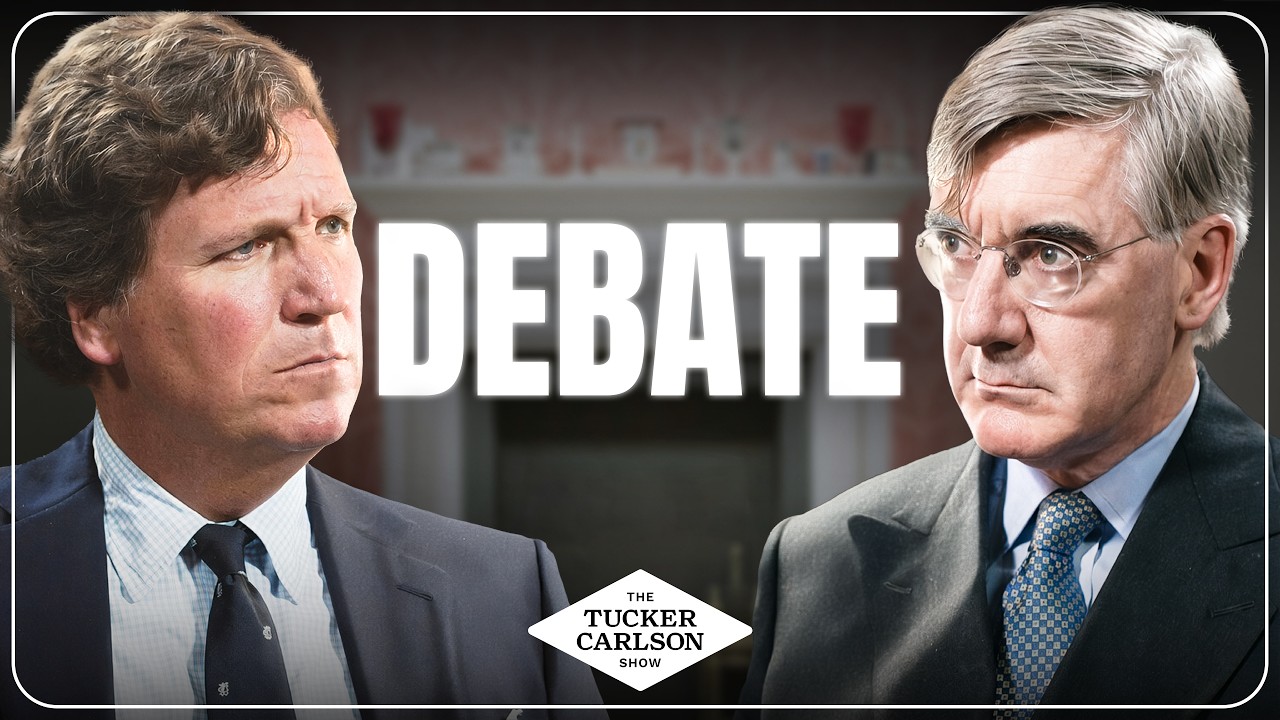
Tucker Carlson interviews Sir Jacob Rees-Mogg, a prominent British Conservative politician and former Leader of the House of Commons, at his home to debate whether Britain should prepare for war with Russia and what that preparation would entail. Rees-Mogg argues that deterrence through military strength prevents conflict, while Carlson challenges the premise that Russia threatens Britain, the wisdom of past wars, and the state of British sovereignty and free speech.
The Core Argument: Prepare for War to Prevent It
Rees-Mogg contends the UK must be prepared for war because it is already under attack from Russia through murders (Salisbury poisonings, London assassination), cyber operations, submarine activity near undersea cables, and nuclear threats from figures close to the Kremlin.
His central thesis: “the way to avoid war is to prepare for it and if you’re prepared for war it doesn’t happen” — deterrence worked during the Cold War and fails when adversaries perceive weakness.
He argues Britain’s current combat-ready force of under 19,000 (smaller than the NYPD) and defense spending at 2.7% of GDP project weakness, inviting miscalculation by Putin just as Hitler and the Kaiser miscalculated when Britain appeared weak in 1914 and 1939.
The interim target should be 3.5% of GDP on defense, focused more on equipment than troop numbers, because Russia will not invade Britain directly but will test NATO’s resolve in Poland or the Baltics.
Why Russia Threatens Britain
Rees-Mogg traces Russian motivation to the post-Soviet collapse: Russia historically expanded nearly every year from the Romanovs to 1991, then shrank dramatically, which many Russians view as a historic humiliation and betrayal of destiny.
Putin seeks to reassert a Russian sphere of influence over neighbors (Georgia, Ukraine) and views Britain as a combatant because the UK funds and arms Ukraine’s defense.
Carlson presses repeatedly for a direct Russian interest in fighting Britain; Rees-Mogg responds that Russia threatens NATO members (Poland, Baltics), triggering Article 5, and has explicitly made “bellicose” statements about the UK.
Carlson counters that Russia’s GDP is smaller than Britain’s, its economy is corrupt and inefficient, and it gains nothing from war with the UK — Rees-Mogg insists GDP understates Russia’s resource wealth and that dictators attack when they perceive weakness, not necessarily from rational cost-benefit analysis.
Ukraine, NATO, and Treaty Obligations
Rees-Mogg cites the 1994 Budapest Memorandum: Ukraine gave up nuclear weapons in exchange for security assurances from Russia, the US, and UK; Russia’s invasion violated this, undermining the non-proliferation regime and the principle that nation-state territorial integrity is inviolable.
Carlson argues the US never pledged to go to war for Ukraine, that NATO expansion violated verbal assurances to Gorbachev, and that the 2014 Maidan uprising was a Western-backed coup — Rees-Mogg rejects the coup narrative and says NATO is a voluntary alliance unlike the EU, with Article 5 requiring consultation not automatic war.
The core disagreement: Rees-Mogg sees defending Ukraine as defending the nation-state system itself; Carlson sees Ukraine as a proxy controlled by either Russia or the West, not a truly sovereign actor, and argues the US/UK have no vital interest justifying nuclear risk.
Rees-Mogg: “If aggressors can invade one nation state and get away with it, they will carry on and then you’ve got no global order at all.” Carlson: “The question is can I do anything about it and at what cost to my own population?”
Nuclear Deterrence and Just War
Rees-Mogg defends nuclear deterrence as the reason the Cold War stayed cold: both sides knew the other could wipe them out. He argues you cannot jump from “we’re pacifists” to “we’ll nuke you” — intermediate conventional strength makes the nuclear threat credible.
Carlson asks whether using nuclear weapons is ever justified under Christian just-war theory (Aquinas). Rees-Mogg says yes — Hiroshima and Nagasaki were justified as legitimate authority, just cause (self-defense after attack), and proportionate (shortened the war).
Carlson challenges: killing women and children who did nothing wrong violates the principle that guilt is individual, not collective; Rees-Mogg maintains total war against Japan made the distinction impossible and the bombs saved lives overall.
Carlson presses: if you accept killing innocents, “in what sense are you better than the people you were fighting?” Rees-Mogg: “Once you’re in war, you are justified in winning the war.”
Reassessing WWII: Costs and Benefits for Britain
Carlson asks how Britain benefited materially or spiritually from “winning” WWII: empire lost, India gone within two years, US troops on British soil for 80 years, sovereignty eroded, suicide rates higher, Christian identity lost.
Rees-Mogg concedes problems (immigration, state overreach) but insists Britain is “much richer,” better fed and housed, with 80 years of peace between major European powers — the Congress of Vienna model of generous peace after Napoleon gave 100 years of stability; Versailles failed; post-1945 peace succeeded.
Carlson cites Eaton College losing 1,200 boys in WWI (a full five-year cohort) and asks if any mother could be told her son died for a good cause protecting Belgium — Rees-Mogg admits WWI is “a very different question” from WWII but maintains the lesson: projecting strength earlier would have deterred both Kaiser and Hitler.
Carlson: “You destroyed your entire country and got millions of people killed. Maybe that’s one lesson.” Rees-Mogg: “We really didn’t destroy the entire country… but we unequivocally got the peace wrong” after WWI.
Britain’s Military Weakness and Funding Priorities
Rees-Mogg: UK spends ~£400B/year on welfare (including pensions and working-age benefits); redirecting even a portion could fund defense. He notes 6 million Britons work despite being financially better off on benefits — “this is crazy.”
Carlson asks if the public would choose bombs over welfare in a referendum; Rees-Mogg believes they would cut social spending anyway, possibly for tax cuts, but are “deeply fed up” with welfare as a lifestyle.
The discussion reveals a tension: Rees-Mogg wants military buildup to deter Russia; Carlson argues Britain cannot defend its own borders (19% foreign-born, up from 2% forty years ago) and should prioritize domestic survival over foreign commitments.
Free Speech and Domestic Repression
Carlson cites a GB News segment where a Labour adviser suggested jailing Britons who oppose the war program; Rees-Mogg rejects rounding up dissenters but acknowledges WWII internment of German Jews (some of whom later fought for Britain).
Carlson details arrests for social media posts, praying outside abortion clinics, and the banning of “Palestine Action” leading to elderly protesters jailed — Rees-Mogg agrees this is “overzealous,” “made the government look stupid,” and violates free speech, but insists it doesn’t threaten normal political discourse or elections.
Carlson: “The threat to your freedom comes from your government, not Russia.” Rees-Mogg: “I’m deeply concerned about that… we have historically protected freedom of speech through the way politicians have behaved and we are now attacking freedom of speech.”
Rees-Mogg hopes to stand in the next election and restore free speech via a Conservative government; Carlson questions how a democracy functions without free speech.
Immigration, Sovereignty, and the Nation-State
Carlson presses: if the nation-state is the fundamental unit, why can’t Britain control its borders? 19% foreign-born (8% twenty years ago, 2% forty years ago); small boats, legal immigration, visa overstays all uncontrolled.
Rees-Mogg admits “immigration policies have been catastrophic” but distinguishes civil immigration enforcement from military defense — the Rwanda scheme would have worked for illegal crossings, but legal immigration is the larger driver.
Carlson: “You’re already admitting that you’re not a nation state because you can’t control who comes in and out.” Rees-Mogg: “Every country has crime… this is civilian crime, not military crime.”
The exchange exposes a contradiction: Rees-Mogg invokes nation-state sovereignty to justify defending Ukraine while conceding Britain has lost control of its own demographic destiny.
The Ultimate Question: Is War With Russia Worth British Lives?
Carlson asks: if British children die in a war provoked by UK policy toward Russia, can Rees-Mogg tell their parents “it was worth it”?
Rees-Mogg: “Yes. And the freedom of the United Kingdom is certainly worth my rather elderly life… you cannot say this country must be strong and must be ready to go to war without thinking that if it came to a bomb dropping on your house, that is a bomb you would have to accept.”
Carlson counters that the UK government already jails its own citizens for speech while Russia hasn’t attacked Britain directly — “why is that not a much bigger problem than anything Russia is doing to you?”
Rees-Mogg maintains the UK has a “functioning democracy” with elections; Carlson replies: “How could it be a functioning democracy without freedom of speech?”
The interview ends with mutual graciousness but no resolution: Rees-Mogg insists strength prevents war; Carlson insists the war is already being fought by a government that represses its own people.