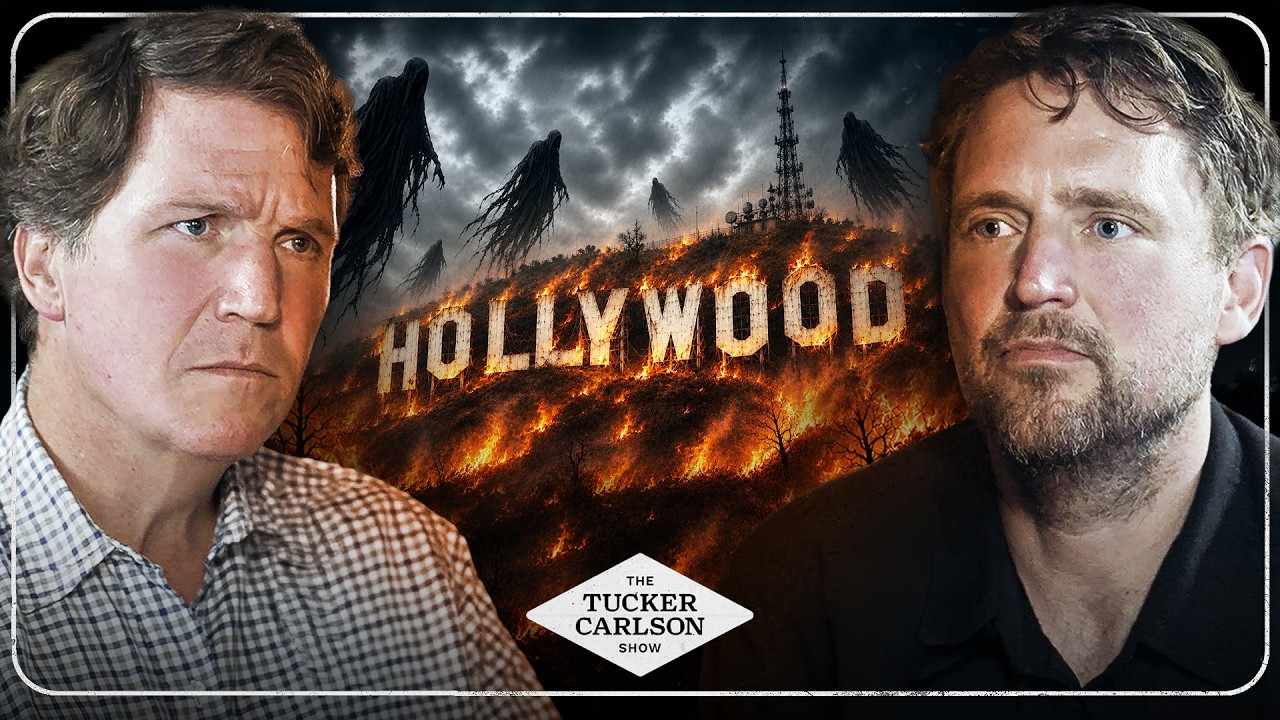
Owen Benjamin was a successful Hollywood comedian and actor—appearing on Punk’d, in Adam Sandler films, and as a lead in a Vince Vaughn–produced sitcom—until he was systematically deplatformed and blacklisted beginning around 2017, primarily for questioning the transgender child movement and later for challenging COVID restrictions, the Me Too movement, and various sacred cows of both the left and the right. His story is one of total professional destruction followed by a radical personal rebirth on a farm in Idaho, where he rebuilt his life, his community, and his understanding of truth, deception, and human nature.
The Craft of Comedy and the Jester’s Code
Owen came to comedy through a classical music background—his father was an opera singer and rhetoric teacher, his mother a children’s literature teacher—which gave him a craftsman’s approach rather than a fame-seeking one.
He started as a paid heckler at a Renaissance Festival in high school, where he learned that effective humor targets a person’s pride, not their identity—and that you must make fun of everyone equally or you become a mercenary.
He believes comedy functions as a pressure relief valve for trauma and stress, and that avoiding any group for humor is actually cruel because it treats them as subhuman and incapable of handling jokes.
He sees the comedian’s role as someone who must be able to mock all identities and institutions without favoritism, because the moment you join a team, you lose the tether to truth that makes comedy work.
The Trans Kid Issue as the Breaking Point
Owen’s public opposition to the transgender child movement—arguing that children cannot consent, that “trans” implies sexuality, and that the adults promoting it were abusive—triggered his cancellation from Hollywood.
He was dropped by his agent and manager, had college tours canceled, and was labeled a “man of hate” by people he had personally been in weddings with.
He had already moved out of Los Angeles to be near family in upstate New York, wanting to raise his child around real people rather than in a city with what he saw as cultural decay.
The Mechanics of Cancellation
Owen describes the cancellation not as a top-down conspiracy but as a “swarm” behavior—a fractal pattern where no one is in charge, but everyone signals and coordinates through shared temperament and incentives.
He was kicked off PayPal, Airbnb, Twitter, and YouTube. Independent theaters that booked him were pressured to cancel. He was never accused of a crime; the charge was always vague “hate.”
One specific joke that got him banned from Twitter involved mocking a child activist (David Hogg) by saying he “can’t grow pubes”—which Twitter characterized as sexualizing a child.
He notes that the people who hate conspiracy theories are almost always conspirators themselves, and that the real “N-word” is “no”—the ability to simply refuse service to someone.
The Neoconservative Phase and Its Limits
After being blacklisted, Owen was taken in by the “neoconservative” media world—Daily Wire, Steven Crowder, Dennis Prager—because they were willing to say things Hollywood wouldn’t.
He eventually realized this world had its own sacred cows he couldn’t question, including Israel, the moon landing, and certain pharmaceutical interests.
He began pointing out that opioid manufacturers were based in Israel and that certain identities served as liability shields for sexual abuse in Hollywood, which made even his allies uncomfortable.
He concluded that every tribe has its own “spells”—unquestionable beliefs that function as identity shields rather than truth claims.
COVID, Masks, and Moving to Idaho
Owen refused to wear a mask from the beginning of COVID, viewing it as the first step in a dehumanizing process—comparing it to the Star Trek episode where prisoners are forced to say there are three lights when there are actually four.
He saw COVID as a tool to cancel the Olympics or manage debt, not as a genuine health crisis, noting that fear was being weaponized to control people.
He moved his family to Idaho after identifying areas with low mask compliance, reasoning that people without debt and with productive skills would be less fearful and more free.
He bought 10 acres with a barn, started raising animals, and began building a self-sufficient life with his wife and children.
Debt as the Mechanism of Control
Owen came to understand that debt is the primary tool of enslavement: people with mortgages, car payments, and student loans cannot afford to lose their jobs, which means they cannot afford to question anything.
He contrasts “currency” (fiat money, debt notes) with real wealth (land, skills, trust, community, children) and argues that the entire financial system is designed to keep people dependent and afraid.
He lived in the corner of a barn with his family and found that his wife’s love was unconditional—she didn’t care about the pear tree or the farm, only about him—which freed him from the idol of provision.
Spells, Wizards, and the Nature of Deception
Owen uses the term “wizard” to describe someone who uses rhetoric and deception to benefit themselves at others’ expense—not through honest persuasion but through manipulation of perception.
He describes “spells” as linguistic and psychological tricks that make people accept lies: slogans like “obey your thirst” or “the best a man can get” that appeal to lower nature and bypass rational thought.
He believes these spells operate in a metaphysical or spiritual realm, not just a psychological one, and that certain names and phrases are deliberately chosen for their occult or twilight-language resonance.
The way to break spells is simple but not easy: gratitude, toiling (physical work that produces something real), love, service, and refusing to accept something for nothing.
The Something-for-Nothing Principle
Owen identifies “something for nothing” as the fundamental lie behind all other lies—whether it’s fiat currency, dark matter (invented because the equations didn’t work), virtue signaling, or AI promises.
He notes that the Old Testament repeatedly warns against this pattern: every time people try to get something for nothing, they end up in bondage.
He sees AI as the latest version of this lie—the promise that machines can replace human beings—and argues that the elites promoting it don’t understand logistics, energy, or the fact that you need competent, functional people to maintain any system, including a prison.
Building Community After Cancellation
Despite being deplatformed, Owen built a community through his own app (the Bertari Times), meetups, barn shows, and word of mouth—proving that comedy and connection can exist anywhere, not just in Hollywood venues.
He emphasizes the importance of physical, local community over digital connection, noting that during COVID, people who knew their neighbors survived better than those dependent on institutions.
He homeschools his four boys with his wife, and they’ve built a community of like-minded families who do activities together—jiu-jitsu, violin, skiing, soccer—creating what he calls the “Amish classroom” where younger children learn by watching older ones.
Honor Culture vs. Permission Culture
Owen contrasts “honor culture” (where your word is your bond, boundaries are respected, and you carry yourself properly because your reputation travels with you) with “permission culture” (where tolerance means allowing violations of your space, and sacred things are attacked rather than respected).
He sees the inversion of the proper hierarchy—God, man, government, corporation—as the root of modern dysfunction, with corporations ruling government and government ruling men.
He believes forgiveness is not the same as permission; you can forgive someone while still holding boundaries, and forgiveness is primarily about releasing yourself from the burden of resentment.
Music, Symmetry, and the Rejection of Jazz
As a classically trained pianist, Owen opposes jazz not because the music is inherently evil but because its culture celebrates transgression against symmetry and harmony.
He explains that music has measurable physical properties—sound waves that are either dissonant or harmonious—and that certain ratios and patterns (like Pachelbel’s Canon in D) produce universal feelings of beauty.
He sees the banning of certain chords in the dark ages (the “devil’s chord”) as evidence that music has real psychological effects, and that modern pop music often uses musical continuity to mask disturbing lyrical content.
Animals, Children, and Moral Reflection
Owen believes animals and children are essential because they reflect your moral state back at you—if you’re a sadist, your dog will be bad; if you’re a poor parent, your children will act out.
He sees caring for animals as a form of dominion and responsibility, not ownership, and notes that people who hate kids and dogs reveal something broken in themselves.
He is still grieving the death of his dog Benny, whom he buried under a tree, and sees that kind of loyal companionship as one of life’s greatest gifts.
Hope and the End of the Current Order
Despite knowing about many deceptions—including his belief that pandas were artificially bred and are not naturally wild animals—Owen remains genuinely hopeful about the future.
He believes the current debt-based system is mathematically unsustainable and will eventually collapse, but that this collapse will be a “good hurt” that forces people back to reality, local community, and real skills.
He doesn’t claim to be special or wise—he attributes his clarity to spending most of his time around animals and children, who haven’t yet learned to lie to themselves.
His final message is one of grounded hope: life is a gift, the world is fundamentally good, and the spells can be broken by anyone willing to toil, love, serve, and refuse the lie of something for nothing.