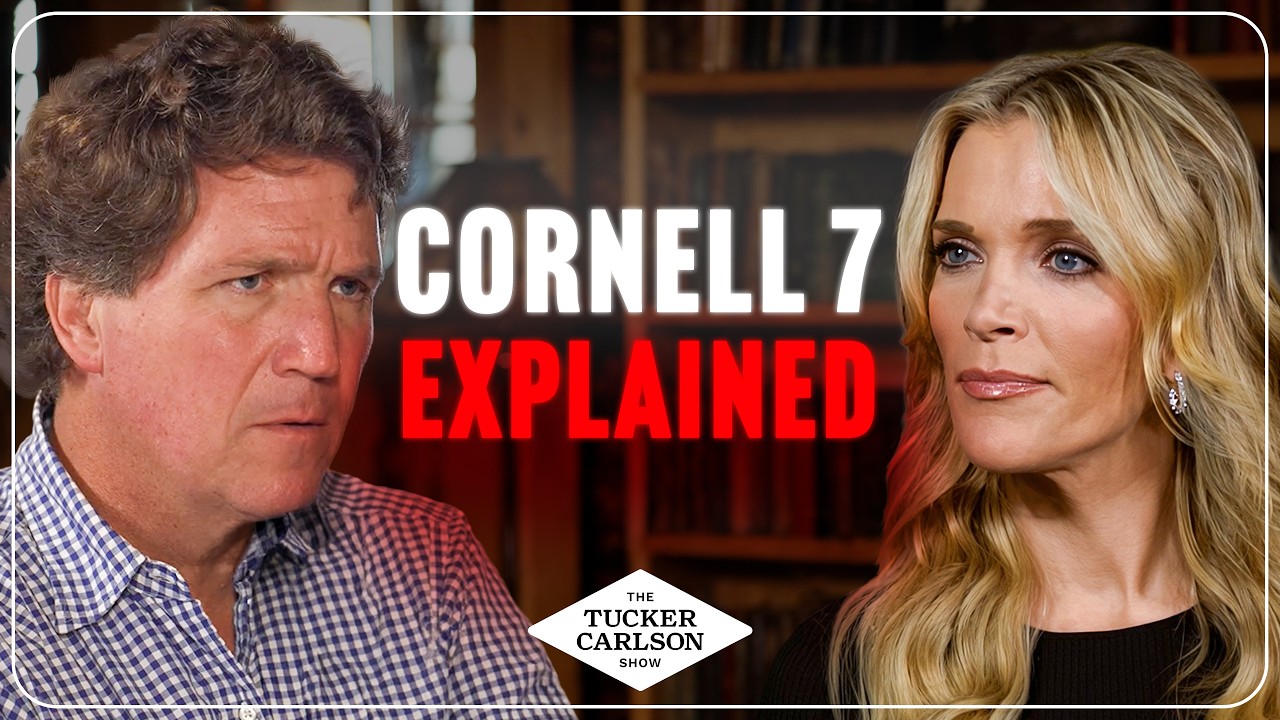
This episode features Megyn Kelly recounting the “Cornell 7” case to Tucker Carlson: a white female Cornell student (Jane Doe) had group sex with four minority fraternity brothers at the Ki house on October 19–20, 2024, then days later alleged gang rape after being disinvited from a Halloween party; the local DA declined charges based on her own sworn statement, but NY Attorney General Letitia James and Governor Kathy Hochul seized the case, and a civil suit now targets seven men.
The Night of October 19–20, 2024
Jane Doe arrived at the Ki fraternity house roughly ten drinks in, danced with Matt Engles (a friend she had a crush on and had slept with before), and agreed to a threesome with him and John Newell.
Engles passed out repeatedly; Newell and Jane Doe had sex; a third brother, Jillio Lopes, entered and also had sex with her; a small group of others came in and, per the men and her own texts, snorted ketamine off her naked body with her permission.
Winston Lee, a fourth brother, entered later; he says she offered him sex; Engles revived and joined for a final threesome; she said she was tired, they stopped, and Engles drove her home to her sorority house.
Throughout the night she was lucid enough to set boundaries (swatting away unwanted anal advances, refusing a foursome with Engles because it would require anal), initiate ketamine use (snorting it off Newell’s penis “because I’d already done it once”), and direct the sequence of events.
Jane Doe’s Own Statements Undermine the Rape Claim
In texts immediately after, she wrote: “I really enjoyed my time with you, John, and with Matt… nothing we did was illegal,” “Everyone needs to grow up because sexuality… is changing,” and “I love you, King” to Engles.
She told her sorority “big sister” there was a rumor she was a slut, then laughed: “Unfortunately, it’s true.”
She eagerly sought an invite to the Ki Halloween party days later, forwarding a “gang rape” rumor to Engles with question marks as if unaware.
Only after the fraternity president disinvited her from the Halloween party — and after roommates and friends insisted she had been raped — did she reframe the night as an assault.
The Police Interview and the DA’s Decision
Jane Doe gave a six-page, single-spaced, signed statement to Cornell police over two days with three victim advocates present; she made 20+ handwritten margin notes, confirming careful review.
Her statement described voluntary intoxication (10 drinks before arrival, voluntary ketamine use), active participation, selective consent (saying no to anal, yes to other acts), and detailed recall of each encounter — including rating her intoxication 8/10 during the final threesome yet remembering positions, partners, and sequence.
Tompkins County DA (a Democrat) reviewed the statement and concluded no crime occurred: under NY law, voluntary intoxication does not negate consent unless the person is “physically helpless” (unconscious/unable to communicate), which her own account showed she was not.
The DA also noted the men were more impaired (dry-heaving, passing out) than she was, yet the law would not treat their intoxication as a defense.
University Title IX Proceeding and Civil Lawsuit
Cornell’s Title IX process expelled only Engles and Newell for “sexual exploitation,” rejecting Engles’s counter-claim that she assaulted him while he was in and out of consciousness.
Jane Doe’s civil lawyer then filed a damages suit naming seven defendants — the four who had sex plus three others who merely entered the room or snorted ketamine off her body — labeling all “gang rapists.”
The suit leans heavily on a fraternity Snapchat thread (57 members, most asleep at 1:40–5:40 AM) where Engles, Newell, and others posted crude, celebratory messages (“free pussy,” “boys come whip it out,” “shop still open”); no messages reference incapacity or non-consent.
Media Anonymity Norms and Legal Asymmetry
Media outlets name all seven men but shield Jane Doe’s identity, despite her suing publicly for money and seeking criminal penalties of 20+ years for the men.
Kelly argues the rape-shield anonymity rule is anachronistic and sexist: no other crime grants accusers automatic anonymity in civil court; it reinforces the message that female victims should feel shame, and it denies the accused the constitutional right to face their accuser publicly.
The men are all minorities (Engles: Muslim from Dubai; Newell: Black/mixed race; Lopes: Portuguese; Lee: Asian); Kelly suggests this may be the only factor preventing immediate ruin given the political actors now involved.
Letitia James and Kathy Hochul Intervene
After the Snapchat messages leaked, the local DA agreed to present to a grand jury; Hochul and James removed him, with James publicly declaring “I stand with survivors, including Jane Doe” — abandoning prosecutorial neutrality.
Kelly characterizes James as career-driven (eye on the governorship) and indifferent to actual victims, citing negative accounts from Weinstein-victim lawyers; Hochul as incompetent rather than malicious.
Both are pushing to change NY law to eliminate the “voluntary intoxication” standard, so any drunk woman could claim inability to consent — a change the Assembly has blocked for six years but now faces intense pressure to adopt.
Cultural Diagnosis: Feminism, Male Hatred, and Cornell’s Role
Kelly traces the dynamic to modern feminism telling women that mimicking male promiscuity is empowering, then leaving them with regret and no framework to process it except victimhood.
She argues the “Call Her Daddy” culture (anal on the first date as empowerment) collides with residual female shame, producing retroactive rape allegations when the “slut” label sticks.
Men, meanwhile, have been taught that chivalry is sexist and the only non-paternalistic behavior is treating women exactly like men — i.e., assuming full agency and accountability — creating the “toxic mix” in the Ki room.
Cornell is complicit: it admits high-achieving, anxiety-ridden students selected for ideological conformity, fosters a pressure-cooker environment (notorious suicide gorges), and prioritizes diversity optics (four minority defendants, white accuser) over student welfare.
Federal funding sustains this system; Kelly questions why taxpayers subsidize institutions that function as ideological factories rather than educational ones.
The Stakes
If NY adopts the “drunk = unable to consent” standard, Kelly warns no responsible family can send a son to college in the state unless he joins the priesthood.
The case epitomizes a broader hatred of men — especially strong men — that Kelly sees as the defining animus of American institutional life, driving young men to disengage and fueling the political realignment behind Trump.
The only path out, she argues, is restoring moral foundations (religion, sexual restraint) and demanding equal accountability: if you invoke the courts, you stand behind your name; if you had agency that night, you own your choices the next morning.