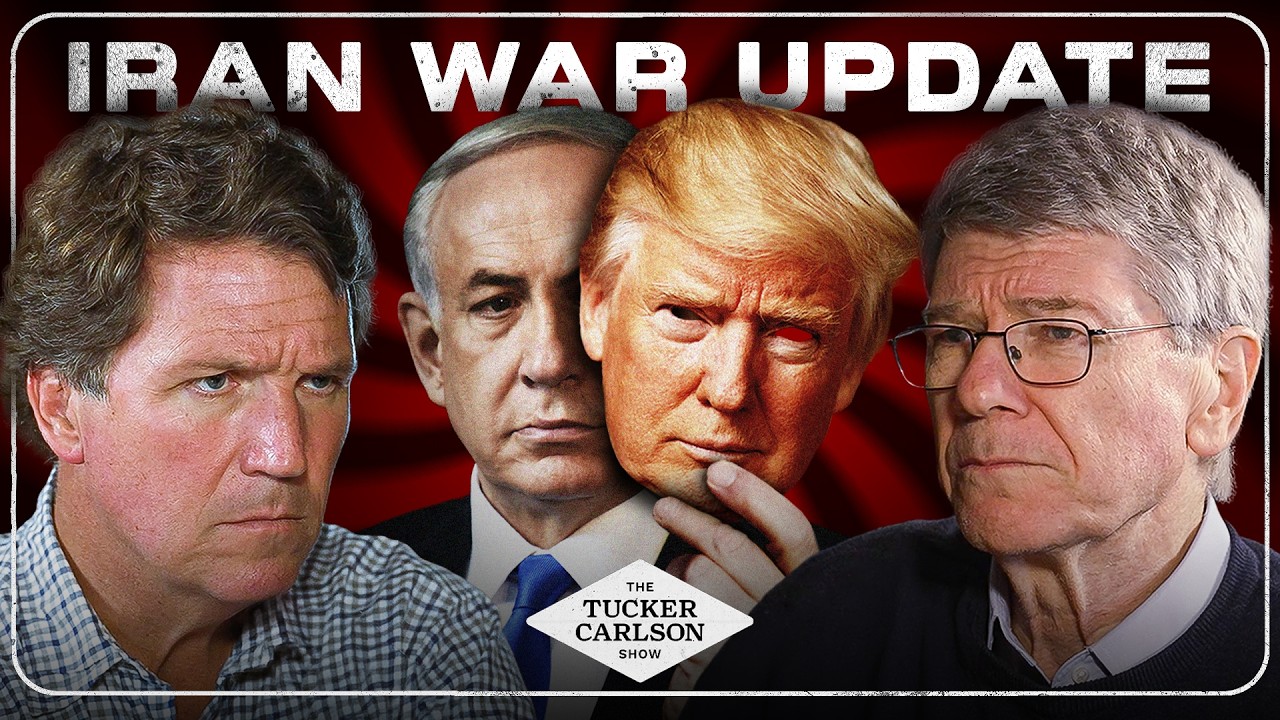
- Jeffrey Sachs on the Iran war’s origins, the urgent need for an off-ramp, and the risk of global economic collapse
- Sachs, a development economist and longtime advisor to governments, argues the US-Israel war on Iran—launched February 28—was driven not by nuclear threats but by America’s imperial need to punish Iran for escaping CIA control in 1979 and Israel’s “Clean Break” strategy for regional dominance. The Strait of Hormuz is now closed, triggering a building worldwide economic crisis. Sachs says there are only two paths: an off-ramp (de-escalation without achieving war objectives) or uncontrolled escalation to regional and potentially world war within weeks. He argues the off-ramp is the only responsible choice, even though it means admitting the war failed and leaves Iran stronger.
The Strait of Hormuz and the Building Economic Crisis
- The Strait of Hormuz is closed as of the war’s start, blocking a narrow waterway through which flows an enormous share of the world’s oil, gas, fertilizers, petrochemicals, aluminum, and other key commodities.
- Sachs emphasizes this is not a stable situation: the world economy is already reeling, and every week of closure deepens the crisis.
- Time is not permissive—waiting weeks or months to decide is not an option given the accelerating economic damage.
The Two Paths Forward
-
The off-ramp: The US simply pulls back, reopens the Strait, and avoids further military action.
- This does not achieve any of the stated US or Israeli objectives (regime change, nuclear disarmament, etc.).
- Sachs argues none of those objectives were valid or achievable in the first place.
- It requires “grown-up behavior”—saving the world rather than saving face.
- He is not optimistic Trump or Netanyahu will take it, since it represents a political loss for both.
-
The escalation path: Trump and Netanyahu conclude they cannot wait and must follow through on threats to massively bomb Iran.
- Iran would strike back hard and fast at exposed Gulf infrastructure—desalination plants, oil and gas fields, port facilities—as well as Israel.
- Anti-missile defenses in the region are permeable, limited, and in many areas depleted.
- Sachs believes within a few weeks, a very large part of the region’s infrastructure would be destroyed—in Iran, the Gulf, and Israel.
- The result would be a global calamity: world economy in crisis, potential escalation to world war.
Why the Off-Ramp Is So Hard: Imperial and Israeli Motivations
-
The American imperial motive
- In 1953, the CIA and MI6 overthrew Iran’s democratically elected Prime Minister Mossadegh after he nationalized Iran’s oil. The US installed the Shah and ruled Iran as a de facto province for 26 years.
- The 1979 Iranian Revolution threw out the Shah, Savak, and CIA control. The US has never accepted this loss of imperial control.
- Since 1980, the US has been at war with Iran in various ways: proxy war through Saddam Hussein (including poison gas attacks), economic warfare, sanctions, assassinations, covert operations, and funding of insurgencies.
- Trump personally has held the view since at least 1980 that the Iranian government must be overthrown.
- Trump also wanted Iran’s oil—he believed, based on the Venezuela model, that decapitating the Iranian leadership would let America seize control of Iran’s oil reserves.
-
The Israeli “Clean Break” strategy
- In 1996, Netanyahu adopted the “Clean Break” strategy: Israel would never accept a Palestinian state, would occupy all of mandatory Palestine, and would achieve “Greater Israel”—control from the Nile to the Euphrates.
- Rather than fighting militant groups directly, Israel would overthrow the governments that supported them. Seven countries were targeted: Libya, Sudan, Somalia, Lebanon, Syria, Iraq, and Iran.
- Six of those seven countries have been thrown into chaos or civil war through US-Israeli operations. Iran was the last on the list.
- Netanyahu tweeted at the start of the war: “This is my dream come true for 40 years.”
- Israel’s goal is military hegemony over West Asia. Iran is the last major obstacle.
-
Trump’s dual beholdenness
- Sachs argues Trump is beholden to both the Zionist lobby and the oil lobby.
- The oil lobby motivation: Trump explicitly promised oil executives in 2024 that raising money for him would yield access to oil assets, as he attempted in Venezuela.
Iran’s Actual Nature and the Nuclear Weapon Pretext
-
Sachs challenges the entire US-Israeli narrative about Iran:
- Iran is not an aggressive expansionist power. It has not invaded another country in roughly 230 years (since a border dispute over Basra in the 1790s).
- Iranians are “very civilized” people who have wanted to negotiate for years. Sachs has visited Iran and spoken with Iranians repeatedly over decades.
- The nuclear weapon justification is fabricated. US intelligence agencies have repeatedly said Iran is not pursuing a nuclear weapon. Iran wanted a deal: strict IAEA monitoring in exchange for lifting sanctions and returning tens of billions of dollars of confiscated Iranian funds.
- The JCPOA (2015) was a successful agreement reached with the P5+1 and unanimously endorsed by the UN Security Council. Trump ripped it up in his first term under pressure from the Zionist lobby.
- Iran’s supreme leader issued a fatwa prohibiting nuclear weapons on religious grounds. Israel killed that very leader in the opening strike—an act Sachs calls evidence that the nuclear pretext was always a lie.
-
Iran has suffered enormously in this war
- Thousands killed, including 160 school girls on the first day (reportedly by an AI targeting error).
- Tens of billions of dollars in damage that will take years to recover.
- Sachs, as a development economist who has spent his career building things, finds the destruction “mindless,” “cruel,” and “repulsive.”
The Greater Israel Project and Its Religious Dimensions
-
Secular extremism (Netanyahu’s version)
- “They’re out to annihilate us every generation”—a security-based worldview rooted in Holocaust trauma but disconnected from current realities.
- Netanyahu’s position: no diplomacy, no Palestinian state, preemptive killing as permanent policy.
- Sachs calls this “pathological” and “a complete collapse of understanding that there are people to talk to that actually want to make peace.”
-
Religious extremism (Smotrich and Ben-Gvir’s version)
- A new form of Judaism that emerged in the late 20th century, not traditional rabbinical Judaism.
- The land is God’s promise to the Jews; controlling it is a religious commandment and redemption.
- The party is literally called “Jewish Power.”
- This view holds that Palestinians—who may be descendants of Jews who converted to Islam in the 7th century—have no claim to the land.
-
David Ben-Gurion’s view
- The secular Zionist founder of Israel acknowledged in the 1930s-40s that Palestinians were likely descendants of the original Jews of the land.
- The original Zionist movement was almost entirely secular; the rabbis for 1,500 years had told Jews to stay where they were and wait for the messiah.
- The religious zealotry emerged after the 1967 war and the settlement movement.
-
Christian Zionism
- Zionism did not originate with Judaism. It was encouraged by 19th-century British Christian evangelicals who read the Bible in a specific way: Genesis (the promise of the land), Joshua (command to kill everyone to take the land), and Revelation (the second coming requires Jews to control the Holy Land).
- Many Christian Zionists were also anti-Semites who wanted Jews out of their own countries.
- This theology has a major political base in the US and Britain but is not mainstream Christianity or Judaism.
- The Gospels’ message—“blessed are the peacemakers,” the Sermon on the Mount, radical reconciliation and nonviolence—is completely opposite to Christian Zionism.
The Exchange with Danny Danon at the UN
- Sachs told Israeli UN Ambassador Danny Danon that Israel is “committing suicide” by pursuing such an extreme course that it puts itself outside the bounds of civilization, international law, and global public opinion.
- Israel can only sustain this extremism because of unconditional US backing—military, intelligence, satellite data, diplomatic cover.
- Sachs believes American public opinion has turned overwhelmingly against Israel’s wars and extremism.
- If the US withdraws support, Israel cannot continue for a single day.
Could Israel Accept a Stronger Iran?
-
Sachs argues the premise is wrong: Iran is not a threat to Israel’s existence.
- Iran has nuclear-armed neighbors and great powers (Russia, China, India) that would constrain any aggressive action.
- Iran wants to live normally, not as an American satrapy.
- Iran’s support for Hezbollah and Hamas would end if there were a Palestinian state alongside Israel.
- The easiest way to ensure Iran has no nuclear weapons is diplomacy—which Iran has consistently wanted.
-
The real issue is that “Greater Israel” is untenable
- If Israel’s goal is permanent expansion and dominance over the entire region, then any deal that leaves Iran intact and accepts a Palestinian state is unacceptable.
- Sachs argues this goal is delusional, illegal, and has already cost the US an estimated $5–10 trillion.
- Trump could constrain Netanyahu—he has done so before (e.g., telling Netanyahu to stop bombing Beirut)—but the question is whether Trump can constrain himself.
The Economic Consequences of Escalation
-
Sachs wrote his PhD dissertation on the oil shocks of the 1970s and authored The Economics of Worldwide Stagflation (1982).
- The 1973 and 1979 oil shocks caused stagflation—simultaneous economic contraction and soaring inflation—because oil supplies were temporarily disrupted but infrastructure was not destroyed.
- The current situation is far worse: escalation would mean physical destruction of oil fields, refineries, petrochemical plants, and distribution infrastructure across the Gulf region and Iran.
- These are extraordinarily complex systems that cannot be rebuilt quickly.
- Shutting off even 20% of world oil supply would send prices soaring.
- Americans would suffer not just at the gas pump but in food prices (fertilizer disruption), utility bills, and across the entire economy.
-
Cascading financial effects
- The UAE has already asked the Federal Reserve for emergency swap lines—shocking for a country seen as super-rich.
- Financial runs, capital flight, and loss of confidence in Gulf economies would follow physical destruction.
-
Potential compounding factor: a super El Niño
- Evidence is building for a very large El Niño later this year, which would disrupt weather, rainfall, and food production across tropical and subtropical regions.
- The 1973 oil shock coincided with an El Niño, amplifying food price spikes.
- A combination of Gulf infrastructure destruction and a super El Niño would be a shock unprecedented since World War II, with massive political destabilization potential.
-
Military escalation risks
- A Chinese naval fleet is heading to the Gulf to escort Chinese vessels. If the US blockades or interdicts a Chinese ship and a Chinese destroyer intervenes, the situation could spiral out of control instantly.
- Sachs warns decisions are being made at “nanosecond speed” with AI systems like Palantir’s Maven potentially making lethal calls.
The Degradation of US Decision-Making
-
Sachs contrasts current US decision-making with the Cuban Missile Crisis:
- Kennedy convened an executive committee (ExComm), held detailed debates, consulted Congress, used back channels, and exercised cool rationality that saved the world.
- The current process appears to be Trump acting on gut instinct, influenced by Netanyahu and Mossad, with no inter-agency review, no intelligence assessments, no Joint Chiefs input, and no congressional consultation.
-
Congress has abdicated its constitutional responsibility
- Article I of the Constitution gives Congress alone the power to declare war.
- Almost all Republicans (except Rand Paul) and almost all Democrats (except John Fetterman) have voted to strip Congress of war oversight.
- Sachs calls this evidence of how degraded the US political system has become.
-
The concentration of power in the executive
- Sachs asks whether any legislature in the world has grown more powerful in the past decade—he believes all have shrunk.
- He notes that China, despite its one-party system, has highly deliberative policy processes (he was in Beijing recently and observed two years of sophisticated economic planning).
- The US has the opposite: one person operating on gut hunches and delusions of grandeur.
Could the System Survive?
- Sachs believes the US system could work—it has worked before, with genuine legislative deliberation, independent voices, and institutional checks.
- Congress once held real hearings, wrote papers, proposed legislation, and had leaders who were independent voices.
- The system could be updated and improved for the digital age.
- But it does not have to devolve to one person’s whims sending the world to disaster.
- Sachs receives emails daily from people who believe these are the “end times” prophesied in the Bible. He says: “I’m hoping we’re not in the end times. We should have some prudence. Somebody should reach the president and say stop before disaster.”