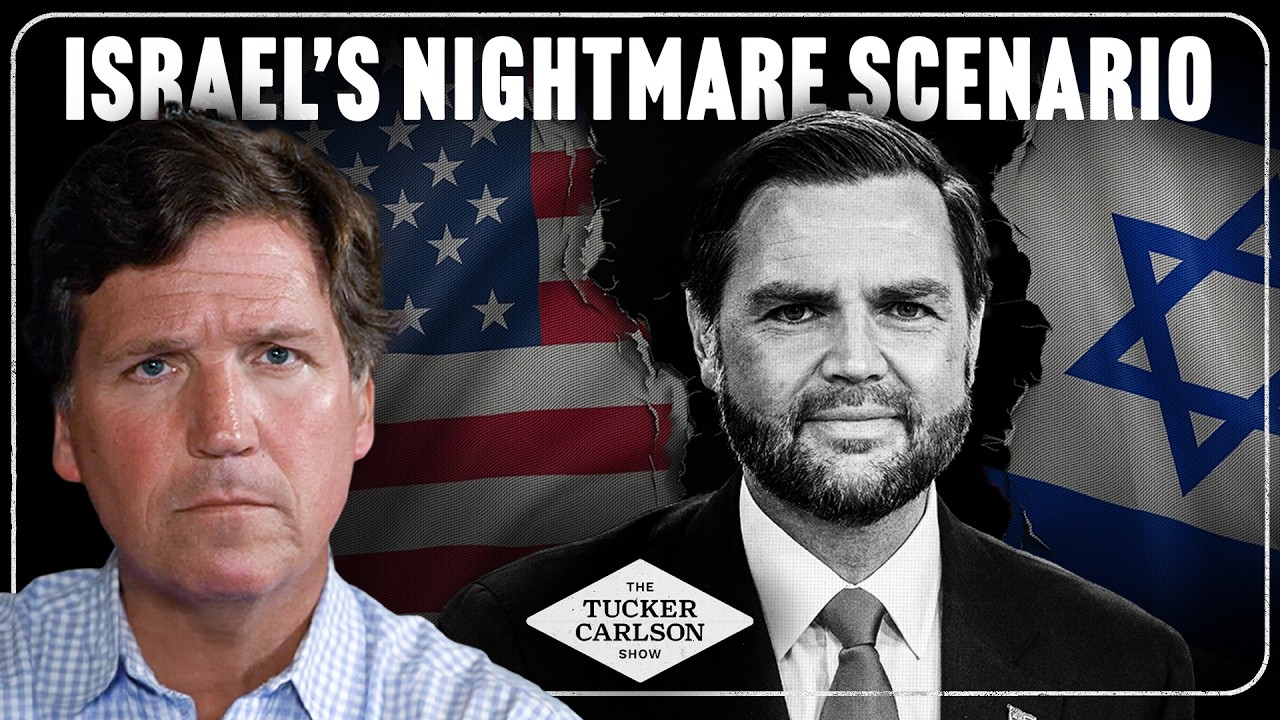
- The episode argues that the U.S.-Israel partnership in the recent war against Iran has collapsed into open friction, with the United States concluding it must withdraw from a failed regime-change war while Israel, facing the opposite of its strategic goals, lashes out at its only remaining great-power patron. The core dynamic is that Israel drew the U.S. into a war by invoking an imminent Iranian nuclear threat, then used that war as cover to launch a separate, widely condemned campaign in Lebanon that killed more people than the war with Iran itself.
The U.S. realization and the cost of the war
- The United States has concluded there is no military solution in Iran: despite overwhelming force, the U.S. cannot permanently neutralize Iran’s nuclear program or force open the Strait of Hormuz, and continuing the war risks economic collapse through energy price shocks and hyperinflation.
- The president’s decision to seek a negotiated exit is described as a rational, if humiliating, acknowledgment of the limits of American power and the only way to avoid worse outcomes.
- American military resources were severely depleted: roughly half of Patriot ballistic missile interceptors and 50–80% of THAAD interceptors were expended, over 1,000 Tomahawk cruise missiles used, and large stocks of JASM, PRISM, and naval SM-3/SM-6 interceptors consumed, with replenishment timelines stretching years into the future.
- The Strait of Hormuz is operating at only 20–30% of pre-war ship traffic, and a temporary oil price dip to around $72 per barrel is attributed to a “mini glut” of stranded ships and China having voluntarily removed itself from the global market using its 1.4-billion-barrel strategic petroleum reserve.
Israel’s strategic failure and behavior the episode calls destructive
- Israel’s war aim was to disable Iran and break it apart; the opposite occurred. Iran’s leadership was killed but new leaders stepped in seamlessly, Iran emerged stronger and globally recognized as a player that stood up to the most powerful coalition in the world, and Gulf states are now moving closer to Iran because it partners with Oman and controls commodity transit through the Persian Gulf.
- While the U.S. fought Iran, Israel used the war as a pretext to attack Lebanon—killing over 4,000 people, almost all civilians, a higher total than Iranian casualties—occupying roughly 25% of the country, emptying ancient Christian villages, and pursuing what Israeli officials privately call the “Gaza model” of creating a desolate security buffer.
- Israeli officials publicly declared a “thousand-to-one” retaliation ratio, which the episode frames as morally indefensible and historically associated with discredited regimes, and the war is described as underpinned by a belief that some lives are worth more than others based on bloodline—a direct contradiction of the Western concept of equal human souls and individual justice.
The rupture between the U.S. and Israel
- Vice President JD Vance publicly noted that the U.S. spent more money defending Israel than Israel spent on its own defense, and warned Israeli cabinet members that Trump is the only sympathetic head of state Israel has left and should not be attacked personally. The episode frames this as a factual, measured reminder of dependence, not an attack.
- In response, Israeli officials and their U.S. defenders escalated: an Israeli defense analyst tweeted that “maybe America needs another 9/11,” which the episode treats as a threat and an ugly expression of rooting for civilian terror deaths in an ally’s country.
- Republican Congressman Randy Fine called Vance’s comments “disgusting” and invoked the Holocaust, claiming Israel was created by Jewish blood and sweat, not the U.S.—a claim the episode challenges by noting American sacrifices fighting Nazis and the factual imbalance in U.S. aid and defense spending.
- The episode argues that invoking the Holocaust in this context is a tool to induce unearned guilt and shut down rational policy debate, and that most American criticism of Israel is rooted in disapproval of a secular government’s behavior, not irrational Jew-hatred.
The emerging post-American Middle East
- The new regional order is forming around five greater Middle East powers—Saudi Arabia, Iran, Pakistan (with its nuclear umbrella), Egypt, and Turkey (with its growing indigenous defense industry)—in a post-American configuration where Israel is likely to become the pariah state.
- Israel’s strike on Hamas negotiators in Doha in September 2025 is described as a pivotal moment that convinced Arab states the Israelis, not Iran, are the destabilizing actor, accelerating the shift toward a regional alliance aimed at containing Israel and reducing U.S. presence.
- The episode warns that Israel, feeling cornered and under real existential pressure for the first time in decades, may be unpredictable, and while a nuclear escalation is not yet probable, it is a higher possibility than before.
Domestic U.S. political dynamics and institutional rot
- Pro-Israel agents in the U.S. are described as having lost the information war: figures like Sean Hannity and John Federman now equate any criticism of Israel with hatred of Western civilization, a framing the episode calls insane and disconnected from reality.
- The episode argues that Tom Cotton’s push to mandate intelligence sharing with a foreign country, end the Director of National Intelligence’s office, and block JFK file releases amounts to treasonous behavior serving foreign rather than American interests.
- A War Powers vote in the Senate is interpreted not as a principled stand but as a quiet message from the neoconservative wing to Trump not to interfere with their agenda, which includes FISA reauthorization, blocking the SAVE Act, and installing preferred intelligence officials.
- The episode predicts that the current level of automatic congressional support for Israel is unsustainable, driven by aging boomers and AIPAC-era dynamics, and that a more skeptical generation will eventually reshape policy.
Military and strategic lessons
- The IDF is described as being on the brink of collapse in southern Lebanon, using outdated 2006 tactics—driving Merava main battle tanks into urban centers where they are destroyed by Hezbollah anti-tank guided munitions and drones—without learning from Ukraine’s successful anti-tank warfare against Russia.
- The U.S. military’s unpreparedness for modern drone warfare is highlighted by the fact that the Houthis chased the U.S. Navy out of the Red Sea in 2024 and Iran kept the U.S. out of the Strait of Hormuz, preventing even a freedom-of-navigation operation, let alone an amphibious assault.
- The episode calls for congressional accountability and after-action reviews for the war’s failures, noting that no one was held accountable after 9/11 or the Iraq insurgency, and that the system in Washington protects itself rather than the public.
Second-order effects on the American population
- The Strait of Hormuz closure has disrupted one-third of the world’s agricultural base supplies during planting season, and combined with the reemergence of the screw worm in U.S. livestock and fertilizer shortages, the episode warns of severe food and energy consequences for ordinary Americans in the coming year.
- The episode frames these outcomes as the result of policy choices, not natural scarcity, and suggests that the American people are bearing the cost of a war of choice that serves neither their interests nor the principles of Western civilization.