-
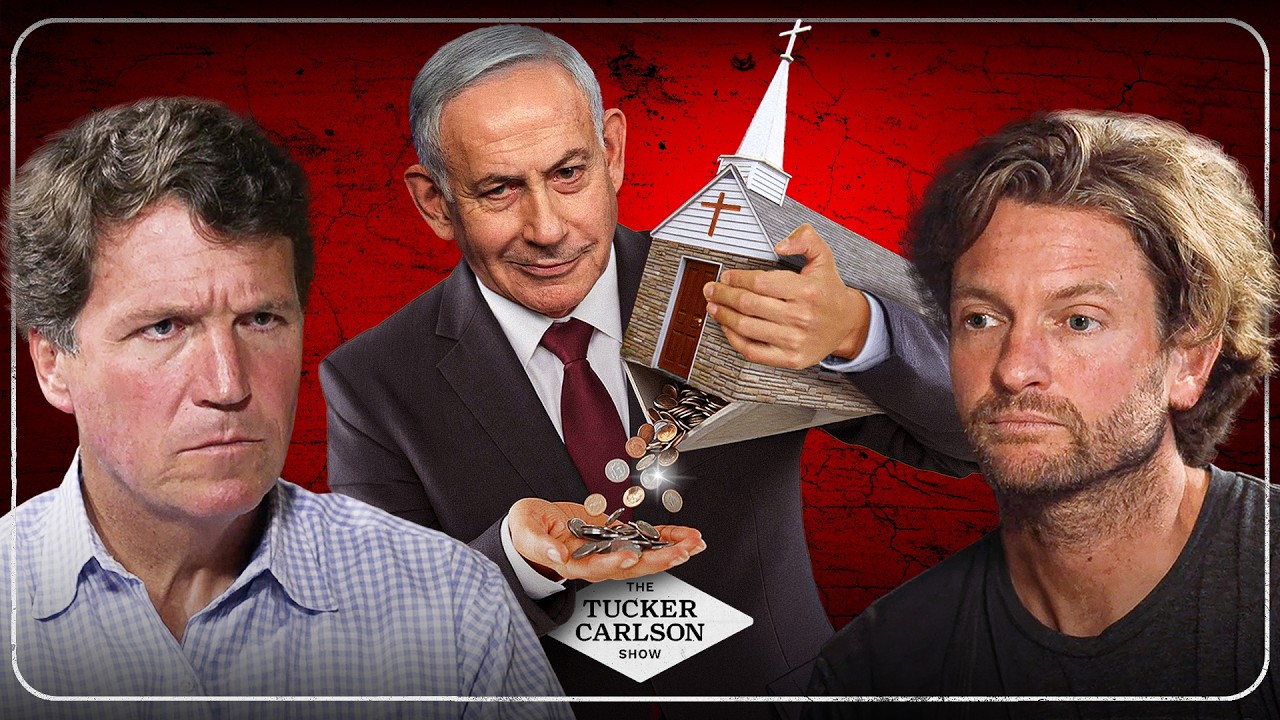
The episode investigates how the nation-state of Israel has become a dominant, almost idolatrous focus for many American Christian leaders and churches, and exposes a coordinated, well-funded system — largely hidden from ordinary congregants — designed to shape evangelical opinion in favor of the Israeli government. The central figure is Nathan, a self-described “auditor” of religious institutions, who walks through the theological, financial, and legal machinery behind this effort, including a Foreign Agent Registration Act (FARA) filing from an LLC called “Show Faith by Works” whose foreign principal is the Israel Ministry of Foreign Affairs.
-
The theological core: how the “old covenant” gets weaponized.
- Many churches treat support for the modern nation-state of Israel as a biblical obligation, but Nathan argues this is a fundamental theological error — the old covenant (Mosaic law, including tithing and tribal Israel) was fulfilled and completed by Christ, and the new covenant is based on grace, free-will generosity, and personal priesthood, not legalistic or nationalistic obligations.
- Cherry-picking the old covenant while claiming the new creates what Nathan calls “Judeo-Christianity” — neither Judaism nor Christianity — which can be used to build power structures, justify political positions, and pressure Christians (“If you don’t back Israel, you don’t believe the Bible”).
- The modern nation-state of Israel is not the same as the ethnic tribe described in the Torah, yet many pastors treat them as identical and use scripture to calcify political support.
-
The FARA documents: a foreign government targeting American churches.
- The filing from “Show Faith by Works” (registered in San Diego, foreign principal: Israel Ministry of Foreign Affairs) reveals a massive geofencing and marketing campaign targeting hundreds of large churches, primarily on the West Coast.
- When a person enters a geofenced church, their phone’s IP is captured and they are sent pro-Israel, anti-Palestine messages — funded and directed by the Israeli government, often without the church’s or congregation’s knowledge.
- The campaign’s stated goal is to “combat low American evangelical Christian approval of the nation state of Israel.” Messaging includes claims like “Hamas is a Palestinian terrorist organization” and “There was never a state of Palestine at any time in history.”
- The documents describe this as “the largest geo-fencing and Christian targeting campaign in US history” and include pastoral education resources, college outreach, and targeting of large Christian events.
- Nathan notes that the two churches he attended as a child appear on the target list.
-
The money: how Christian giving gets redirected to the Israeli state and its priorities.
- The International Fellowship of Christians and Jews raises roughly $315 million per year from individual Christian donors, but the money goes to Israeli border security, ambulances inside Israel, and government operations — not to Christians in Gaza or Lebanon being killed by the same government.
- An estimated $320 million per year is spent bringing American pastors to Israel for tours of historical sites, which are then used to justify the nation-state’s actions as biblical.
- Nathan argues this is not a genuine “fellowship” but a funding mechanism that calcifies the Israeli state while Christians in the broader region are being bombed and displaced.
-
The institutional church as a financial machine.
- Tithing, Nathan argues, is not scriptural for modern Christians — there is no single tithe in the Old Testament (there are three, totaling roughly 23.3%), and Paul, who wrote much of the New Testament, never instructed churches to tithe; the New Testament model is free-will generosity directed toward the poor, not a fixed revenue stream for an institution.
- The modern tithing model emerged only in the last couple of centuries as churches needed a reliable income stream, and it has become a legalistic tool to fund buildings, salaries, and expansion.
- About 70% of church spending goes to buildings and salaries; less than six cents of every dollar leaves the institutional walls.
- Youth groups are taught to commit portions of allowance, birthday money, yard work income, electronics sales, and savings to the church — a practice Nathan calls indoctrination into a financial model, not scripture.
-
Lack of transparency and accountability.
- Many non-denominational mega-churches have no external accountability; some have budgets of tens or hundreds of millions but disclose only vague pie charts to congregants.
- Pastors’ salaries, retirement packages, and real estate acquisitions are often hidden. One Florida church had a $91 million annual budget and bought a $12.7 million hunting ranch while taking a $1.7 million PPP loan that was later forgiven.
- Churches enjoy unique legal advantages: they file no IRS Form 990, few state documents, and can acquire for-profit businesses (thrift stores, consulting firms, investment funds, TV networks) under their church banner, all tax-exempt and shielded from disclosure.
- The LDS Church is estimated to have roughly $350 billion in net assets, over $300 billion invested through a hedge fund, and could fund itself in perpetuity from interest alone — yet still demands tithing, tied in Mormon theology to entry into the celestial kingdom.
-
The “Walmart effect” and consolidation of power.
- Mega-churches function like franchises, drawing congregants away from small community churches with entertainment, coffee, and polished services; when the mega-church eventually collapses in scandal, the small churches that served as the community backbone are already gone.
- Resources flow upward and out of local communities — a Sarasota church funded by local Christians was acquired by a Dallas church and can now be sold off, redirecting the money to Dallas.
- The Johnson Amendment, which once prohibited churches from endorsing candidates from the pulpit, has been effectively neutralized, and many pastors now openly advocate for political candidates.
-
The reform vision.
- Nathan advocates for transparent, open-source accounting; public knowledge of pastor salaries; and legal structures that do not depend on nonprofit status, which he argues creates a box that can be weaponized.
- He points to small, bivocational pastors (who earn their living outside the church) as often the most biblically grounded, because their livelihood does not depend on pleasing a congregation.
- He sees signs of change at the individual level — Christians waking up to these issues, reading the Bible cover to cover, and questioning institutional narratives — though institutional-level change has not yet materialized.
- He suggests that if the church adopted the humility model of an AA meeting — admitting brokenness openly without defensiveness — it could become a genuinely collaborative and reforming force.
-
Palestinian Christians and the silence of the church.
- The episode began with Nathan’s concern that many pro-Israel Christians ignore the suffering of Palestinian Christians — descendants of the first converts, whose families have worshiped in the Holy Land for centuries and are now fleeing war and anti-Christian pressure.
- He highlights the Vulnerable People Project as one of the few groups consistently delivering food, water, and emergency aid to trapped Christian communities in Gaza and helping them remain in their ancestral communities.
- At the institutional level, concern for Middle Eastern Christians has not meaningfully shifted, but at the individual level, Nathan sees “massive theological change” as Christians re-examine what the Bible actually teaches.