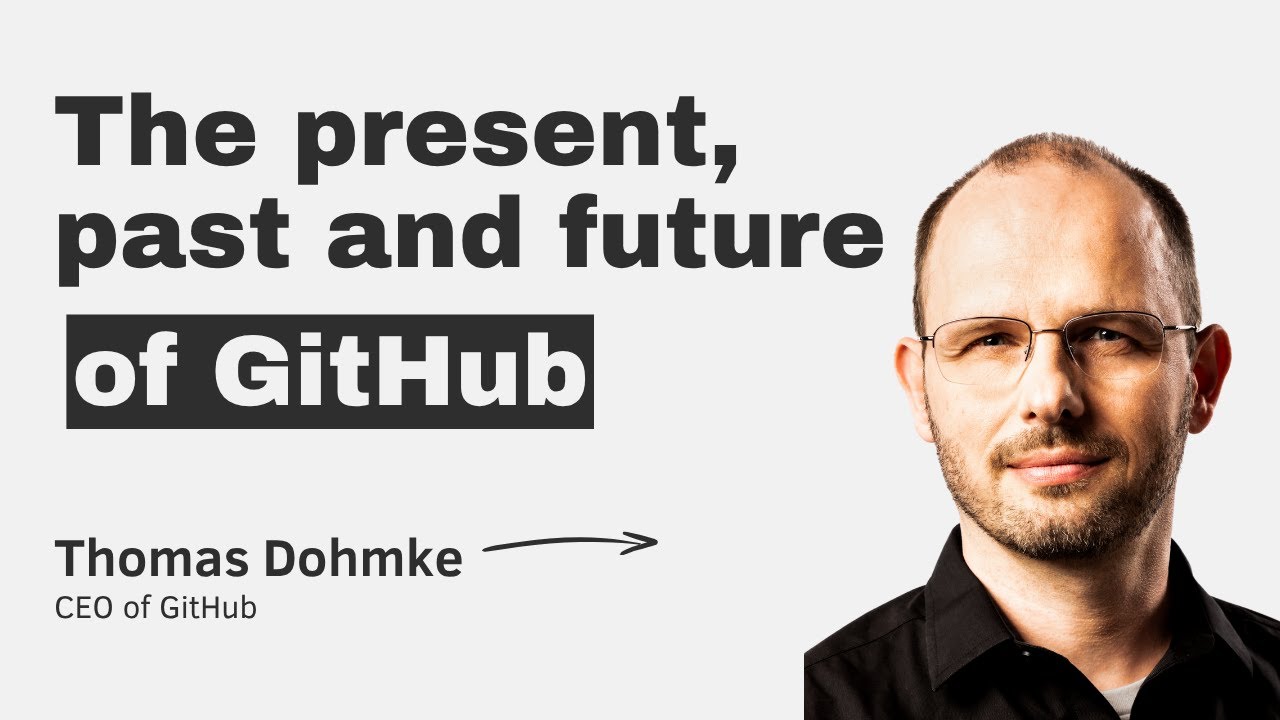
GitHub turned 17 years old in 2025, and CEO Thomas Dohmke—a 16-year GitHub user, 7-year employee, and 4-year CEO—walked through the platform’s history, internal culture, and how AI is reshaping its future. The conversation covers GitHub’s scrappy bootstrapped origins, its remote-first async culture, the quiet years before Microsoft’s acquisition, the creation of Copilot, and why Thomas believes junior engineers and human oversight remain essential even as AI agents become more capable.
GitHub’s early history and explosive product-market fit
Git was created by Linus Torvalds in 2005 out of frustration with existing source control tools for the Linux kernel. It was open source and designed for Linux, but its distributed model—where every developer has a full local copy of the repository—was a radical departure from centralized systems like Subversion and TFS.
GitHub was founded in October 2007 by Chris Wanstrath, Tom Preston-Werner, PJ Hyett, and Scott Chacon. The idea came from a bar conversation: Git was powerful, but there was no easy way to host repositories without managing your own server and SSH access. Existing platforms like Source Forge were painful to use and hadn’t adapted to the modern web.
The public launch came in April 2008—just six months after the first commit. By the end of 2008, Reddit, Yahoo, Twitter, and Facebook had already onboarded. GitHub hit product-market fit almost immediately because it solved a real pain point: developers were frustrated with SVN and TFS, and Git’s branching model was intrinsically motivating to try.
GitHub invented the pull request, which was not present at launch but arrived roughly a year in. Before pull requests, Linux developers exchanged patches via email—a workflow that still exists in the Git command line. The pull request democratized collaboration: you could fork a repo, make changes, and ask the maintainer to merge them, or simply keep your fork independent.
GitHub also pioneered a freium model that wasn’t ad-based: public repositories were always free (helping the community and growing the network), while private repositories required payment. After the Microsoft acquisition in 2019, private repos were made free as well, with monetization shifting to enterprise features like SSO and branch protection.
A key design advantage: even though GitHub is a central hub, Git itself is decentralized. If GitHub goes down, developers keep working locally. Combined with the fact that migrating away from GitHub is straightforward, this reduced lock-in anxiety and helped adoption.
Internal culture: remote-first, async, and built on GitHub itself
GitHub has been remote-first since its early days. The founders initially met in San Francisco, but the company quickly hired passionate fans from around the world, making a headquarters-centric model impractical. This gave GitHub a significant advantage when the pandemic hit.
Communication is heavily async and Slack-based rather than email-based. Thomas’s joke: as a Microsoft executive and GitHub CEO, his mornings are full of Slack messages on the GitHub side and dozens of emails on the Microsoft side. Almost all internal functions—HR, finance, comms, legal—use GitHub for their work, including pull requests against internal repos for things like terms of service changes and company announcements.
The company-wide town hall is called “Git Together.” Scheduling it is a challenge: accommodating North America and Europe excludes Australia and India, and what works for West Coast mornings conflicts with European family dinner times. GitHub rotates time zones throughout the year.
This remote-first approach enables hiring talent regardless of location and life stage, and mirrors how the open source ecosystem itself operates—async, distributed, and collaborative by necessity.
The quiet years: 2015–2020
From the outside, GitHub appeared to ship very little between 2015 and 2020. Thomas explains this was driven by two factors: the platform had grown so large and so many developers depended on it that the fear of breaking things or causing outages made engineers extremely cautious about shipping changes. A small change could bring down GitHub, and the loud minority on the internet would react intensely to any UI tweak or rate limit adjustment.
Internally, features were being built and shipped to GitHub employees (called “staff ship” at GitHub, “stockfooding” at Microsoft), but many never made it to public release because teams worried they weren’t good enough. This created a culture where innovation was happening but not visible externally.
There were also cultural issues, a CEO transition (Chris Wanstrath stepped down, Nat Friedman took over), and the Microsoft acquisition in 2018. GitHub Actions was announced at Universe in 2018, before the deal even closed, and was initially built on containers in Google Cloud as something of a hack. It was originally designed for workflow automation, but developer demand pushed it toward full CI/CD, which it evolved into over 2019 and 2020.
GitHub Sponsors launched in mid-2019 at the last Satellite conference in Berlin. Then the pandemic disrupted plans, including the return of Universe. It took time to get the organization into a state where it could innovate fast while maintaining fundamentals like security, availability, and accessibility.
The Microsoft acquisition: principles and outcomes
Microsoft acquired GitHub in June 2018 for $7.5 billion. By then, GitHub had about 700 employees and roughly $200 million in annual recurring revenue. Today, GitHub has over 3,000 employees and surpassed $2 billion ARR—a 10x increase in seven years.
The acquisition was guided by three principles, in order: (1) developers first—make great developer products, (2) accelerate GitHub—invest in the platform and its people, (3) GitHub accelerates Microsoft—grow revenue and contribute to Microsoft’s ecosystem.
Microsoft had changed significantly under Satya Nadella, who embraced open source early. .NET was open sourced, VS Code launched as open source, and the company’s reputation in the developer community had improved. Microsoft had also done two prior acquisitions—LinkedIn and Minecraft—where it kept the brand and platform independent, providing a template for GitHub.
Microsoft lacked access to the open source ecosystem and wasn’t attracting cloud-native developers. GitHub filled that gap. The acquisition was framed not as “Microsoft gets a lot out of GitHub” but as “Microsoft is willing to invest in GitHub.”
GitHub remains operationally independent: there’s no Microsoft branding on github.com (unless you use Entra ID for SSO), and the company maintains its own culture and decision-making.
GitHub’s infrastructure: hybrid cloud and own data centers
GitHub started on cloud infrastructure (a PaaS provider on top of AWS) but moved to owning its own servers in commercial data centers early on. The reasons were partly financial—GitHub was bootstrapped with no VC funding until year five, so cost optimization was critical—and partly technical. Storing Git data in cloud storage in 2008-2009 was not ideal, especially for networking between multiple nodes.
Today, GitHub’s core Git infrastructure still runs on owned servers in commercial data centers. But GitHub Actions, Codespaces, and Copilot run on Azure, leveraging cloud scale for CPU-heavy workflows and GPU inference. Copilot also uses models from OpenAI, Anthropic, and Google, which means GitHub works with multiple clouds (Azure, AWS Bedrock, Google Vertex) depending on the model.
GitHub now offers fully Azure-hosted stamps for data residency: enterprises in Europe can have all data stored in the Netherlands or Sweden, with similar offerings for Australia and a forthcoming FedRAMP-compliant US stamp.
Running a Rails monolith across multiple regional stamps with hundreds of deploys per day (forecast at 12 million deploys in 2025 across ~1,000 IC engineers) required significant engineering investment in deployment systems, database migration orchestration, and the ability to hold back changes per region.
GitHub’s tech stack today
GitHub remains one of the largest Ruby on Rails monoliths in the world, with about 700 engineers contributing to it and over 2 million Git commits in the monolith’s history. It also runs on MySQL, and schema migrations across multiple regional stamps are a significant engineering challenge.
Beyond the monolith, the stack has diversified: React on the front end, Go for the Copilot API (due to high inference call volume), .NET code in the Actions pipeline (inherited from Azure DevOps), Swift for the iPhone app, Kotlin for Android, and various cloud services. Thomas describes it as having “all the complexity and challenges that everybody else has as well.”
The company processes about 10 billion API requests per day—roughly 120,000 per second—spanning simple REST calls and complex GraphQL queries.
Internal tools: past and present
GitHub historically built its own internal tools out of a belief that they could do better than off-the-shelf products. GitHub.tv was an internal video streaming platform for town halls (now replaced by Loom). Haystack was an internal exception tracking tool, widely regarded as excellent (now replaced by Sentry). Halp was an internal support ticketing system (now replaced by Zendesk).
Some of these internal tools inspired startups when employees took the ideas external. Electron, which powers many desktop apps, originated from Atom, GitHub’s now-retired text editor. The GitHub CLI, written in Go, is open source and serves as a reference for anyone building a command-line tool.
The culture of experimentation continues, but the focus has shifted toward making new products externally facing rather than internal-only.
Security as a cultural priority
GitHub employs about 150 people in security out of ~3,000 total employees. The CSO reports directly to Thomas. The company’s philosophy, introduced by former CISO Mike Hanley (who came from Duo), is that every employee is on the security team—when asked “who here is on the security team?”, every hand goes up.
GitHub’s security lab uses CodeQL, a query language for finding variations of known code vulnerabilities, to proactively hunt for security flaws in open source projects and responsibly disclose them to maintainers.
Because GitHub has a holistic view of developer activity across organizations, it can detect anomalous patterns—for example, a single user accessing repositories at competing companies like BMW and Mercedes, which is highly unusual. Combined with Microsoft’s cyber defense operations center, this gives GitHub significant threat intelligence.
A famous example: in 2022, GitHub detected unusual patterns that led to discovering a Heroku security incident before Heroku’s own team did, and contacted Heroku’s security team directly.
Why GitHub is hiring junior engineers despite AI
GitHub runs an institutionalized intern program (started after the pandemic) with three cohorts each summer. Interns often receive full-time offers, and the company is actively hiring early-career engineers across engineering, sales, and marketing.
Thomas pushes back strongly against the narrative that AI eliminates the need for junior engineers. His argument: younger developers are more open-minded about AI, haven’t been burned by past failures, and bring fresh perspectives. They grew up with smartphones, constant connectivity, and different expectations of how systems should work.
He also notes that many successful engineers at Microsoft and GitHub don’t have formal university degrees—they were hired because of their green contribution graph, open source contributions, and demonstrated passion for the product.
The future engineer’s goal is no longer to write everything from scratch but to combine prompting skills, agent tools, and open source libraries to solve problems faster. Interview processes are evolving to assess these skills, including how candidates use agent mode or coding agents to complete exercises.
The creation of Copilot
Copilot’s origins trace to 2020, right after Microsoft’s Build conference, when Kevin Scott and Sam Altman presented on transformers and large language models. GPT-3 entered preview, and through the OpenAI-Microsoft partnership, GitHub got access and discovered it could write decent code across multiple programming languages without mixing up syntax—despite having no built-in compiler.
OpenAI fine-tuned a model called Codex specifically for coding. In August 2020, GitHub published a paper outlining three scenarios: text-to-code (prompting within the editor), code-to-text (describing code), and conversational coding (chat). Text-to-code worked well; the other two were unreliable.
Internal adoption was organic and enthusiastic—engineers gave it high scores without management mandating use. Early on, Copilot wrote about 25% of code in enabled files; by early 2023, that number reached around 46%.
Copilot entered public preview in June 2021 and reached a million users within months. It became generally available in June 2022, with individual paid subscriptions starting in August 2022—before Chat GPT’s public launch in November 2022.
A widely cited (but often misused) study found developers were 55% faster with Copilot in one specific scenario. Thomas emphasizes this was a single case study, not a universal productivity claim—there are many developer tasks where Copilot doesn’t provide that level of acceleration.
At GitHub Universe 2023, Thomas wrote that “just as GitHub was founded on Git, today we are refounded on Copilot.” The parallel: GitHub didn’t invent Git, and didn’t invent transformers or LLMs, but recognized a technology that fundamentally changes how developers work and built a product around it.
Open-sourcing the Copilot extension
GitHub announced at Build 2025 that it is open-sourcing the Copilot extension for VS Code. This follows the same path as VS Code itself, which was published under the MIT license in 2015 and has been forked by competitors like Cursor and Windsurf.
The decision might seem counterintuitive—Copilot is a key differentiator—but Thomas argues the real value is in the platform layer: compute/inference, security and control (enterprises need to manage which models are enabled and who can use them), and collaboration (human-to-human and human-to-agent).
The Copilot extension for Xcode was already open source (via a commercial agreement with an open source maintainer), so the system prompt and APIs were already public. Open-sourcing the VS Code extension continues that journey and allows the community to learn from it, contribute to it, and fork it for specialized use cases like interview tools.
AI agents and the future of software engineering
Thomas dislikes the term “autonomous” for AI agents because it implies the agent figures out what to work on by itself. In reality, agents have restricted autonomy: they’re assigned tasks by humans, constrained by configured tools (MCP services), repository permissions, and human-defined boundaries. He compares current AI tools to driver assistance systems, not full self-driving cars.
Developers have always automated what they can—compilers eliminated the need for assembler, linters catch errors automatically. Agents are the next tool in that lineage, handling tasks developers don’t want to do: writing test cases, finding security vulnerabilities, writing documentation, describing pull request changes (without the author’s confirmation bias).
The risk isn’t that agents take away the parts of the job engineers enjoy—it’s that managing multiple agent-generated pull requests requires deep understanding of system design, merge conflicts, security, availability, and business constraints. Someone needs to validate what the agent produced before merging.
Thomas’s advice: keep an open mind, experiment, and see how agents can help. The engineering skill of the future is the ability to take large, complex problems, break them down into smaller ones, and direct agents to solve those subproblems with high-quality output—then integrate and validate the results. Coding remains part of the skill set, but it’s no longer the whole job.
He also notes Jevons paradox applies: as AI makes development easier, more ideas get stacked onto the backlog rather than the backlog shrinking. The demand for engineering skill increases, not decreases.