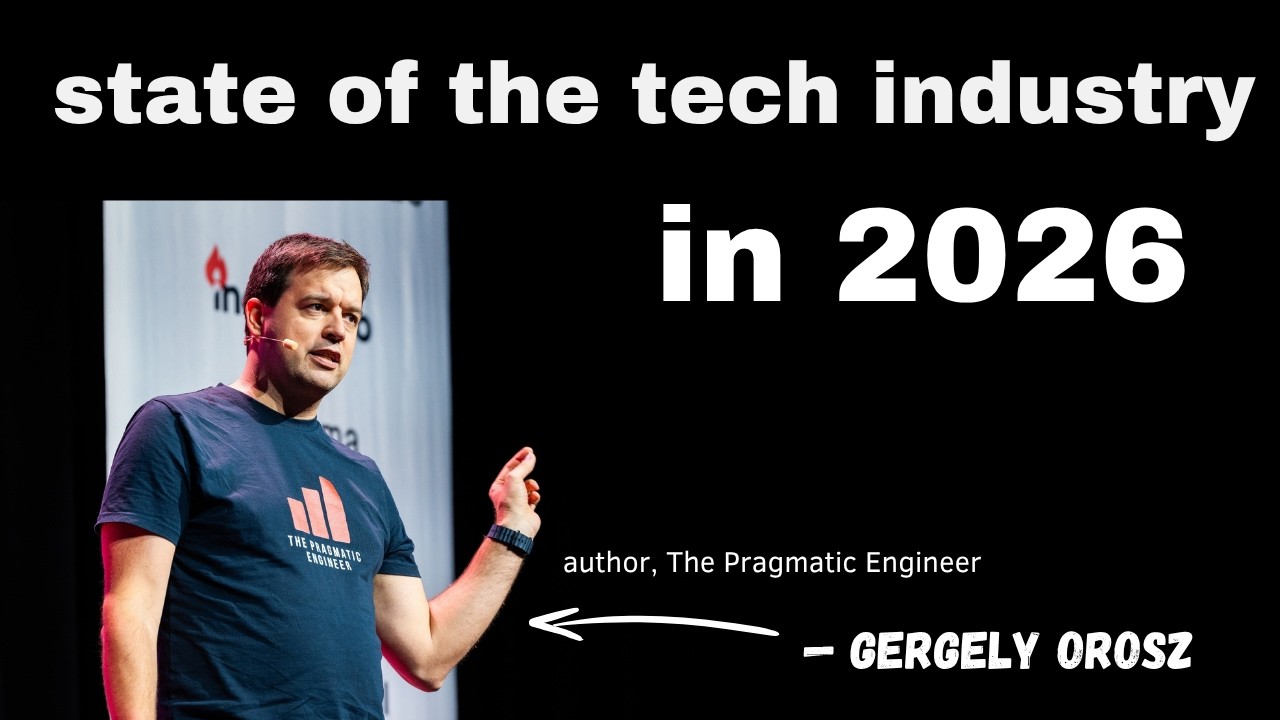
Gergely Orosz, author of The Pragmatic Engineer, presents a snapshot of the tech industry in late 2026 based on visits to OpenAI, Anthropic, Cursor, Ramp, Linear, Uber, and other companies, covering what has changed in the last 12 months, what hasn’t, what is breaking, and what comes next.
What changed in the last 12 months
AI-generated code is now the default; engineers rarely write code by hand, with startups reporting close to 100% AI-generated code prompted by humans, a shift that accelerated after Opus 4.5 and GPT-5.2 released in January.
Parallel agent workflows are widespread among senior engineers; Boris Cherny (Anthropic) runs 5–10 Claude Code sessions locally plus 5–10 on the web, Dima Zats (Linear) manages 5–10 work trees simultaneously, and Peter Mattis (Cockroach Labs CEO) routinely runs 5–10 agent sessions in parallel.
Heavyweight IDEs are fading; the last major VS Code fork (Windsurf) launched in November 2025, OpenAI chose not to fork VS Code for Codex, JetBrains pivoted to Air (an agentic harness), and Cursor rebranded to an agentic interface in April 2026 — Cursor’s team calls the IDE a “legacy product” kept only for enterprise.
Companies of all sizes are building custom AI coding harnesses; Ramp, Stripe, Uber, Block, Shopify, Google, Meta, Amazon, Dropbox, DoorDash, Grab, WorkOS, Monzo, HubSpot, Sierra, Harvey, Bowery, and others have internal platforms, often to plug in proprietary data sources or build on top of Codex, Claude Code, or Open Code.
Developer work increasingly starts in Slack; at OpenAI engineers tag Codex in Slack to implement tasks, Anthropic does the same with Claude, and startups like Linear build their own Slack bot integrations.
The “agentic software factory” is real; OpenAI runs a production system where agents monitor production and raise PRs to improve performance (the “perf factory”), with humans reviewing only critical or large-radius changes.
Large-scale migrations that used to take years now take months or weeks; Anthropic migrated Zig to Rust with one engineer (who wrote much of Bun), OpenAI is ~90% done migrating their API from Python to Rust in 4–5 months under production load, Airbnb moved from Enzyme to React Testing Library in 6 weeks, Asana did similar in ~2 weeks (after years of prep), and Uber migrated JUnit 4 to 5 across millions of lines in 4 months.
Agent-created issues and PRs are surging; Linear data shows agent-created tickets surpassed human-created ones for the first time, GitHub reports a nearly 10x increase in agent-generated PRs from January to August 2026 (7.7M to ~77M), and agent-only reviewed PRs (no human review) are spiking.
AI skill usage is mainstreaming; Factory AI data shows ~80% of users now employ AI skills, up from ~30% in February.
Cost curves are bending; after a spring spike (Uber blew its annual AI budget), large companies cut per-token costs ~50% by September via open models and smarter routing, flattening total spend.
Engineering specializations are disappearing; OpenAI no longer hires iOS/Android or frontend specialists because LLMs let any engineer work across the stack at a “good enough” level.
Projects are increasingly staffed by one or two engineers; Anthropic’s Catherine Less notes that with each engineer running multiple agents, adding more people creates coordination overhead — one-person projects are common in startups.
Teams are shrinking across the industry, a logical consequence of the above.
Junior hiring continues to decline; intern hiring keeps trending lower.
Agentic infrastructure has emerged as its own discipline.
What has not changed
Teams remain the unit of work; Anthropic and OpenAI still organize around two-pizza teams that own software, on-call, and accountability — agents supercharge individuals but don’t replace the team dynamic (vacation coverage, energy, high bar, accountability).
Planning remains essential for complex work; Anthropic’s infrastructure planning looks similar to pre-AI practices at Stripe, and building the wrong thing faster is still waste.
Testing and validation ratios haven’t shifted; Jared Sumner (Bun team at Anthropic) says AI writes nearly all code but humans still write nearly all tests — the time spent on tests vs. code is unchanged, and tests remain the primary trust mechanism (formal verification is growing but not dominant).
Non-engineers are not shipping production code; despite hype, at every company visited (Linear, Cursor, OpenAI, etc.), non-engineers build prototypes or file bug reports via Slack bots but do not push production-ready code — they don’t even know what a PR is.
Old software design patterns are being rediscovered to guide AI; Matt Pocock found that using terms like “tracer bullets” (Pragmatic Programmer) and “deep/shallow modules” (Philosophy of Software Design) in prompts yields better AI output.
What broke
Code volume exploded; GitHub data shows ~5x growth in PRs/commits/repos over 3 years, with a further 2x jump in just the last 6 months, and agent-only PRs up ~10x since January.
Code reviews have become “zombie reviews”; engineers rubber-stamp (“LGTM”) due to volume, Ramp has officially dropped mandatory reviews for non-critical code, and more companies will follow.
Quality and reliability are degrading visibly; “paper cuts” appear everywhere from Spotify to Substack as agents ship faster with less oversight.
CPU capacity is scarce; cloud customers face 6-month lead times for servers (up from 1–2 weeks), some regions accept no new orders, and companies pay for capacity arriving in December — Turbo Buffer and Anthropic confirm this crunch.
Focus and productivity are fracturing; Dima Zats (Linear) describes constant context-switching across agents — what felt like a productivity advantage became the new baseline, leaving him feeling more worked than pre-AI.
Engineering leadership is in crisis; ~20–25 leaders interviewed are taking career breaks due to: unrealistic founder expectations (fire half the team, 2x revenue from AI), startups failing or not adopting AI fast enough (career stagnation risk), fewer leadership roles as teams shrink, fractional CTO work rising in NYC/SF/Seattle (leaders don’t want full-time roles back), AI startups paying far more for execs (Anthropic hires public-company CTOs as ICs), leaders realizing they want to build hands-on, and burnout.
What comes next
Cloud agents and harnesses become standard; Ramp’s advanced cloud harness outperforms Codex/Claude Code by leveraging unlimited cloud compute, better frontend tooling, and remote dev environments — Dima Zats (formerly pro-local) now sees cloud as the future because it doesn’t hog local machines.
Engineers will stop reading code before shipping; Charity Majors (skeptic) agrees this is a “when, not if” — ops and QA already operate this way.
New internal infra will embed evals in CI/CD, agentic factories will iterate continuously, and agents will join deployments, observability, and incident management.
A refactoring/rewrite wave will hit; with migrations cheap, companies will refactor proactively as low-risk agent practice.
AI fluency and positivity become hiring baselines; a Series A engineering director screens for “AI positivity” — wanting people who push AI limits.
Organizational AI maturity means building team- and company-level agentic systems that reduce handoffs and friction, not just individual automations (Lara Hogan, Pragmatic Summit Feb 2026).
Deep domain knowledge (wisdom) and influence (charisma) outweigh raw intelligence; Titus Winters (Software Engineering at Google) argues intelligence (how) is commoditized by AI, so wisdom (what) and charisma (convincing others) become differentiators.
Thriving as an engineering leader
Future-proof by staying hands-on; Will Larson (CPTO, 50-engineer org) shipped more code in 15 months than the prior 5–10 years combined.
Build AI infra systems that help your team and company succeed — be hands-on with them.
Use AI to remove friction from your work, your team’s work, and company work.
Don’t outsource your learning; use AI to get better, not to avoid understanding.
Accept less people management for now; ICs don’t expect it, the career path is unclear, and founders aren’t demanding it.
Lean in, learn continuously, and remember why you got into tech — Peter Mattis (CTO, ~600-person org, 100+ engineers) returned to hands-on work after years away: “I like building stuff and now I can build faster and without some of the compromises I had before. It’s a little bit exhausting but it’s also very very exciting.”