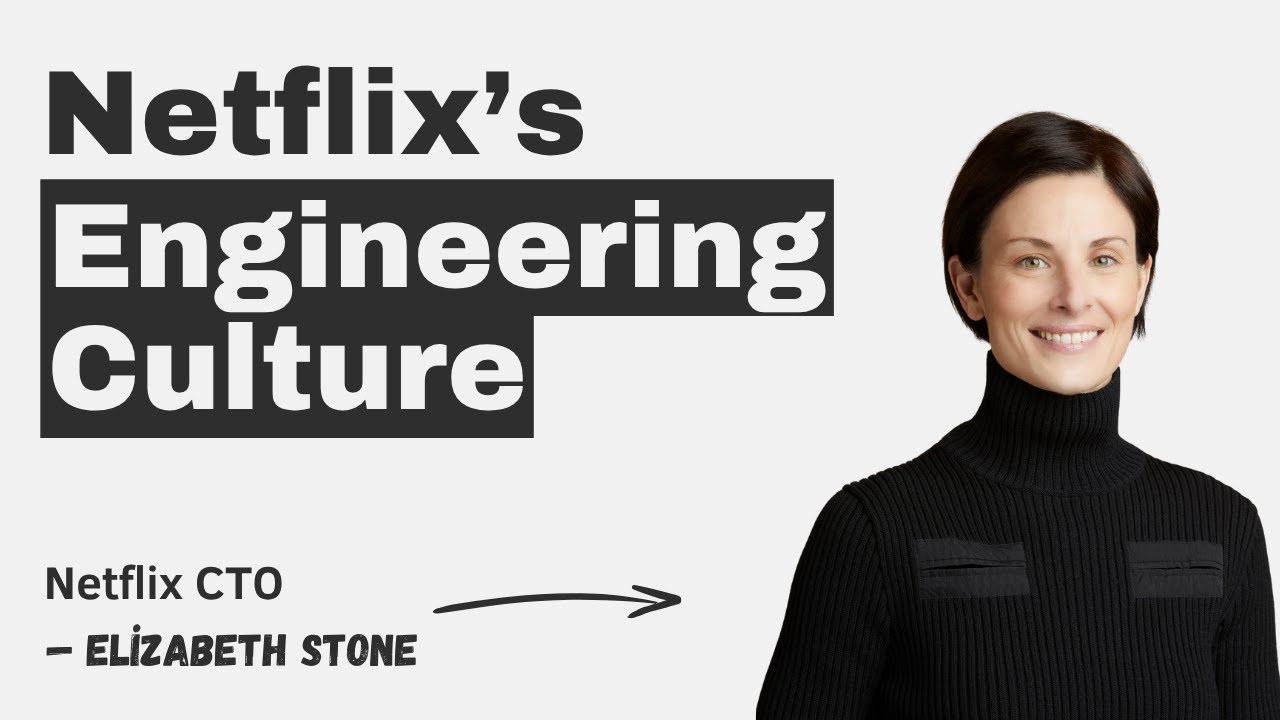
Netflix CTO Elizabeth Stone discusses the company’s unique engineering culture, the technical challenges of scaling live streaming to tens of millions of concurrent viewers, how Netflix manages performance without formal reviews, and the growing role of AI tools — all within a culture built on high talent density, autonomy, and curiosity.
The scale of Netflix’s engineering operation
Netflix captures more than a trillion events per day from consumer interactions and internal systems, supporting decision-making across a global enterprise.
The tech team does far more than power the streaming product: it builds tools for studio productions, an advertising tech stack, developer platforms for games, and systems for commerce, pricing, payments, and partnerships.
Many engineers outside the company underestimate how many people and how much complexity are required to make the experience feel seamless to members.
Production software: a unique engineering domain
Netflix builds proprietary production tooling that most other companies never touch, such as its media production suite, which modernizes how large media files travel between creative teams worldwide — enabling, for example, daily footage shot in Europe to be reviewed in Los Angeles and returned with notes within a day.
Through acquisitions like Scanline and Eyline (a visual effects studio), Netflix does cutting-edge research in data capture and visual effects that goes beyond standard camera technology.
Engineering challenges here include the sheer volume of media files (hundreds or thousands of productions running simultaneously), the cost of storage and compute, latency requirements that range from next-day review to real-time live delivery, and the extremely high quality bar for both content and promotional assets.
Open Connect: Netflix’s custom content delivery network
Netflix built its own CDN, Open Connect, more than 10 years ago — a major strategic bet. It operates in over 6,000 locations across 175+ countries, placing content close to members for low-latency, high-quality playback.
Open Connect integrates with internet service providers to handle the “last mile” of delivery to any device.
It has become a strategic advantage as Netflix expands into new content types like live events and cloud-streaming games, and it sits at the end of a long integrated lifecycle that Netflix calls “pitch to play” — covering everything from the initial content pitch, through production, promotion, recommendations, and final delivery.
How Netflix builds: autonomy over top-down control
Innovation at Netflix is driven from within teams rather than dictated from above. Engineers have significant autonomy and local judgment in how they build systems.
This bottom-up approach allowed Netflix to assemble the end-to-end content delivery pipeline over time and to adapt it quickly when new needs arose — such as the shift from video on demand to live streaming.
As the company has scaled, it has had to evolve, adding some structure to manage complexity, but the preference remains to keep constraints minimal and push decision-making to the teams closest to the work.
Building Netflix Live: from Chris Rock to Paul vs. Tyson to the NFL
Netflix’s first live title was a Chris Rock special in March 2023. Within 18 months, the company went from that first outing to streaming the Jake Paul vs. Mike Tyson fight in November 2024 — the largest streamed event ever at 65 million concurrent streams.
Teams self-organized across Open Connect, encoding, content production, promotion, and discovery. They built their own roadmaps and identified what systems needed to be resilient enough for live.
The Paul vs. Tyson event was extremely stressful: dashboards were brand new, the launch room was makeshift (about 100 people on site, 30–40 in the core room, all hardlined to internet with VPN backups), and real-time problem-solving was required as rebuffer rates spiked under unprecedented load.
A 40–50 page “if-then” launch plan was created, with designated decision owners for each subsystem. Despite hiccups, the team kept the stream stable enough to deliver a historic event.
Just five weeks later, Netflix used those lessons to deliver two NFL Christmas Day games flawlessly, having built better resilience, traffic-direction algorithms, and graceful degradation mechanisms in the interim.
Blameless post-mortems and “unusual responsibility”
Post-mortems at Netflix are not rigid or process-driven. They are led organically by the people closest to the work, who feel strong personal accountability.
After Paul vs. Tyson, Stone woke up to find that engineers had already written detailed memos documenting observations, proposed improvements, and immediate priorities — without being asked.
Netflix’s culture memo includes the concept of being “unusually responsible”: high talent density, autonomy, and treating people like adults who own both successes and failures. Leaders provide input and ask questions, but teams drive the reflection and improvement process.
Guardrails for live: tiering and quiet periods
Before live, teams had wide latitude to take smart risks with video on demand, relying on good on-call practices and resilience engineering.
Live introduced a higher-stakes threshold because there is no “we’ll be back soon” — members must be able to watch in real time.
Netflix introduced a tiering system (tier zero and tier one for critical-path applications) with higher testing requirements, end-to-end dependency mapping, and guidelines for what must be proven before a system is trusted for live.
Quiet periods around live events and end-of-year holidays limit risky deployments, but the company actively works to reduce these constraints because they slow down teams working on unrelated improvements.
Talent density and the evolution of engineering levels
For roughly its first 25 years, Netflix had only one software engineering level: senior software engineer. This signaled high expectations and attracted people who thrived with autonomy and accountability.
As the company scaled, it introduced additional levels to accommodate roles that don’t require 10–20 years of experience, enabling the hiring of early-career talent and creating IC and management pathways.
Level expectations include both skills and cultural behaviors: selflessness, good judgment, building for future teams, thinking globally while acting locally, and “yearn to learn” — Stone’s favorite engineering principle, emphasizing curiosity and questioning whether the right problems are being solved the right way.
Netflix now invests in both ends of the talent distribution: early-career hires (who bring fresh perspectives and native AI familiarity) and staff/principal/distinguished engineers (who provide deep technical leadership).
Performance management: no formal reviews, continuous feedback
Netflix does not have formal performance reviews with ratings like “meets” or “exceeds” expectations.
Instead, it relies on continuous, timely, candid feedback as a daily practice, built on trust and strong working relationships.
An annual 360 process serves as a safety net: individuals request feedback from colleagues, review themes with their managers, and identify areas to work on — but it is structured as developmental feedback, not an evaluation.
Compensation reviews happen separately, with managers assessing each person’s level of impact, skills gained, and contributions to determine top-of-market compensation.
Promotions are evaluated a couple of times per year with collected feedback for candidates being considered.
The “keeper test” is the central performance heuristic: managers ask “Would I fight to keep this person?” and team members ask “Do I want to stay and do my best work here?” It creates shared accountability for maintaining high talent density without requiring a rigid review process.
Data from Signal Fire shows Netflix has among the highest retention of engineering talent in the industry — people stay because they get challenging problems, autonomy, agency, and are surrounded by impressive colleagues.
AI tools at Netflix: pragmatic experimentation
Netflix is investing heavily in AI coding assistants and agentic tools but with pragmatism — seeking meaningful business impact rather than cost reduction or silver-bullet thinking.
Teams are given multiple tools to experiment with, dedicated time to explore them, and GenAI champions embedded throughout the organization to help troubleshoot and relay feedback to central teams.
The highest-impact use cases so far are:
Prototyping: rapidly visualizing ideas with cross-functional teams (engineers, data scientists, product managers, designers) to workshop concepts before committing to production code.
Documentation and knowledge access: reducing time spent understanding how systems work.
Anomaly detection and response: using GenAI for deep-dive issue analysis, improving resilience and system health.
The goal is to free engineers from lower-impact activities so they can focus on innovative architecture and product work.
Netflix is also strategic about build vs. buy: for most tech productivity tools, the market is solving problems well, so the company prefers to choose carefully among external tools rather than building in-house.
Open source: a hidden strength
Approximately one in five Netflix engineers works on open source projects — among the highest rates in the industry.
Netflix has won nine Emmy Awards for technical contributions, particularly in video encoding innovation.
The company is a founding member of the Open Media Alliance, an industry group pushing for open advancement of encoding technology.
Netflix’s encoding improvements have reduced required bit rates by 60% for the same or better quality, even as the content catalog has grown dramatically — benefiting both Netflix and the broader industry.
Netflix sees open source as a way to uplevel the entire ecosystem while still maintaining proprietary advantages where they matter.
Advice for new engineers joining Netflix
Lead with curiosity — ask questions, challenge assumptions, explore, and take smart risks. Great ideas come from everywhere, regardless of tenure.
Lean on the community: find mentors, ask for context and history, and learn which business problems the team is solving and why.
Reduce the internal voice that fears trying something new. A curious, open-minded mindset is the single best predictor of success at Netflix.