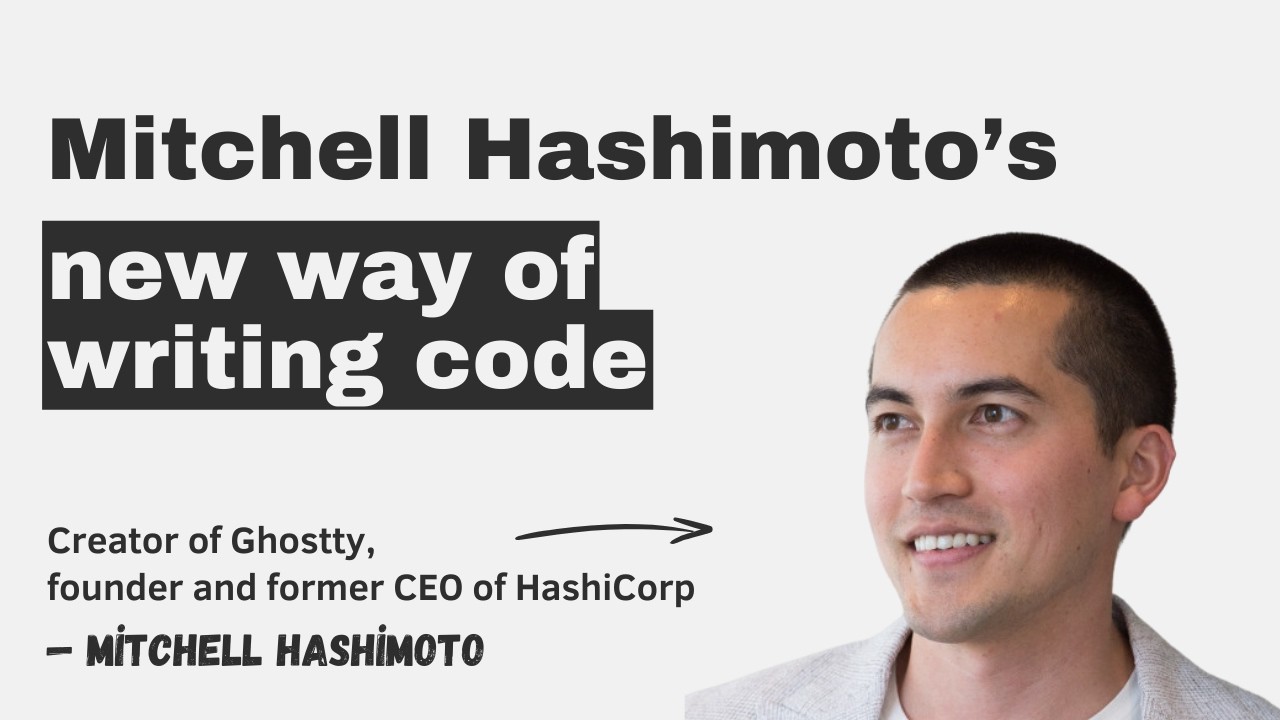
Mitchell Hashimoto, co-founder of HashiCorp and creator of Ghostty, reflects on building foundational cloud infrastructure tools, the near-sale of HashiCorp to VMware, his candid views on AWS/Azure/GCP, and how AI is reshaping open source, software engineering, and his own daily workflow.
He grew up self-teaching programming via open source, studied at University of Washington, and got his first job through a cold email as a Ruby on Rails consultant.
A failed university research project on distributed computing led him to list unsolved infrastructure problems in a notebook—those ideas became the blueprint for HashiCorp’s product stack.
He co-founded HashiCorp with Arman Dadger after a two-minute email exchange, initially self-funding with $20k and paying himself nothing for six months.
The company’s early products—Packer, Consul, Terraform, Vault, and Nomad—solved core cloud infrastructure challenges: image building, service discovery, declarative provisioning, secrets management, and workload scheduling.
Their first commercial product (Atlas) failed because it required adopting all tools and created internal budget conflicts; they pivoted over a single weekend to an open-core, per-product enterprise model starting with Vault.
Terraform became dominant despite being seventh to market, largely due to relentless community engagement and Mitchell’s constant travel and advocacy.
HashiCorp went public in 2021; Mitchell stepped down from the executive team six months prior.
VMware nearly acquired HashiCorp two years in for $100M using a regret-minimization framework, but the deal failed by one board vote—likely preventing Terraform from ever being built.
Mitchell’s honest take on cloud providers
AWS: Felt arrogant and unhelpful; acted like partners were lucky to engage, and subtly threatened to build competing services. Only began supporting Terraform after HashiCorp threatened to deprecate the AWS provider.
Microsoft Azure: Technically complex and hard to navigate, but business teams were professional, collaborative, and consistently supportive—first to back Terraform.
Google Cloud: Built the best technology (e.g., automated provider generation), but ignored business alignment—no interest in co-selling or quota attribution.
AI’s impact on open source and Ghostty
After leaving HashiCorp, Mitchell built Ghostty—a modern, opinionated terminal emulator using Zig and GPU rendering—to relearn systems programming and explore new tech like GPUs.
Ghostty is architecturally split into UI, IO, and renderer threads; its performance focus reduced frame processing to ~9 microseconds.
He extracted libghosty, a minimal, embeddable terminal library, to fix widespread broken terminal implementations in tools like Docker and Heroku.
AI has flooded open source with low-effort, plausible-looking but incorrect contributions.
Ghostty initially required AI disclosure, then banned AI PRs without accepted feature requests, and is now moving to a vouching system inspired by Lobsters and the PI project.
New contributors must be vouched for by trusted community members; bad actors can be denounced, blocking them and their inviter’s tree.
He believes open source must shift from “default trust” to “default deny,” emphasizing reputation and human accountability.
How Mitchell uses AI daily
He always has at least one agent running—coding, researching, or analyzing—while he focuses on higher-level thinking.
Agents run in separate tabs; he disables all notifications and controls when to check in.
Example: While driving to this podcast, he had an agent map out libraries with specific licenses and properties.
He delegates non-thinking tasks (boilerplate, research, edge-case analysis) to agents but reviews all code going into Ghostty.
His advice for engineers new to AI: reproduce your existing work with an agent—either coding or research—to learn its strengths and limits through deliberate practice.
Broader shifts in software engineering
Git and monorepos are under strain from AI-generated code volume: merge queues grow unmanageable, context becomes harder to find, and branching workflows don’t preserve failed experiments.
CI/CD and testing must evolve: agents need expansive test harnesses to validate behavior and avoid breaking unrelated features.
Observability and sandboxing face new scale pressures from ephemeral agent environments.
Hiring: The best engineers often have quiet, private backgrounds—no social media, no side projects—but are deeply focused during work hours.
He values candidates who use AI tools strategically, especially for rapid prototyping and research.
Advice for aspiring founders
Startups take longer than you think—plan for 10 years, not 5.
You need enough hubris to believe you’ll do it better than anyone, but not so much that you ignore market signals.
Most common questions: whether to open source, go remote, or target enterprise—all depend on context.
AI startups face extreme pressure to move fast, but productionizing still requires rigor.
Personal insights
He recharges through quiet solo time—walking near the beach, thinking through problems in the dark before sleep.
Reads mostly fiction; recommends The Invisible Life of Addie LaRue for its exploration of immortality and human connection.
Believes the key to staying competitive is thinking more about the problem than others—not working longer hours, but never fully switching off.