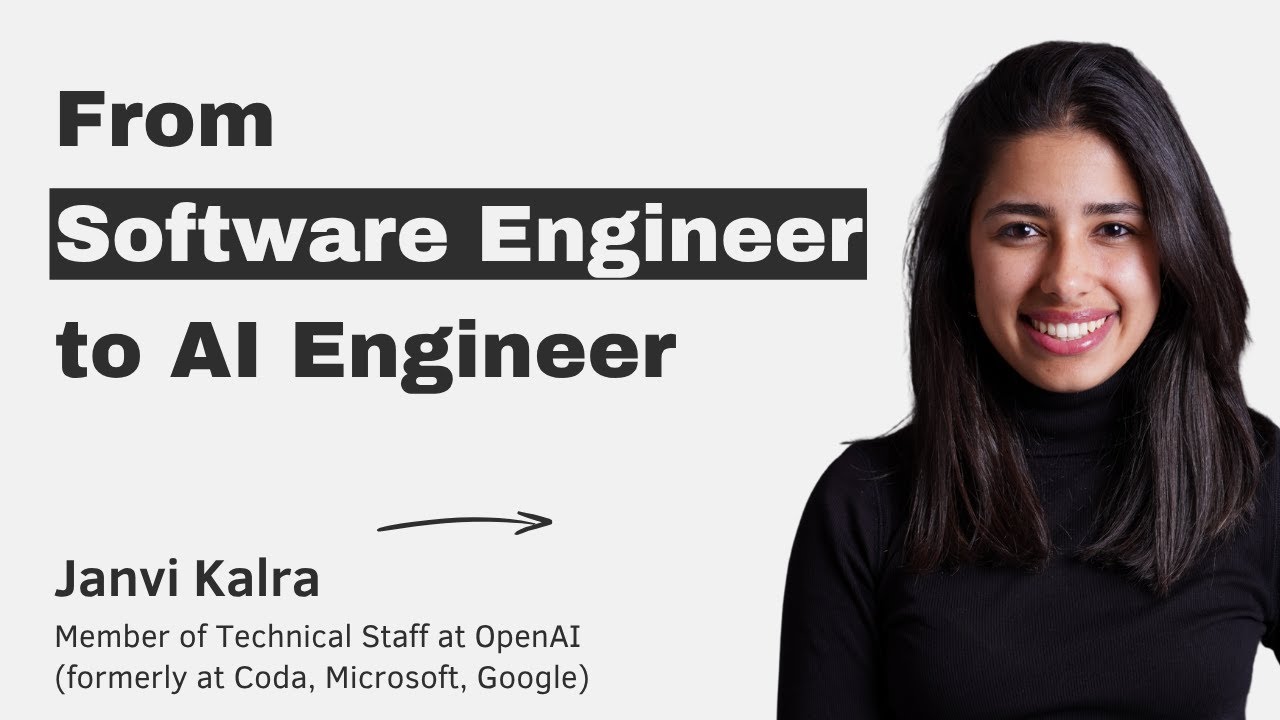
Janvi Kalra is a software engineer turned AI engineer who interned at Google and Microsoft, joined Coda as an early engineer, became one of its first AI engineers, and now works on safety at OpenAI. Her path illustrates how initiative, self-directed learning, and strategic career decisions can accelerate growth in the fast-moving AI space.
How Janvi got her internships at Google and Microsoft
She applied through the companies’ online portals as a sophomore at Dartmouth, writing essays that highlighted projects she had built outside of class and why she wanted to work at each company specifically.
She prepared for coding interviews using Cracking the Coding Interview by Gayle Laakmann McDowell, which was one of the few structured resources available before LeetCode and Blind 75 existed.
At Google, she worked on the search team and spent weekends exploring internal documentation and codebases to understand how Google’s search algorithm worked. She valued learning how to operate in large codebases and write unit tests, and especially appreciated coffee chats with engineers five to ten years ahead of her.
At Microsoft, she worked on the Azure OS team on a product that let users interact with Azure blobs locally from their file system, similar to Dropbox for Azure blobs. She had expressed interest in operating systems after taking a computer architecture class where she built a computer from transistors, and was placed on that team as a result.
She advises that expressing preferences during internship placement can work in your favor, since most candidates don’t speak up and companies want interns to have a great experience.
Why Janvi chose a startup over returning to big tech
She weighed the tradeoffs: big tech offers experience building reliable software at scale, moonshot projects without existential pressure, faster green card processing, higher pay, and more recognizable role titles.
Startups offered breadth of skills, more agency, exposure to how the business works, and the chance to work on zero-to-one green field problems where there are more problems than people.
She chose Coda for growth and breadth, and got both.
How Janvi evaluates which startup to join
Early on, she looked for smart people she could learn from and passion for the product.
Now she uses a more robust rubric with four criteria:
High revenue and steep revenue growth rate — relative to the company’s stage.
Large market with room to expand.
Loyal, obsessed customers — she evaluates this by searching Reddit and YouTube for real users, or for B2B products, finding companies that use the product and talking to them directly.
Competition — a clear thesis for why this company will win in its space.
She emphasizes doing this due diligence yourself rather than outsourcing it, since you own the decision.
She cites Fast (the one-click checkout startup) as a cautionary example where many employees ignored missing revenue data and headcount growth charts were used to obscure the lack of a real business.
She notes that engineers taking a pay cut for equity are effectively investors and have the right to this information, especially after receiving an offer and signing an NDA.
How Janvi became one of Coda’s first AI engineers
When ChatGPT launched in November 2022, Coda was forming an AI team. Janvi asked to join and was politely declined.
She spent nights and weekends self-studying deep learning foundations — from tokens, weights, and embeddings, through RNNs and LSTMs, up to the transformer architecture and attention mechanisms — and wrote about it on her blog.
She attended hackathons, including a six-week online one through Buildspace where the goal was acquiring users or generating revenue, not just building. She built a language-learning tool for watching TV to practice Hindi and Mandarin.
After five months of visible self-driven work, when she asked again, the team said yes.
She emphasizes: don’t wait for permission to work on something you care about.
What an AI engineer does
An AI product engineer builds products on top of models through experimentation and prototyping, then productionizes them.
Core skills include software engineering fundamentals plus domain-specific abilities: fine-tuning, prompt engineering, hosting open-source models, and writing evaluations.
A surprising reality: running an eval suite costs money when using APIs, unlike traditional unit tests which are free. This forces more intentional test design.
How Janvi developed her AI engineering skills
She learned primarily by doing — through internal and external hackathons.
At an internal hackathon coinciding with OpenAI’s release of function calling, her team built a system to turn natural language prompts into the correct third-party code integrations using embeddings from Pinecone.
At an external fine-tuning hackathon in San Francisco when Llama 3 launched, she fine-tuned a model on Replicate to turn natural language into Coda formulas (Coda’s equivalent of Excel formulas).
She also read blogs, papers, Twitter, and documentation from open-source projects like LangChain, which had clear guides on RAG when it was first popularized.
Janvi’s favorite AI project at Coda: Workspace Q&A and Coda Brain
A common customer complaint was difficulty finding internal knowledge across many documents.
In November 2023, as RAG was being popularized, Janvi combined three existing pieces — Coda’s rebuilt search index, reliable LLM calling infrastructure, and an in-doc chatbot — to build a workspace Q&A chatbot in a couple of days.
The CEO saw a grander vision: an enterprise search tool that could pull from all third-party integrations (e.g., a sales team asking for projected ARR from Salesforce).
A small team of five (Janvi, her manager, the Coda CTO, a designer, and a PM) had four weeks to experimentally prove this could work, demoing to important stakeholders. They flew to New York on one day’s notice and worked nights and weekends.
It succeeded and became Coda Brain, a second product line. From January to June 2024, a team of 20 productized it, and it was presented at the Snowflake Dev Day keynote.
Janvi reflects that being new to AI was an advantage because the field is so new that nobody knows the right way, leveling the playing field across seniorities. Fresh minds without biases from traditional software engineering (like over-reliance on unit testing) can adapt faster to the nondeterministic nature of AI systems.
Learnings from interviewing at 46 companies
Over a six months, she interviewed at 46 AI companies. The first half she was getting rejected while ramping up on LeetCode and system design prep.
She found the AI space noisy and many companies had open questions about growth potential. A mentor advised: if it’s not a “heck yes” and you have savings, don’t join.
She categorized AI companies into three segments:
Product companies building on top of models (e.g., Cursor, Codium, Harvey).
Infrastructure companies helping product companies use LLMs (e.g., inference providers like Modal, Fireworks, Together; vector databases like Pinecone, ChromaDB; eval/observability tools like Braintrust, Arize, Galileo).
Model companies building the base intelligence (e.g., Google, Meta, OpenAI, Anthropic).
She focused her search on model and infrastructure companies to gain breadth beyond her product experience at Coda, though this was an uphill battle since her experience was less directly relevant.
For infrastructure companies, she evaluated whether margins were high enough given GPU costs (a good software business should have ~70% gross margins) and whether engineers would build it in-house instead.
For model companies, she assessed whether they could afford to keep training frontier models and whether they could stay ahead of open-source competition (open weights models reduce willingness to pay for closed-source).
She got financial insights by asking companies directly about GPU spend and revenue after receiving offers, reading investigative outlets like The Information, and talking to investors who had seen company decks.
How Janvi prepared for AI engineering interviews
Coding: LeetCode-style data structures and algorithms using NeetCode (which has video explanations). She believes in spaced repetition.
Frontend: The Great Frontend for obscure JavaScript questions.
Backend: Drew on work experience.
System Design: Alex Xu’s two books, reading them repeatedly until understanding why things work certain ways.
Project interviews: Her favorite format — build something in a day, showing passion for the product and practical ability.
She hopes the industry moves away from LeetCode toward project interviews, code reading, and debugging, but acknowledges the industry is in transition.
Interviews were a mix of remote and in-person between June and December 2024. She optimized for in-person companies because meeting future teammates and seeing the office provides valuable information when committing to a multi-year role.
What Janvi works on at OpenAI
She works on safety engineering at OpenAI, focused on the mission of ensuring AGI benefits all of humanity.
Her work includes:
Building low-latency classifiers that detect harmful model or user behavior in real time to block live, including training data flywheels and hosting these models at scale.
Measuring when models are being harmful in the wild, identifying unknown harms as models become more capable and users find new jailbreaks, then distilling findings into small classifiers.
Owning safety mitigation services and integrating them with all product launches.
What makes OpenAI unique
Speed combined with scale: Startups offer speed, big companies offer scale, but OpenAI currently has both. Her service handles 60,000 requests per second.
Open culture: People are very open to answering why and how things work, making it a great place to learn.
Mission-driven passion: People work hard and care deeply; it’s never a boring day.
Trust in engineers to ship fast: Engineers can deploy with just one reviewer on services handling massive traffic. This trust comes with the downside of occasional outages, but keeps red tape minimal. She cites the example of Deep Research, which started as an engineer hacking on an idea, presenting it to the C-suite, and becoming a major product.
Surprising realities of AI engineering
Much of AI engineering is building solutions to known model limitations, then scrapping that work as models improve and building new guardrails.
Example: Before function calling existed, Coda prompted models to return JSON and parsed it deterministically. When function calling launched, they scrapped that integration. Function calling was initially unreliable, so they built guardrails. Now the industry is moving to the MCP paradigm.
As models gain capability, new engineering guardrails are needed to ensure reliability at scale.
Engineers must become comfortable discarding work — especially when LLMs helped generate that code, making it easier to let go.
How AI tools are changing software engineering
What stays the same: Code remains how innovation manifests. Engineers still need to understand high-level systems, design them well, debug effectively, and read code carefully.
What changes:
Roles between PM, designer, and engineer are blurring. Engineers are expected to do product and design work.
Engineers become more full-stack, building data pipelines themselves rather than outsourcing to data engineers.
Engineers must get better at articulating software architecture and thoughts because they’re prompting models to implement them. The most efficient engineers can zoom out to write great prompts that catch edge cases, then zoom in to read the generated code and catch bugs the LLM missed.
AI tools excel at greenfield work but are less effective in large existing codebases, where knowing where code should go, which modules to use, and how to integrate features remains a core engineering skill.
How AI might impact new graduates
Janvi is not convinced AI will be disproportionately worse for junior engineers. It allows everyone to move higher in the stack and be more creative.
There will be people who use AI to learn and people who use AI to avoid learning, and both approaches have their place.
For greenfield projects proving a vision, vibe coding to validate quickly makes sense. For building robust systems you own, deep understanding is essential because AI doesn’t help much during incidents at the systems level.
The key skill is learning when to outsource the doing versus when to use AI to become a stronger engineer.
She draws a parallel to React adoption: some developers went deep (understanding the virtual DOM, reading source code) and became better engineers for it. The same pattern will play out with AI tools.
Rapid fire
AI stack for coding: Cursor for hackathons, Deep Research to find existing libraries, ChatGPT as default search and tutor, internal tools for RAG over company documentation.
Book recommendation: The Almanack of Naval Ravikant — she’s read it multiple times for its pragmatic advice on career and happiness.
Key career advice: Don’t wait for someone to give you the opportunity — go work on it.