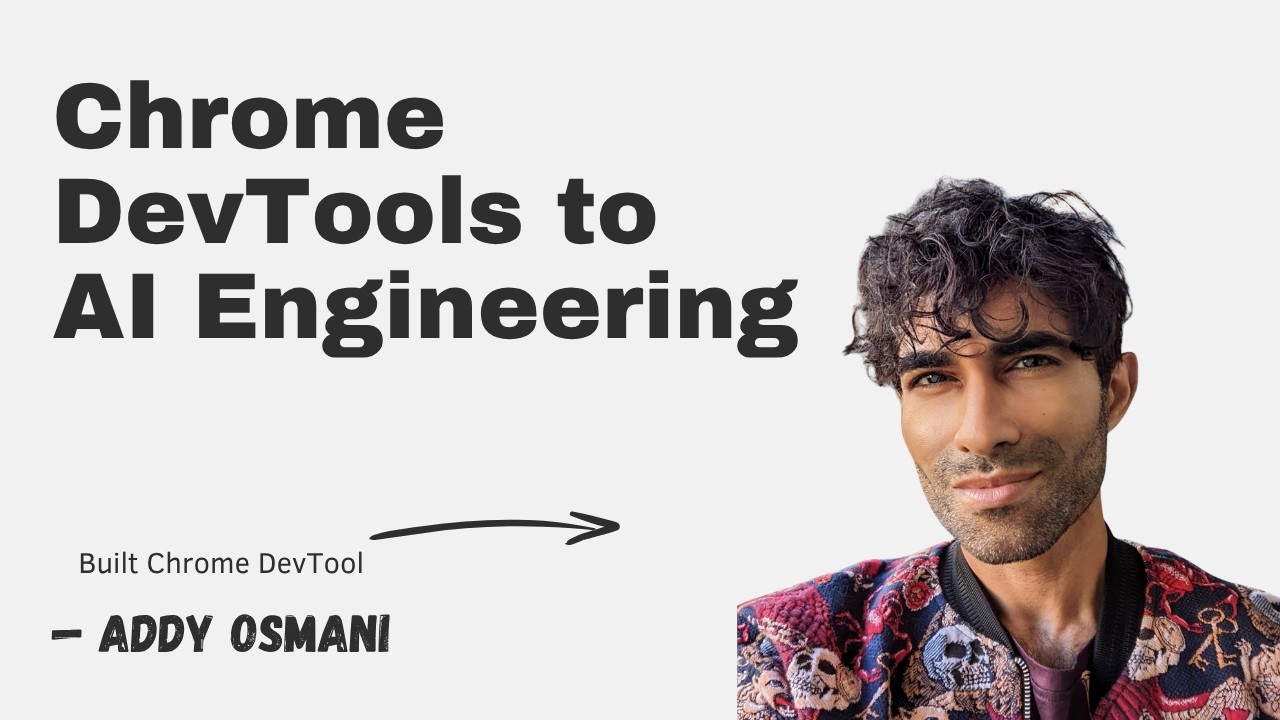
Addy Osmani spent 14 years at Google, most of it on Chrome, progressing from software engineer to director of engineering; he now focuses on how AI agents are reshaping software engineering, emphasizing the risk of cognitive surrender and the enduring need for human accountability.
Early path into tech
Grew up in rural Ireland with dial-up internet; got first desktop around age 8–9 and became fascinated with how browsers work.
At 15–16, built a custom web browser from scratch (parsing HTML/CSS/JS, supporting applets/Flash) to speed up page loads over slow connections by chunking downloads across multiple threads.
Won a national science competition with the browser, attracting media attention (Wall Street Journal, CNN) and realizing that building something that runs doesn’t equal understanding all the underlying layers.
Worked at startups and AOL (where day one required entering a credit card to log into the internal browser) before joining Google.
jQuery and TodoMVC
Contributed to jQuery early on (triage, blog posts, code) under John Resig; learned how to balance community input with long-term maintainability.
Created TodoMVC to compare emerging frameworks (Backbone, Angular, YUI, Knockout, etc.) by implementing the same todo app in each; it became a de facto standard for framework tutorials and benchmarks.
Apple/WebKit team collaborated with him to turn TodoMVC into Speedometer, the primary web responsiveness benchmark still used by all browser vendors.
Joining Google and early Chrome era
Joined Google UK as a Level 4 Developer Relations Engineer after Google noticed his open-source education work; moved to Chrome team around 2012–2013.
Early Chrome period: no meta-frameworks, build tooling in flux (Grunt → Gulp → Webpack), debugging often meant Firebug in Firefox; Chrome team built Yeoman (scaffolding tool) and invested in DevTools to meet developers where they were.
Building Chrome DevTools
Pavel Feldman (tech lead) and Paul Irish drove a developer-centric vision; Addy and other “web developer archetypes” fed real-world friction into the team.
Key evolutions: performance panel (flame graphs, deep tracing), source maps and blackboxing to debug through framework layers, device mode for mobile viewport/sensor simulation, Application panel for PWA debugging (service workers, cache, push).
Memory debugging remained a hard, unsolved problem; few developers understand memory management, making tooling difficult.
Later, under Yong Gao, DevTools integrated LLMs to help reason through massive traces and connect agents for automation.
Core Web Vitals
Team wanted nuanced, user-centric metrics beyond “page load”; identified key moments: is it happening? is it useful? is it usable? is it stable?
Largest Contentful Paint (hero content), First Input Delay / Interaction to Next Paint (interactivity), Cumulative Layout Shift (stability — e.g., ads pushing content down).
Metrics validated with standards community and developers; gave companies a shared language to prioritize user experience.
Google engineering culture
Scale (billions of users) demands rigorous A/B testing, experimentation, and evaluation amid hundreds of concurrent experiments.
Strong developer goodwill sentiment, though cross-org collaboration is hard; Addy’s cultural contribution: “meet developers where they are” — collaborate with framework teams rather than guess needs.
Internal knowledge sharing (e.g., “Software Engineering at Google” style docs) enabled learning across orgs; YouTube collaboration on Core App Vitals exemplified high-agency partnership.
Career trajectory at Google
Started L4 (mid-level) in DevRel in UK; promoted to L5, L6 (staff), became DevRel manager.
At ~5–6 years, missed building; transitioned back to engineering management (EM) to blend hands-on work with team leadership.
Grew team to ~45–50 people globally; aimed for self-sufficient org (“tap the blimp occasionally”) to free time for strategic work (model quality, dev tooling for AI, benchmarks).
Promoted L7 → L8 (Director); director role = first executive level: accountable for top goals, weekly/biweekly reporting, sponsoring large programs, unblocking teams, connecting tech to business goals.
Noted recent shift: directors/VPs/SVPs now rolling up sleeves, building with agents, sharing workflows weekly.
Cognitive debt and cognitive surrender
Cognitive debt: erosion of memory and problem understanding from over-reliance on AI.
Cognitive surrender: blindly accepting AI output as your own answer, losing critical thinking.
Goal: avoid both by maintaining enough understanding to fix things when agents go wrong.
Working with agents today
A year ago: could follow single agent’s reasoning step by step; now 20–30 sub-agents fire in parallel — impossible to read all trajectories.
Addy’s practice: (1) read the final decision summary (or prompt for one), verifying it’s not hallucinated; (2) mutual amplification — have agents log learnings, decisions, friction, unique approaches each session so both human and agent improve.
Intentionality and curiosity preserve cognitive depth despite speed.
Loop engineering and software factories
Loop engineering = building systems that prompt, generate, test, verify, and iterate autonomously (software factories); next abstraction layer after prompting.
Requires guardrails: human-in-the-loop for critical changes, blast-radius limits, quality gates.
Unlike physical factories, software factories must connect to production telemetry (errors, logs, user feedback, analytics) to prioritize and improve continuously.
Example: Addy’s app ingests issues, analytics, hosting logs; agent prioritizes fixes by impact (e.g., slow view for high-traffic region) and implements.
Sentry autofix (error → agent one-shot fix → PR) is an early loop; future loops may auto-merge with sufficient confidence.
Changing role of software engineers
Ryan Dahl: “era of humans writing code is over”; syntax writing shrinking, but accountability remains.
Alpha (advantage) shifts: taste, judgment, deciding what’s “good” (delightful, usable), verification, being answerable for systems.
Chromium model: OWNERS files assign accountability for subsystems; engineers gate what ships, defer, block — even if they didn’t write every line.
Automation historically expands total software created (app releases surging); new roles will emerge in the knowledge economy.
Addy’s writing workflow with AI
18 books published; agents accelerate research (deep research across HN, Twitter, blogs to map opinions, contention, gaps).
Writing process: hand-draft thesis → agent drafts version → compare → human refines; uses models for readability passes but struggles with “AI-looking” patterns (triads, homogeneous structure).
Spends 3–7 days per piece, line-editing multiple times; worries about losing personal voice to model homogeneity; tried detectors (Pangram) but they flag human writing too.
No silver bullet yet; custom models on old writing feel wrong because perspectives evolve.
What’s next for Addy
Leaving Google after 14 years; staying in developer/AI engineering space, helping companies navigate the transition.
Will announce next role in coming months; wants to remain hands-on with ecosystem.
Career advice for engineers
Unbundling of roles: engineer with product sense, product person with engineering/UX sense, etc.
Invest in non-engineering skills: product, technical evangelism, go-to-market, UX.
Show employers you can operate across fuzzy boundaries; be a lifelong learner, endlessly curious, and look for where you can help beyond building.