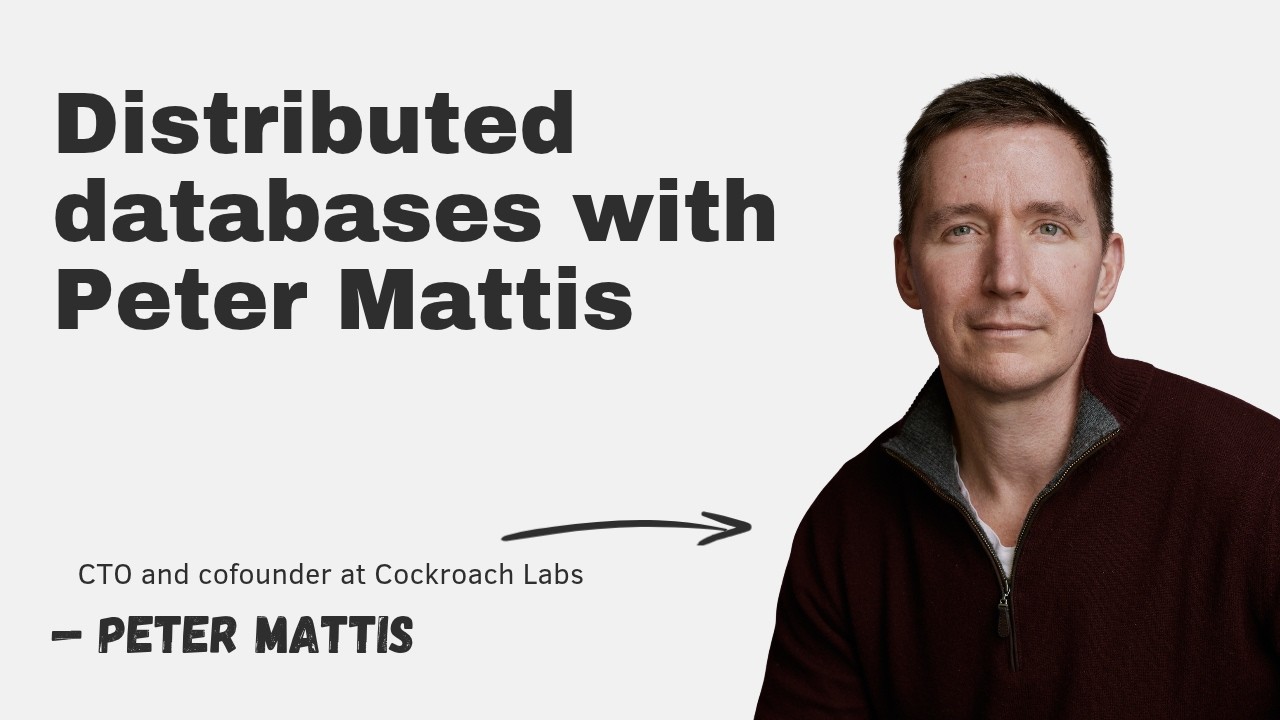
Peter Mattis, co-founder and CTO of Cockroach Labs, traces a 30-year arc from building GIMP in college to designing Google’s Gmail storage, Colossus distributed file system, and Spanner, then founding CockroachDB — a strongly consistent, horizontally scalable SQL database — and recently returning to high-volume production coding using AI agents that he says amplify expertise rather than replace it.
Early path into software
Gaming and a household with early Apple computers sparked Peter’s interest; he started college as a mechanical engineer but switched to CS after finding the coursework far easier and more engaging.
In college, he and his roommate built GIMP (GNU Image Manipulation Program) and the GTK graphics library from scratch, learning graphics, rendering, and data structures on the fly; a competing pre-announcement on Usenet nearly dissuaded them, but they shipped anyway and the other project vanished.
GIMP led to a Google interview in 2001 (Google was three years old); Peter declined due to the commute, joined a startup, then accepted a second offer in 2002.
Gmail and Google infrastructure
Joined Google on April 1, 2002; worked on “Caribou” (Gmail’s internal codename), building the backend threading, message storage, and indexing system — his second B-tree implementation.
Gmail launched April 1, 2004 with 1 GB free storage (vs. 4 MB from competitors), using Google’s distributed file system (GFS) and an inverted index for fast search; ads were added later by Paul Buchheit, creating a massive business.
Invite-based rollout controlled demand and generated buzz; Peter wasn’t directly involved in the invite mechanics.
Google’s build system and Colossus
Google’s monolithic repo strained under a single massive Makefile (Google2); Peter laid the foundation for Google3, introducing “build files” — a stripped-down Python DSL that generated Makefiles — which evolved into Blaze (internal), then Bazel (external) and Buck (Facebook).
GFS hit scalability limits (~1,000 machines, single master bottleneck); Peter joined the founding team of Colossus, the successor, which used a distributed metadata layer backed by Bigtable (creating a circular dependency resolved by a bootstrap Bigtable that didn’t depend on Colossus).
Colossus adopted Reed-Solomon erasure coding (~2x overhead vs. 3x replication) for storage efficiency and higher durability; latency was bounded by HDD speeds (~5–10 ms), later improved by SSDs and faster networks (intra-zone ~100 µs).
Spanner and the storage/database distinction
Spanner, a distributed database built on Colossus, required different primitives: small, typed rows with random access vs. large append-only files; this drove log-structured merge trees (LSMs) — popularized by LevelDB/RocksDB — which Peter later reimplemented as Pebble for CockroachDB.
The circular dependency (Bigtable on Colossus, Colossus metadata in Bigtable) was resolved by a foundational Bigtable instance that didn’t use Colossus, a pragmatic hack that lasted years.
Founding Cockroach Labs
After a brief stint on Google Goggles and a failed startup (Viewfinder, acquired by Square as an acqui-hire), Peter reunited with college roommate Spencer Kimball and Ben Darnell at Square; they revived a Viewfinder-era design for a distributed SQL database.
Raised VC immediately (unlike Viewfinder); named it CockroachDB for resilience (“unkillable like cockroaches”).
Early customers came post-outage (e.g., a major bank after a region-wide power loss) or when hitting single-node limits (RDS max instance size) and facing manual sharding burden.
Automatic sharding vs. manual sharding
Manual sharding: hash user ID into fixed shards; resharding requires remapping and moving data — painful at scale.
Consistent hashing reduces data movement when adding nodes.
CockroachDB uses range-based partitioning (like Bigtable/Spanner/HBase): contiguous key spans split and moved automatically; a meta-index (B-tree-like) maps ranges to nodes, enabling automatic rebalancing without application involvement.
Consistency models and Raft
Strong consistency (linearizability/serializability) means reads always reflect the latest write, even from different replicas; weak/eventual consistency allows stale reads, pushing complexity to the application.
CockroachDB uses Raft (a Paxos variant) for consensus: minimum 3 replicas, writes go to all, reads typically from one; on failure, any 2 of 3 can recover state. Customers can configure 5 or 7 replicas for higher durability at latency cost (speed-of-light cross-region latency).
Design principle: minimize round-trips; batch reads then writes to avoid serial latency accumulation.
~100–150 engineers in R&D; steady growth; focus on stability, performance, enterprise features; revenue growing with a clear path forward.
AI-assisted coding: return to the keyboard
Peter wrote ~100k lines/year pre-AI (peak CTO years); stepped back 2022–2024 to focus on management, but found it hard to guide engineers on AI tools without using them himself.
Started with GitHub Copilot/Cursor (glorified autocomplete); progressed to Claude Code, Opus, Sonnet, then o1/Fable/Astra; by late 2024 (Thanksgiving break) he was “agenting” — spinning up many parallel agents.
Example: built a massive benchmarking matrix tool (vertical scaling configs) in 4 days; implemented a highly optimized B-tree in Rust (~10k lines) in ~30 minutes.
Workflow: uses Claude desktop app + Codex desktop app; runs 5–10 concurrent sessions, each with many sub-agents (sometimes 100+); uses adversarial review (one model writes, another tears it down).
Moved from Emacs (20 yrs) → VS Code → terminal-based agents → graphical agent UIs (Claude/Codex desktop) for better session management.
Quality, testing, and security with AI
Ambition must increase: higher quality, security, performance. AI agents are “lazy” on testing — need firm guidance to use property-based, metamorphic, deterministic simulation testing.
Security: every commit can get adversarial AI review; guardrails (e.g., verifying decompiled assembly for zero-overhead abstractions) prevent regressions.
UX: designers now write HTML/CSS/JS directly and open PRs, eliminating waterfall handoffs.
Code review: scrutiny decreases as agents improve; moving toward trusting AI output like compiler assembly, with AI verifying AI (guardrails, not human eyeballs).
The “zone” and 100x engineers
Flow state differs: less intense typing, more cognitive orchestration — firing many experiments in parallel, reviewing progress updates, iterating rapidly.
Analogy 1: learning to drive a car (AI tools) instead of walking; early crashes, then F1-driver skill gap emerges.
Analogy 2: domain experts become “sorcerers” — knowing the right incantations (prompts, constraints, architecture) yields magical output; novices get hollow scaffolding.
10x → 100x engineer: pre-existing expertise amplified; best results from strong engineers who lean into tools and know where they break.
Advice for engineers in the AI era
Use AI as an always-available tutor: dissect senior engineers’ code, ask for explanations at any level, generate diagrams, translate to familiar concepts.
Cultivate curiosity beyond your immediate area; explore adjacent systems (e.g., Peter studied Bigtable/Spanner while on Gmail).
Personal agency is essential: no one will teach you fast enough; you must use the tools daily and stay current — Peter learned more in the past year than the prior five combined.
Deep expertise remains the lever: AI amplifies what you know; hollow prompting produces hollow results.
Closing reflections
Peter is both excited and exhausted; the pace is unsustainable but transformative.
Cockroach Labs now has 500–1,000 internal apps built by non-engineers (HR, finance) on an AI platform — empowering custom software for everyone.
Core belief: asymptotically 100% of code will be AI-generated; humans supply agency and vision.