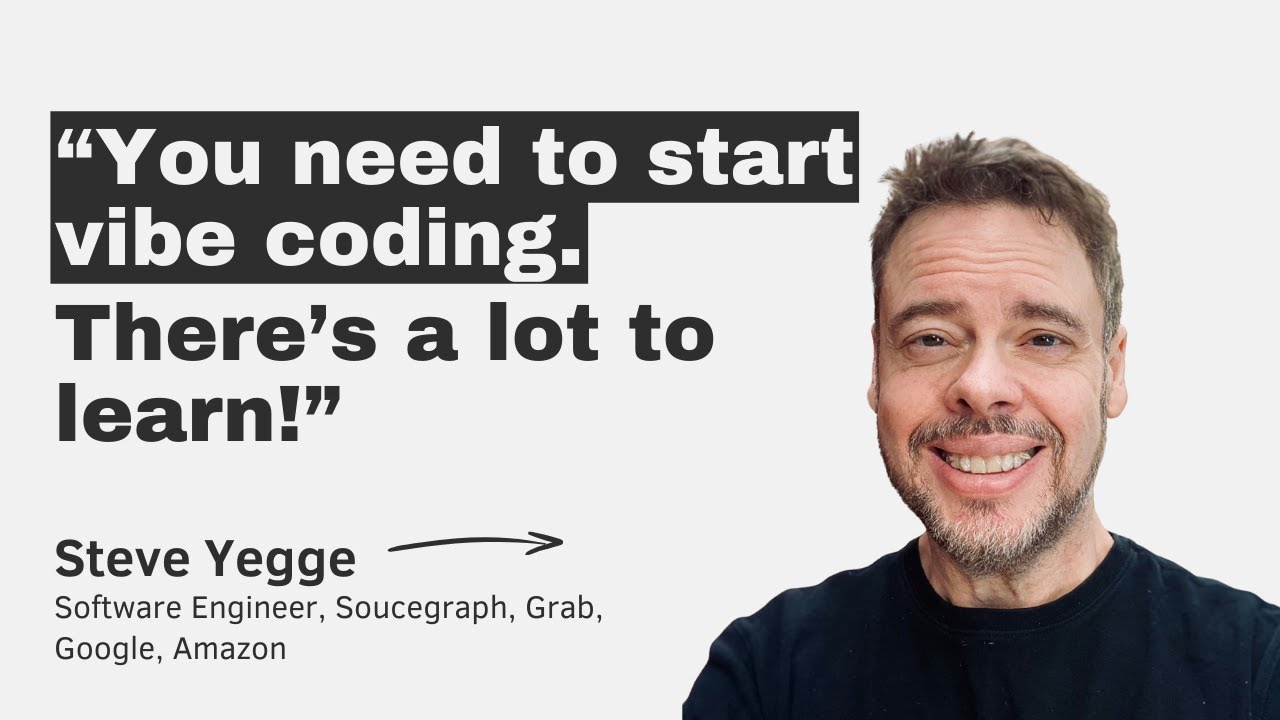
Steve Yegge is a veteran software engineer who spent 7 years at Amazon, 13 at Google, and is now building AI tools at Sourcegraph. He’s widely known for two influential blog posts: “Get That Job at Google” (2008), which Google HR circulated internally for over 15 years as hiring guidance, and the “Google Platforms Rant” (2018), an internal memo that leaked externally and became one of the most cited critiques of Google’s platform strategy. In this conversation, he reflects on both pieces of writing, explains why he believes Google still fundamentally doesn’t understand platforms or developers, discusses why Amazon has improved dramatically while Google has not, and shares his experience coming out of retirement because of AI coding tools. He argues that AI will create more developer jobs, not fewer, but the role will change fundamentally: engineers will stop writing code and start building software by directing AI agents. He also predicts a new “fixer” role will emerge to clean up the messes AI creates, and warns that companies and developers who don’t start learning these tools now will be left behind.
The “Get That Job at Google” article and why Steve wrote it
Steve wrote the article in 2008 after three years of participating in Google’s hiring process, motivated by seeing talented friends get rejected due to the interview process’s high false-negative rate.
The “interview anti-loop” he described refers to the phenomenon where a candidate might simply get unlucky and draw six interviewers who disagree with them technically, leading to rejection regardless of actual ability.
He noted that Google’s own internal statistical analyses found weak correlation between interview scores, offer decisions, and eventual job performance, yet the process persisted.
A famous anecdote: Google’s hiring committee once reviewed their own anonymized interview packets as an experiment and voted not to hire 60% of themselves, revealing how arbitrary the process was.
Steve’s core message: getting an offer means you “squeaked by,” and rejection doesn’t mean you’re unqualified. The process is noisy, and persistence matters. He knew people who got in on their fifth attempt and then rose quickly.
On fairness: Steve empathizes with critics who say the process isn’t meritocratic, but argues it’s a trade-off companies make between effort spent finding candidates and accuracy of assessment. Some companies like Linear are now trying paid work trials as an alternative, which is more realistic but costs a week of the candidate’s life.
On entry-level hiring: big tech companies don’t post junior roles publicly because they fill them through internships, which function as extended recruitment operations. College hiring is dominated by companies with the resources to build university relationships.
The Google Platforms Rant: origin and key arguments
Steve wrote the rant in 2018 after six years at Google, frustrated that he still couldn’t get anyone to build a proper internal platform. It was part of an planned 11-part series critiquing Google+, but Part 2 accidentally got published externally and went viral on Hacker News.
The rant compared Amazon and Google on platform culture. Amazon, despite doing many things wrong, had a strong platform DNA. It started when Jeff Bezos, through weekly customer service