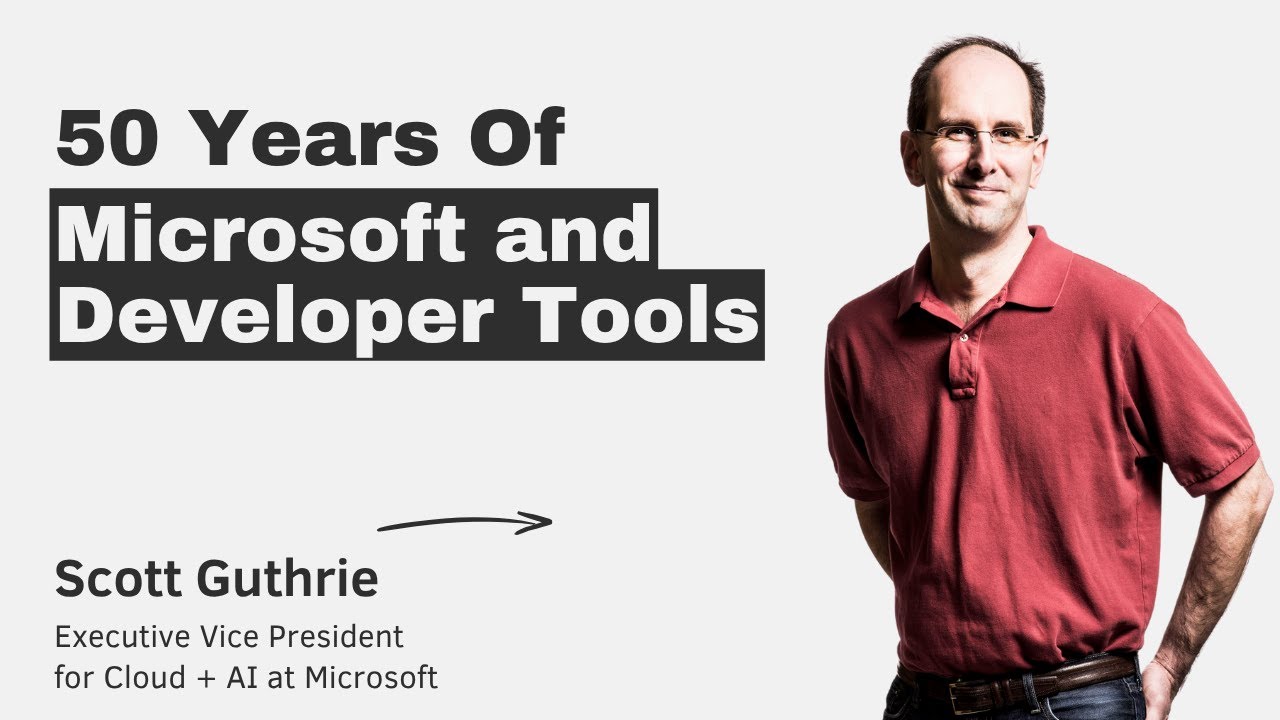
Scott Guthrie, who joined Microsoft in 1997 and now leads cloud and AI, traces the company’s 50-year arc from a developer tools startup to a cloud and AI powerhouse, showing how each era’s tools—from BASIC to Visual Basic to .NET to VS Code—were driven by a single strategic insight: platforms succeed only when developers are productive on top of them.
Microsoft’s DNA as a developer tools company
Microsoft’s first product was Microsoft BASIC for the Altair in 1975, built by Bill Gates and Paul Allen before they had access to the actual hardware—they flew to Albuquerque with a paper tape and it worked on the first try.
For decades, Microsoft was purely a developer tools company: compilers, languages, and frameworks were the products, and the revenue came from selling them.
This DNA persists today: VS Code, GitHub, Azure, and Copilot are all developer tools, and the company’s strategy remains “make developers successful, and the platform succeeds.”
How developer tools drove Windows adoption
When Microsoft built Windows 1.0 through 3.1, it shipped QuickBasic, Microsoft C, and QuickC alongside the OS—an intentional strategy to ensure developers could build applications for the platform.
The logic was straightforward: no developers means no apps, no apps means no OS sales. The same logic later applied to Azure and cloud.
Visual Basic and the productivity revolution
Visual Basic (mid-1990s) was revolutionary because it let developers drag-and-drop UI elements, double-click to write event handlers, and hit F5 to run—dramatically reducing the boilerplate that GUI development required on platforms like Mac System 7.
It pioneered “edit and continue,” letting developers modify code while the application was running and see changes immediately without recompiling—a paradigm that felt radical in the 1990s but is now standard in web development.
Visual Basic, Access, and Visual Fox Pro extended this productivity to database and line-of-business applications, enabling non-professional developers (like traders at banks) to build their own tools.
There was pushback—some worried “anyone can code” would devalue professional developers—but Scott argues that every productivity leap (garbage collection, IntelliSense, type safety, debuggers, cloud) faced the same resistance and ultimately made developers more valuable, not less.
The birth of .NET, C#, and Visual Studio
By the late 1990s, Microsoft had a gap: Visual Basic was productive but limited; C++ with MFC and ATL was powerful but difficult. Each language had its own IDE, debugger, and libraries with no sharing.
.NET (unveiled July 2000 at PDC) was designed to unify this: a Common Language Runtime that could run multiple languages, a shared class library, and a single Visual Studio IDE with shared tooling (debugging, IntelliSense, profiling, visual designers).
Scott Guthrie wrote the first ASP.NET prototype over Christmas 1997–98, exploring how classes and objects could make web development more productive. This ran in parallel with the CLR project (codenamed “Core”) and the Visual Studio IDE consolidation, and the three teams converged in 1998–99.
C# was designed by Anders Hejlsberg, who came to Microsoft from Borland (where he created Turbo Pascal). His philosophy emphasized language consistency and careful feature addition—generics, then LINQ built on generics, then async/await—giving C# a coherent evolution over 25+ years. He also created TypeScript.
Steve Ballmer’s famous “developers, developers, developers” moment was from a 2000-era event where he was explaining why Microsoft was betting everything on .NET—his core point was that winning developers’ hearts and minds was existential for any platform.
The MSDN subscription era
Before Google, Stack Overflow, and modern web documentation, Microsoft sold MSDN as a subscription service: CDs (sometimes 50+ per quarter) shipped with every Microsoft OS, database, developer tool, Office, and searchable documentation.
This was expensive—$1,000–$3,000 per developer per year—but companies paid it because the integrated stack (Visual Studio, C#, ASP.NET, SQL Server, IIS, plus world-class documentation and a first-class debugger) made developers dramatically more productive than alternatives.
The debugger experience itself was a differentiator: before Visual Studio, most debugging meant printf statements or rudimentary command-line symbol dumps.
Windows Phone: lessons in platform timing and developer reach
Windows Phone had genuinely excellent tools: first-class debugger, great simulator, C# and .NET on a mobile platform, and forward-looking UX concepts like Live Tiles.
It failed for two structural reasons: (1) it launched after iPhone and Android, and being #3 or #4 in a platform market makes catch-up nearly impossible; (2) it required Windows for development, excluding Mac-using developers and designers who dominated the post-2009 conference circuit.
Key lesson: speed matters in platform shifts, and you must meet developers where they are (including their OS choice).
Azure: from #7 to #2 through focus and openness
Azure launched in preview at PDC 2008 and went GA in 2010. It pioneered platform-as-a-service but had usability problems, no Linux/open-source support, and poor tooling—and was roughly #7 in the market.
When Satya Nadella took over the server and tools business in 2011, he asked Scott Guthrie to lead Azure. Scott’s first move was a two-day internal hackathon where senior leaders tried to build an app from scratch—most couldn’t even sign up, documentation was broken, and the tools didn’t work.
This produced a punch list that drove a 2012 relaunch: Linux support, VMs, better tooling, and a focus on hybrid cloud for enterprise (a segment Amazon was ignoring). The tagline was “the cloud for modern business.”
This beachhead strategy—finding an underserved segment small enough to win but big enough to matter—moved Azure from #7 to #2 and created the escape velocity that later enabled deals like hosting ChatGPT.
The open-source transformation
Microsoft’s early hesitation around open source was rooted in business model (per-seat licensing) and fear (GPL concerns about IP contamination), not just philosophy.
The shift started small: the ASP.NET AJAX Control Toolkit was one of the first open-source releases, and bundling jQuery (MIT/BSD-licensed) into Visual Studio templates was considered groundbreaking at the time.
The business model shift came with cloud: in a cloud world, customers paying for compute and services could run entirely on Linux, so Microsoft needed developer goodwill more than license revenue.
Codeplex existed but was half-hearted—projects used non-permissive licenses and the community didn’t truly embrace it.
2014: Three bold decisions in 90 minutes
When Satya became CEO in February 2014, Scott took over the developer division and recognized Microsoft was losing relevance with developers. In spring 2014, his team held a meeting, wrote “let’s be bold” on the whiteboard, and made three decisions in about 90 minutes:
Free Visual Studio Community Edition: Previously cost ~$1,000+; making it free for individuals and small teams was scary for revenue but essential for adoption.
Open-source .NET and make it cross-platform: Not just publishing source, but accepting community contributions, using the right license, putting it on GitHub, and supporting Linux and Mac as first-class platforms.
Create VS Code: A lightweight, open-source, code-optimized editor based on an internal web-based editor project (written in TypeScript/Node). They stripped out project systems, added file system support, ported the .NET open-source debugger, and focused purely on streamlined editing.
Of the three, VS Code was the most speculative—there were already Atom, Sublime, and other editors—but it became the most impactful. Ironically, the decision Scott thought would have the biggest impact (free Visual Studio) had the least relative impact.
VS Code also served as a bridge to the GitHub community, building credibility that made the 2018 GitHub acquisition possible—something that would have been unthinkable in 2010.
Looking ahead: AI agents and the next productivity leap
Scott is most excited about moving beyond the request-response model of AI assistants (typing a prompt, getting an answer) to asynchronous AI agents: assigning a task (turn this Figma design into HTML/CSS, create a Kubernetes deployment with these requirements) and having an AI coworker work on it for 10–20 minutes, then returning a result.
This extends beyond development into operations: anomaly detection in logs, performance debugging, understanding what changed in the environment or codebase.
Combined with Azure’s global infrastructure (70 regions, data residency for every country, GPU compute for training and fine-tuning models), this gives every developer “superpowers”—the ability to go from idea to global deployment faster than ever.
Scott sees this as comparable to the jumps from MFC to Visual Basic to .NET, but more profound because it affects both development and runtime, with a feedback loop of deploying, learning from user behavior, and improving.
Advice for engineers facing AI disruption
Every major productivity shift in computing history—IntelliSense, garbage collection, type safety, debuggers, JavaScript, open source, cloud—was met with resistance and fear that it would devalue or replace developers. In every case, the opposite happened: developers who embraced the new tools became more productive, delivered more value, and saw their careers and compensation grow.
The engineers who will stand out are those who focus on problem-solving, creativity, and delivering business value rather than memorizing syntax or taking pride in doing things the hard way.
Scott’s prediction: AI will create more engineering jobs, not fewer, and those jobs will be higher-paying because the value each developer can deliver will increase dramatically.