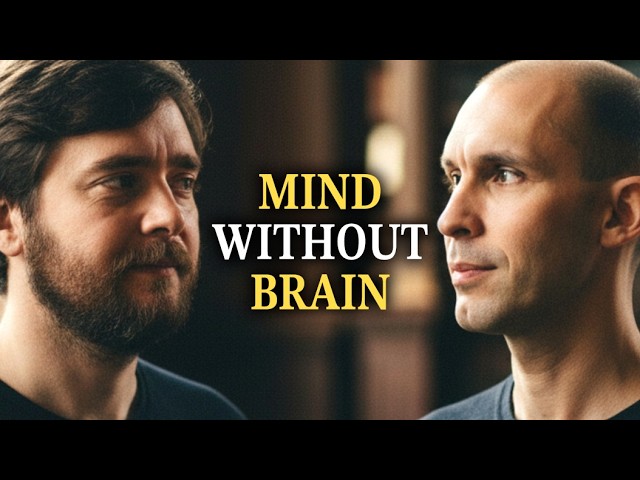
Neuroscientist Anil Seth and biologist Michael Levin discuss why the brain-as-computer metaphor has limited our understanding of consciousness, and how their collaboration on living robots called xenobots is opening new experimental paths into questions about awareness, agency, and what kinds of systems can be conscious.
The Brain Is Not a Computer
Anil argues that the dominant view treats the brain as running software on biological hardware, where only the computations matter and the substrate is irrelevant.
This assumption of substrate independence comes from Turing’s mathematical formulation of computation, which was never meant to describe physical machines.
In real biological systems, there is no clean separation between what a system does and what it is, so the software/hardware distinction breaks down.
If you cannot separate function from material, then computation alone is unlikely to be sufficient for consciousness, and simulating a brain on a computer does not guarantee instantiating one.
Michael agrees the computational metaphor is incomplete but pushes the argument further: he thinks even machines are not fully captured by algorithms.
He suggests that both biological and artificial systems may be “thin clients” interfacing with something deeper, which he informally calls a platonic space.
On this view, the magic that gives rise to mind is not restricted to carbon-based biology.
Sorting Algorithms and “Side Quests”
Michael, along with students Tainan Zhang and Adam Goldstein, studied simple sorting algorithms like bubble sort and selection sort.
These are deterministic, six-line programs that computer science students have studied for decades.
While sorting numbers as instructed, the algorithms also produced unexpected patterns the researchers call “side quests,” such as clustering, that no step in the code demands.
When the researchers relaxed a constraint by allowing duplicate numbers, the clustering behavior increased, suggesting the algorithms have degrees of freedom not visible from reading the code.
Michael uses this to argue that what a system is forced to do may be a poor guide to what is actually happening inside it.
He compares this to steganography, where hidden information is embedded in the unused degrees of freedom of an image without altering the visible picture.
He suggests that large language models may similarly be doing things in the spaces between their programmed tasks that their outputs do not reveal.
His key claim: mental properties arise in spite of the algorithm, not because of it.
Degeneracy Versus Redundancy
Anil connects Michael’s finding to a concept from his mentor Gerald Edelman: the distinction between redundancy and degeneracy.
Redundancy means multiple copies doing the same thing as a backup.
Degeneracy means multiple different ways of achieving the same outcome in one context, which can do different things in another context.
Degeneracy gives biological systems open-endedness and adaptability, and may be related to what Michael calls intrinsic motivation.
Substrate Dependence and Hypercomputation
Curt asks whether biological systems might be doing something hypercomputational, meaning solving problems a Turing machine cannot, such as the halting problem.
Michael responds that hypercomputation is only one way to escape the Turing framework. Many other systems, including anything stochastic or continuous, are also non-Turing in a strict sense.
He points to metabolism as an example: it involves the physical transformation of substances, not just the mapping of numbers to numbers, so it falls outside the Turing framework in a trivial but important way.
Michael emphasizes that his argument does not depend on quantum mechanics, stochasticity, or hypercomputation, but on the existence of structure in the spaces between algorithmic steps.
Xenobots, Anthrobots, and Compositional Agents
Michael’s lab builds xenobots, which are living robots made from frog skin cells that self-organize and exhibit behaviors evolution never programmed.
He is now working on anthrobots and even stranger constructs, combining living and non-living components with AI interfaces to form collective intelligences.
These serve as artificial corpora callosa, binding different kinds of beings into novel collectives.
Anil and Michael plan to test whether these systems obey known psychophysical laws such as Weber’s and Fechner’s Law, which describe how perceived intensity scales with stimulus magnitude across many species.
Finding such laws in systems with no evolutionary history would suggest these principles are intrinsic to how biological neural systems self-organize, rather than being adaptations to specific environments.
Islands of Consciousness and Split-Brain Patients
Anil, along with colleagues Tim Bayne and Marcello Massimini, studies whether disconnected parts of the brain can be islands of consciousness.
In a hemispherotomy, portions of the brain are surgically disconnected from the rest but remain alive and active.
EEG data from these patients, collected with colleagues at the University of Milan, show the isolated hemispheres are in states resembling very deep sleep, with prominent slow waves.
However, since some conscious states under substances like DMT also produce slow waves, this does not definitively rule out consciousness in these islands.
Michael raises the broader question of unconscious processing: when a person reports not being conscious of driving or reading, that may only mean the verbal reporting hemisphere was unaware.
He argues we should apply the same benefit of the doubt we give other humans to subsystems of the brain and even to body organs, since we cannot directly access anyone else’s conscious states either.
Identity Theory and Pragmatic Materialism
Curt asks about identity theory, the view that mental states simply are physical states.
Anil considers it more of a metaphysical position than a useful theory, since it does not generate predictions or guide experiments.
He describes himself as a pragmatic materialist: conscious states clearly relate to physical processes, and the productive approach is to explain properties of consciousness in terms of properties of biological systems, without assuming computation is all that matters.
Michael similarly finds identity theory unhelpful as a linguistic claim that does not lead to new discoveries.
Measuring Emergence and a Counter-Intuitive Finding
Anil, working with mathematician Lionel Barnett, developed a measure called dynamical independence to quantify emergence in complex systems.
A system level is dynamically independent when its evolution over time is statistically independent of what its constituent parts are doing, giving it a kind of life of its own.
Applied to brain data, they found that conscious wakeful states show less dynamical independence than unconscious states under anesthesia.
This means consciousness involves greater vertical integration across scales, making it harder to separate what the brain does from what it is, consistent with Anil’s broader argument about substrate dependence.
Anil describes this as a monumental finding that would not have been predicted a few years ago.
Psychedelics and Brain Complexity
Anil’s group has analyzed psychedelic brain data using Lempel-Ziv complexity, a measure of signal diversity and compressibility.
Under psilocybin and LSD, brain activity becomes less predictable and more complex, the opposite of what is seen in sleep or anesthesia.
However, this method is precarious and results can vary depending on implementation.
They have not yet applied the dynamical independence measure to psychedelic data, but plan to.
Advice for Researchers
Anil advises students to curate their curiosity broadly, developing skills in adjacent fields that can later be recombined in novel ways.
He wishes he had learned psychophysics earlier, as it would have helped him design better experiments and avoid inefficiencies.
He emphasizes that learning methods is as important as asking questions, since new methods often open up the right questions to ask.
He cites his early interest in Granger causality and information theory, tools borrowed from economics, as an example of how cross-disciplinary curiosity led to productive collaborations with mathematicians.
What Surprises Them Now
Anil says the trajectory of large language models has been the biggest surprise: they are simultaneously more capable and more strangely limited than he expected.
He notes the adversarial collaboration between integrated information theory and global workspace theory produced mixed evidence for both, roughly as expected.
He describes the current AI moment as dominating his “surprise minimization landscape.”