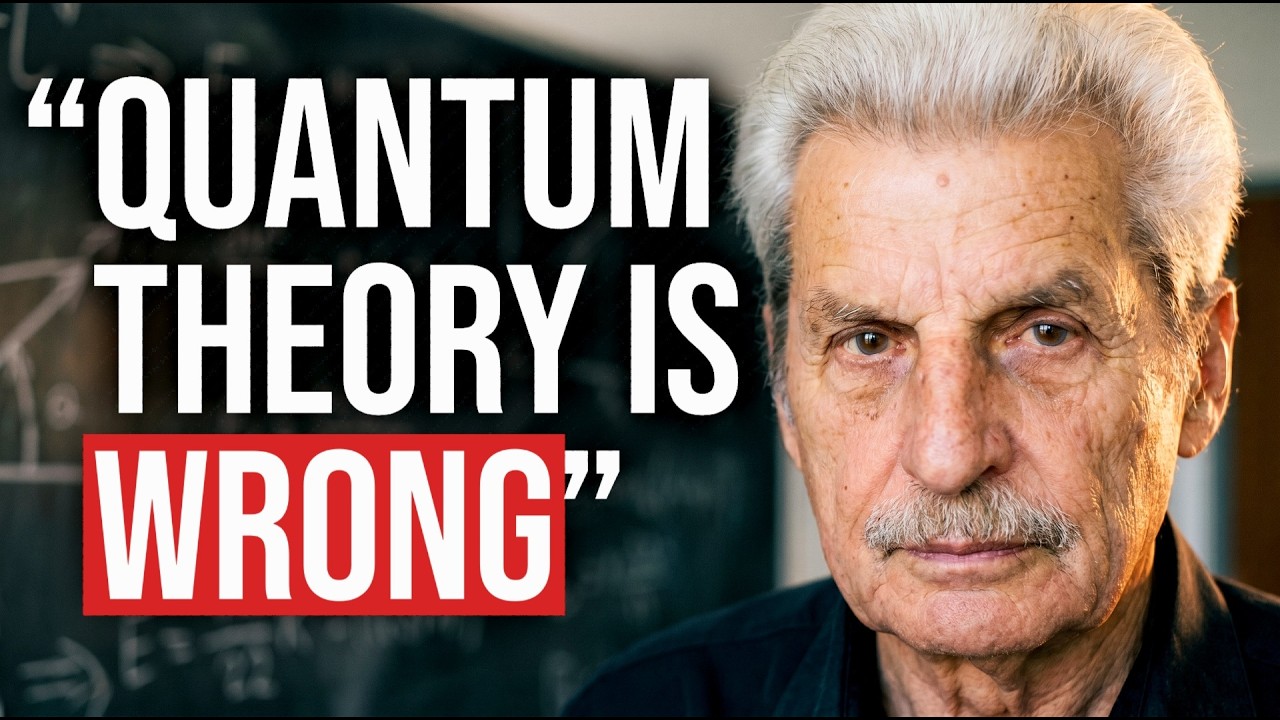
- Yakir Aharonov, co-discoverer of the Aharonov-Bohm effect and pioneer of weak measurement theory, has spent 65 years developing a radical reinterpretation of quantum mechanics. He argues that the standard story — that quantum mechanics is inherently non-deterministic, that measurement necessarily disturbs the system, and that particles are waves — is fundamentally wrong. His alternative framework, the two-state vector formalism (also called ABL theory), describes quantum systems using two wave functions: one propagating forward from the past and another propagating backward from the future. This approach explains weak measurements, reveals new phenomena like the quantum Cheshire Cat, and restores determinism and reality to the quantum domain.
The Standard Interpretation Is Wrong
-
Quantum mechanics is not capriciously non-deterministic. The fact that two identical atoms behave differently (e.g., one decays after a second, another after an hour) does not mean nature is random for no reason. Aharonov argues there is a reason for this indeterminism: it allows quantum systems to have properties that would be impossible in a deterministic world. The apparent randomness arises because we are not seeing the full picture — information from the future boundary condition is also shaping the present.
-
Measurement does not necessarily disturb the system. The standard claim that every quantum measurement irrevocably disturbs the system is false. Aharonov discovered weak measurements — observations so gentle they extract information without collapsing the wave function. By performing weak measurements on an ensemble of identically prepared systems, one can learn about quantum reality without destroying it. This means there is a definite reality in the quantum domain; we simply have to use the right tools to see it.
-
Particles are not waves. The standard wave picture is logically incoherent: if the electron’s charge and mass were truly spread out as a wave, collapsing to a point upon detection would produce enormous radiation, which is never observed. Furthermore, the wave explanation for double-slit interference is unnecessary. Aharonov showed that interference can be explained through non-local equations of motion in the Heisenberg picture, without invoking a physical wave. He demonstrated that you can observe interference via weak measurements and still determine through which slit the particle went — something the wave picture says should be impossible.
The Two-State Vector Formalism (ABL Theory)
-
In classical physics, knowing the initial conditions in the past is sufficient to fully describe the present. In quantum mechanics, Aharonov argues, you need two boundary conditions: one from the past and one from the future. A measurement in the past produces a wave function that propagates forward. A later measurement (post-selection) produces a second wave function that propagates backward from the future. Both are needed to fully describe what happens in the present — but only if you use weak measurements to observe them without disturbance.
-
This is the two-state vector formalism, developed by Aharonov, Albert, and Vaidman (ABL) in the early 1960s. It reformulates quantum mechanics so that the present is shaped by both past and future boundary conditions. The future provides genuinely new information that is not redundant with the past — something impossible classically but allowed quantum mechanically due to uncertainty.
Heisenberg Was Right
-
Aharonov met Heisenberg in 1964 at the Max Planck Institute in Munich and asked him how to explain interference using his matrix mechanics framework (position and momentum with non-commutative dynamics). Heisenberg said he did not know. Aharonov showed him his approach: the Heisenberg equations of motion are non-local. Even though a particle moves through one slit, another variable governed by non-local equations “knows” whether the other slit is open. This non-locality is shielded by uncertainty — if you know which slit the particle went through, the non-local variable becomes completely uncertain, preserving causality.
-
Heisenberg was so excited that he began showing every visitor Aharonov’s explanation at the blackboard. Aharonov sees himself as vindicating Heisenberg’s original matrix mechanics approach, which was overshadowed by Schrödinger’s wave equation. To Aharonov, the Schrödinger wave is merely a mathematical tool for solving Heisenberg’s equations — useful but not physically real. What is real are the observables (functions of position and momentum), and the wave is only an average property over many particles, not a feature of any individual particle.
The Aharonov-Bohm Effect
-
The Aharonov-Bohm (AB) effect, discovered in the late 1950s during Aharonov’s PhD with David Bohm at Bristol, shows that an electron can be affected by electromagnetic potentials even in regions where the electric and magnetic fields are zero. An electron passing around a region with magnetic flux (e.g., inside a solenoid) acquires a measurable phase shift despite never encountering the magnetic field directly. This demonstrated that potentials are physically real in quantum mechanics, not just mathematical conveniences.
-
The effect was initially met with skepticism — Niels Bohr himself doubted it was real, though he was later convinced by his son. The experiment was first performed by Chambers using a magnetic whisker (a thin magnetic flux line), after a suggestion by Sir Frank at an Oxford tea meeting. The AB effect was the first indication to Aharonov that quantum mechanics is fundamentally non-local.
-
Aharonov also developed gravitational and non-Abelian (Yang-Mills) generalizations of the AB effect with his first PhD student. C.N. Yang initially called it the “Bharonov-Bohm effect” (reversing the order), assuming Bohm had originated the idea since he was Aharonov’s advisor. After Bohm wrote a letter confirming the idea was Aharonov’s, Yang corrected the name.
Gauge Theory and Non-Locality
-
All fundamental interactions (electromagnetic, strong, weak, gravitational) are described by potentials, which have gauge freedom — they can be changed without altering the forces. Potentials are necessary for the Hamiltonian/Lagrangian formulation of physics. However, the AB effect shows that the local formulation using potentials is misleading: a gauge transformation can remove the potential from the region where the particle moves, yet the particle still feels the force. This means the physics is inherently non-local, even though the equations look local.
-
Aharonov’s view: neither the wave function nor the potentials are ontologically real. The only things truly observable are forces and observables built from position and momentum. The wave function is a mathematical aid, like a potential — useful for calculation but not a description of what exists.
The Quantum Cheshire Cat
-
One of the most striking phenomena Aharonov discovered using pre- and post-selection is the quantum Cheshire Cat, inspired by Lewis Carroll’s Alice in Wonderland, where the cat disappears leaving only its smile. In the quantum version, a neutron’s spin can physically separate from the neutron itself and travel along a different path, then rejoin the neutron later. This seems impossible — the spin was thought to be an inseparable property of the particle — but weak measurements on pre- and post-selected ensembles confirm it.
-
This is part of a broader set of new phenomena Aharonov uncovered: superoscillations, quantum walks, and quantum counter-particles (pairs consisting of an electron accompanied by a particle with negative mass and opposite charge, visible only through weak measurements).
Historical Context: Bohm, McCarthy, and the Path to Discovery
-
Aharonov studied at the Technion in Haifa under Nathan Rosen (of Einstein-Podolsky-Rosen fame). When he wanted to write his final thesis on quantum measurement theory, Rosen refused, calling it a waste of time. Aharonov then turned to David Bohm, who had just arrived at the Technion after being forced out of the United States during the McCarthy era — Princeton denied him tenure when he was called to testify, and he subsequently lost his citizenship after refusing to testify at Oppenheimer’s trial. Bohm took Aharonov on as a student, and they moved to Bristol, where the AB effect was discovered.
-
Aharonov describes Bohm as extremely brilliant — Einstein saw him as a true follower, and Feynman reportedly said Bohm was the only person he met who was smarter than himself. However, Bohm’s traumatic experience at Princeton led him to become increasingly philosophical in his later work. Feynman, upon receiving the AB effect paper, sent a cable saying, “How beautiful! I have not thought about it myself.”
-
After his PhD, Aharonov spent a year at Brandeis University and then became an assistant professor at Yeshiva University in New York, where the physics department included Lebowitz and visiting professor Peter Bergmann (Einstein’s former assistant). It was there that he developed the two-state vector formalism, collaborating with Albert and Vaidman to produce the ABL paper around 1961–1962.