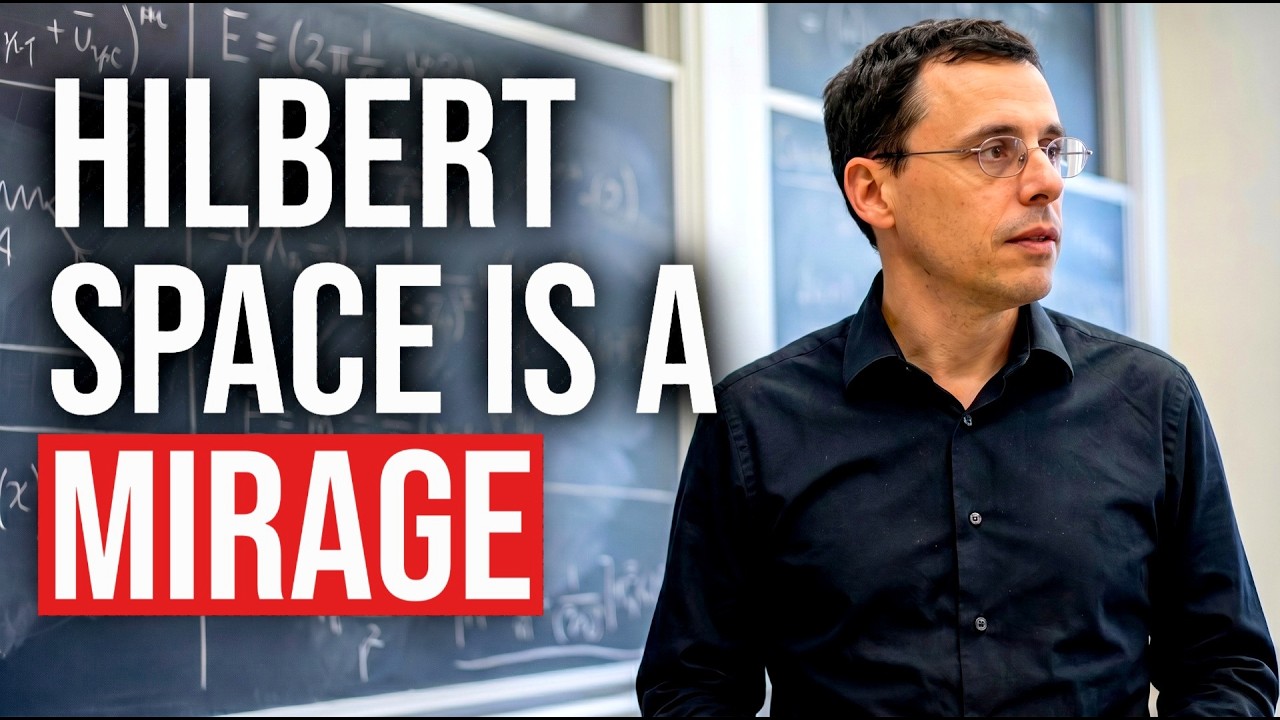
Jacob Barandes, a theoretical physicist and philosopher at Harvard, argues that modern physics has become deeply broken by abandoning philosophy, and he presents his own reformulation of quantum theory—called Indivisible Stochastic Processes—as a way to resolve foundational inconsistencies in textbook quantum mechanics. The conversation spans the philosophy of physics, the historical role of philosophy in scientific revolutions, and the technical details of Barandes’ framework, which eliminates wave functions, superpositions, and collapse by grounding quantum phenomena in classical probability theory applied to systems with fundamentally non-Markovian dynamics.
Physical Philosophy vs. Philosophical Physics
Physical philosophy uses results from physics to address traditional metaphysical questions about time, causation, probability, and laws of nature.
For example, special relativity challenges the notion of a universal “present” because observers in different frames of motion disagree on which events are simultaneous—this undermines the idea of an objective flow of time and supports eternalism (the “block universe”).
Philosopher Hilary Putnam argued in the 1960s that if all observers’ “nows” are equally valid, then all of spacetime must exist eternally—past, present, and future alike.
Philosophical physics applies philosophical tools—thought experiments, conceptual analysis, identifying hidden assumptions, logical rigor—to make progress on open problems in physics.
Einstein exemplified this: his scrutiny of inertial frames and the equivalence principle led directly to general relativity.
Barandes sees himself continuing this tradition, using philosophical methods to re-examine quantum foundations.
Philosophy’s Historical Contributions to Physics
Critics like Neil deGrasse Tyson claim philosophy has contributed nothing to physics in decades, but Barandes counters with multiple examples:
The no-cloning theorem (1982), essential to quantum information, was formulated independently by philosophers Dennis Deeks and physicists Zurich and Wooters.
The term qubit was coined in 1992 by Ben Schumacher and Bill Wooters during a car ride, inspired by a biblical unit of measure—showing how playful, foundational thinking shaped quantum information.
Entanglement originated in the 1935 Einstein-Podolsky-Rosen (EPR) paper, which was a philosophical argument about completeness, not just a technical result.
Decoherence, now central to quantum computing and cosmology, was first rigorously developed by David Bohm in his 1951 textbook while analyzing measurement—before he created his pilot wave theory.
Bohm showed that interaction with a measuring device destroys interference terms—a process later rediscovered and expanded by Dieter Zeh in the 1970s.
Despite its importance, foundational work like Bohm’s was marginalized; he was effectively exiled from the U.S. during the McCarthy era.
Barandes argues that funding and supporting philosophy of physics would yield high returns, as the field has produced major insights with very few researchers and minimal resources.
Inconsistencies in Textbook Quantum Mechanics
The standard Dirac-von Neumann axioms of quantum mechanics work well for microscopic systems but become ambiguous or inconsistent when applied to macroscopic observers.
The Wigner’s Friend thought experiment exposes this: if Wigner’s friend inside a sealed box measures a quantum system, does the wave function collapse for the friend but not for Wigner outside? The theory gives no clear answer—it’s ambiguous, not just counterintuitive.
This is not merely eccentricity (like Newtonian inertia or relativistic time dilation); it’s a singularity in the theory—a breakdown analogous to infinite self-energy in electromagnetism.
Moreover, textbook quantum mechanics only predicts measurement outcomes—not the vast array of phenomena (e.g., bird foraging, galaxy formation) that occur without human observation.
Either these phenomena are secretly measurements (an unfounded claim), or the theory is incomplete.
Decoherence does not solve the measurement problem: it explains why interference vanishes, but it cannot single out one outcome from the diagonal density matrix—it still requires the Born rule and collapse postulate by hand.
Indivisible Stochastic Processes: A New Foundation
Barandes’ framework replaces Hilbert spaces, wave functions, and operators with classical probability theory applied to systems whose dynamics are non-Markovian in a specific, irreducible way.
Every system has an actual configuration (e.g., particle positions, field values) drawn from a configuration space.
The laws are given by conditional probabilities for transitioning between configurations, but these probabilities cannot be divided into intermediate steps—they are “indivisible” in time.
In a double-slit experiment, you cannot restart the evolution at the slits; the entire path from source to screen is governed by a single indivisible law.
This approach restores ordinary probability theory to quantum mechanics, eliminating complex numbers, Hilbert spaces, and superpositions as fundamental entities.
Quantum features like interference, superposition, and unitarity emerge as mathematical artifacts when you force a non-Markovian stochastic process into a Markovian (memoryless) formalism—similar to how Hamiltonian mechanics emerges from Newtonian mechanics by doubling the state space (position + momentum).
Beables vs. Emergibles
Inspired by John Bell’s concept of beables (things that “be” rather than are observed), Barandes distinguishes:
Beables: Observable quantities that reflect pre-existing properties of the system (e.g., particle positions in Bohmian mechanics).
Emergibles: Quantities that appear real when measured but are actually emergent patterns arising from the interaction between system and measuring device.
In this view, some measurements reveal what was already there; others create the outcome through the measurement interaction.
This resolves the Kochen-Specker paradox (which shows not all observables can have preexisting values) without requiring all outcomes to be created anew.
It also explains basis dependence: the configuration basis is special (it defines the beables), but other bases can still be measured—they just correspond to emergibles.
Interference Without Waves
In the double-slit experiment under this model:
The particle always has a definite location—there is no superposition and no wave function.
Interference arises because the indivisible conditional probabilities do not factor through the slits—you cannot compute the outcome by assuming the particle went through one slit or the other.
If you place a detector at the slits, you marginalize over its states (a classical probability operation), which restores divisibility—and destroys interference.
This is the stochastic analog of decoherence, but without any wave function to collapse.
Thus, the measurement problem never arises: there is nothing to collapse, and outcomes are always definite.
Symmetry Breaking and Time
Barandes clarifies the difference between explicit and spontaneous symmetry breaking:
Explicit breaking: the laws themselves lack the symmetry (e.g., gravity pointing “down” on an infinite flat Earth).
Spontaneous breaking: the laws are symmetric, but the particular solution (or physical instantiation) is not (e.g., Earth’s presence breaks rotational symmetry locally).
His theory is fundamentally time-reversal invariant, but individual models spontaneously break time symmetry—just as a pencil balanced on its tip must fall in one direction despite symmetric laws.
This avoids privileging past or future at the fundamental level, while explaining the arrow of time in practice.
The Role of Philosophy in Scientific Progress
Barandes emphasizes that the greatest revolutions in physics—relativity and quantum theory—were driven by thinkers deeply engaged with philosophy:
Einstein read Kant at 16, ran a philosophy reading club, and credited epistemology with fostering independent thought.
Heisenberg, Bohr, Schrödinger, and others were steeped in Kantian and neo-Kantian philosophy.
Greta Hermann, a philosopher and student of Emmy Noether, published a thought experiment in 1935 that likely influenced the EPR paper.
Today, many physicists dismiss philosophy, yet rely on unexamined metaphysical assumptions (e.g., “particles don’t have properties before measurement”).
Barandes advocates for training physicists in philosophy to cultivate precision of thought, independence from slogans, and rigorous scrutiny of interpretive claims.
He warns against conflating calculational methods (e.g., solving the Schrödinger equation) with ontological conclusions (e.g., “the wave function is real”).
Critique of Textbook Narratives
Barandes criticizes influential textbooks (e.g., David Griffiths’ Quantum Mechanics) for presenting contested interpretations as settled fact.
Griffiths claims Bell’s theorem eliminated realism and confirmed the “orthodox” view—but this ignores viable alternatives like Bohmian mechanics and spontaneous collapse theories.
Such narratives discourage students from exploring foundational questions and perpetuate groupthink.
He urges learners to separate methodology (how to calculate) from metaphysics (what exists), and to maintain healthy skepticism toward authoritative pronouncements.
Preview of Part Two
The next episode will cover:
How indivisible stochastic processes handle Bell’s theorem and entanglement without non-locality or collapse.
The status of wave-particle duality and whether waves are real or calculational tools.
Challenges in extending the framework to quantum field theory and gravity.
Barandes’ critique of the many-worlds interpretation.
The philosophy of probability and the origin of statistical mechanics.
Whether gravity is quantum and prospects for a stochastic theory of general relativity.