For over 2,000 years, mathematicians treated infinity as only a process that never completes — you can always add one more, but you never arrive at a finished collection. Then Georg Cantor broke with this tradition by treating infinite collections as completed objects you can manipulate directly, and proved there are different sizes of infinity, launching a debate that continues today.
Potential vs. Actual Infinity
Potential infinity is a process without end: counting 1, 2, 3, 4… you never stop and never claim to have a complete collection. Aristotle and Gauss both held this view.
Actual infinity treats the entire infinite collection as a single finished object — you can examine its properties, compare it to other collections, and ask questions about its size. Cantor insisted on this, and it was considered heretical.
Cardinality: How Mathematicians Compare Sizes of Sets
Two sets have the same size (cardinality) if you can pair their elements exactly one-to-one with nothing left over — mathematicians call this a bijection.
Cantor showed that the even numbers, the integers, and even the rational numbers all have the same cardinality as the natural numbers — despite the rationals being densely packed on the number line. These are all countably infinite sets.
Cantor replaced the ambiguous ∞ symbol with aleph-null (ℵ₀) to denote this specific cardinality, precisely because not all infinities turn out to be the same size.
A defining property of infinity: if you add or remove a finite number from an infinite set, its size doesn’t change. This is the episode’s favorite definition in all of mathematics.
The Real Numbers Are Uncountable
Cantor proved the real numbers cannot be paired with the natural numbers using a diagonalization argument: assume you’ve listed all reals, then construct a new number that differs from each entry on the diagonal — contradicting the assumption that your list was complete.
The cardinality of the reals is written as 2^(ℵ₀) because each real number can be thought of as an infinite binary sequence, and at each position you have 2 choices (0 or 1), giving 2 × 2 × 2… = 2^(ℵ₀).
The base doesn’t matter — 3^(ℵ₀), 7^(ℵ₀), and even ℵ₀^(ℵ₀) all give the same cardinality as the reals.
Disturbingly, the real line has exactly as many points as the complex plane, and ℝ² and even ℝ^(100) have the same cardinality as ℝ. Cantor himself wrote to Dedekind: “I see it, but I don’t believe it.”
Two Machines for Manufacturing Larger Infinities
Machine 1 — Power set construction: Take all possible subsets of a set. The power set of a set with cardinality ℵ₀ has cardinality 2^(ℵ₀). This is the mechanism behind the jump from naturals to reals.
Machine 2 — Hartogs’ construction: Define the next larger infinity after ℵ₀ as ℵ₁, then ℵ₂, and so on. This produces discrete, well-defined larger infinities through a completely different mechanism.
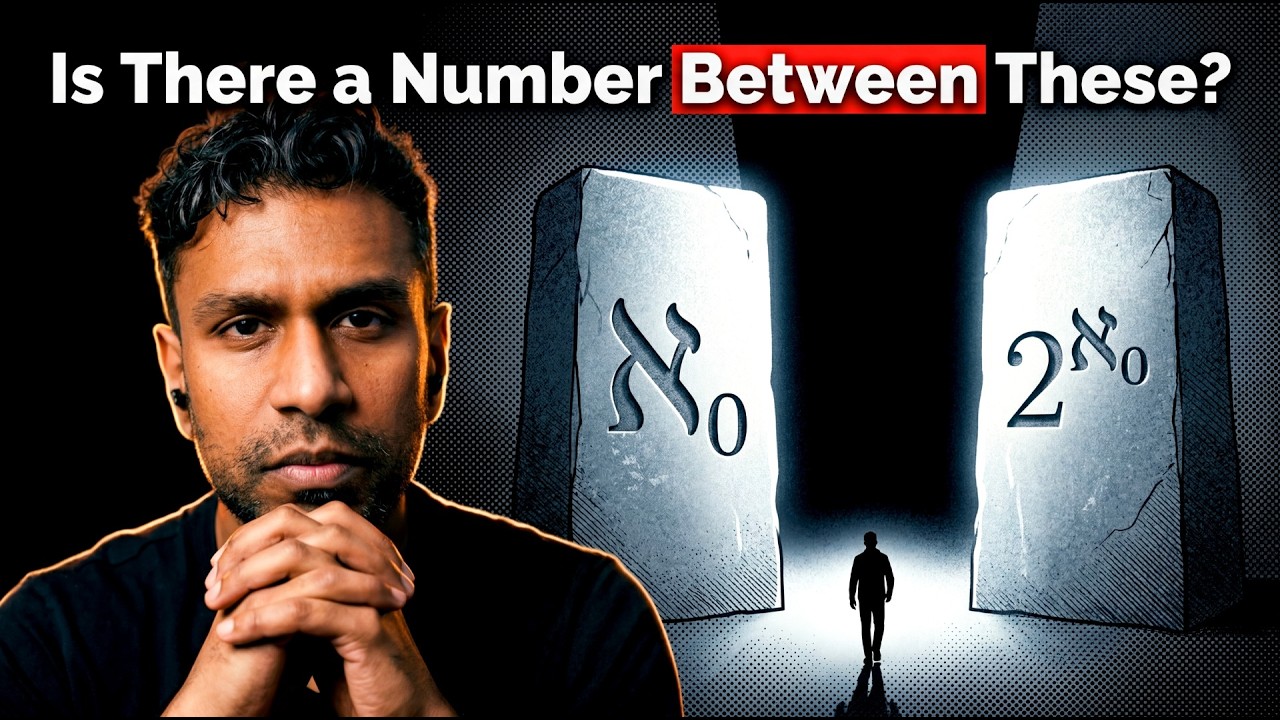
The Continuum Hypothesis asks whether these two machines produce the same result at their first step: is 2^(ℵ₀) = ℵ₁? In other words, is there any infinity strictly between the cardinality of the natural numbers and the cardinality of the reals?
The Continuum Hypothesis Is Independent of Standard Mathematics
The continuum hypothesis was the first of Hilbert’s famous 23 problems in 1900.
Gödel showed in the 1940s that you cannot disprove the continuum hypothesis from the standard axioms of set theory (ZFC).
Paul Cohen showed in 1963 that you cannot prove it either, using a technique called forcing.
This means the continuum hypothesis is independent of ZFC — it can neither be proved nor disproved from the standard axioms. This was a shocking result: there exist meaningful mathematical statements that are undecidable within the standard framework.
Finitists and Ultrafinitists Reject Infinity Entirely
Finitists reject actual infinity. To them, ℵ₀ is at best a useful fiction, at worst a symbol pointing to nothing. Hilbert flirted with this position.
Ultrafinitists go further: even extremely large finite numbers like 157^(157^157) are suspect because no physical process could ever instantiate them. To an ultrafinitist, asking about 2^(ℵ₀) is like asking “what’s the orange about jumping?” — grammatically correct but meaningless.
The episode notes that these positions are philosophically coherent and force a deep question: what does it mean for a mathematical object to “exist”?
Why Infinity Matters Despite the Controversy
Most working mathematicians find infinity indispensable. Hugh Woodin, one of the most important living set theorists, argues the continuum hypothesis does have a definite answer — ZFC is simply too weak to detect it, and stronger axioms (large cardinal axioms, his “ultimate L” program) are needed.
Infinity is where the abstract and the concrete meet: the objects are infinite, but every argument about them is finite, specific, and checkable. Cantor’s diagonal argument fits on a napkin; Hartogs’ construction is an explicit step-by-step recipe.
Infinity even resolves elementary puzzles: in projective geometry (used by Roger Penrose for twistor theory), dividing by zero becomes well-defined by adding a point at infinity to the complex numbers.
The fact that mathematicians can disagree not about whether a proof is valid but about whether the objects in question even exist reveals something unsettling about the foundations on which the rest of mathematics is built.