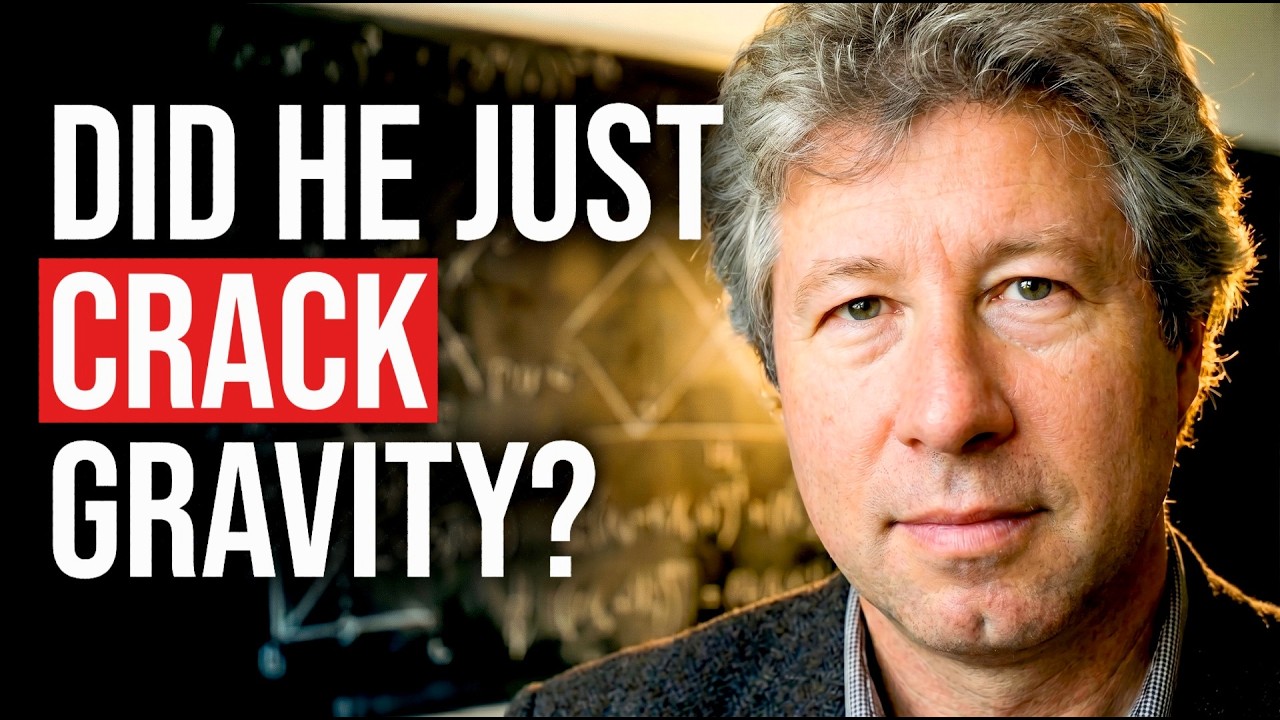
Erik Verlinde is a leading theoretical physicist who argues that gravity is not a fundamental force but a thermodynamic, emergent phenomenon arising from quantum information and entanglement. His work suggests that spacetime itself is not fundamental but emerges from more basic informational building blocks, and that this framework can explain dark matter and dark energy without invoking new particles or free parameters.
No Final Theory of Physics
Verlinde does not believe humans will ever discover a final, complete set of fundamental laws. He sees every physical theory as a condensation of a far more complicated underlying reality, much like thermodynamics was a useful description before atoms were understood.
He views the search for a “theory of everything” as hubris, arguing that there are always deeper layers of description beneath any set of equations we write down.
He does not even assume that the fundamental description takes the form of equations at all; the language of nature may be something humans cannot access or express.
He uses the metaphor of “turtles all the way down”: each layer of explanation rests on a deeper one, and there is no reason to believe we will ever reach the bottom.
What “Microscopic” Means in Modern Physics
In Verlinde’s framework, “microscopic” does not mean smaller spatial scales. It refers to a more fundamental description from which space and time themselves are absent at the outset and must be derived.
He points to examples like the AdS/CFT correspondence, where a microscopic theory living on a boundary gives rise to an emergent bulk spacetime, but he considers this still too dependent on assuming a pre-existing boundary geometry.
The goal is a description in terms of abstract quantum information (qubits, bits) that does not assume any spatial or temporal structure at all.
Entropy, Information, and the Origin of Forces
Verlinde’s key insight is that entropy, understood as a measure of “known unknowns” (things we know we don’t know, quantifiably), can give rise to forces.
In a room full of gas molecules, we don’t track every molecule’s position and velocity; we describe the system with temperature and pressure. The entropy counts how much microscopic information we’ve ignored. The tendency of entropy to increase manifests as pressure.
He extends this reasoning to spacetime: our geometric description of spacetime is a condensation of vast amounts of underlying quantum information that we have coarse-grained over. Gravity arises from the thermodynamics of that ignored information.
He emphasizes that information in this context is abstract, like data stored as zeros and ones in a computer, not necessarily “about” anything in particular.
Entanglement as the Fabric of Spacetime
The connectivity of space, why the left side of a room “knows” it is connected to the right side, is explained by quantum entanglement.
When you divide a region of space into two parts, the amount of entanglement between them scales with the area of the surface separating them, not the volume. This is the Ryu-Takayanagi formula and related results.
Cutting space breaks entanglement, just as cutting a glass breaks molecular bonds. Spacetime connectivity is entanglement connectivity.
This idea was presaged in an email exchange between Verlinde and his twin brother Herman before the slogan “ER = EPR” (connecting wormholes to entanglement) was popularized by Susskind and Maldacena, though Verlinde credits Mark Van Raamsdonk with the original insight.
Verlinde’s Entropic Gravity vs. Ted Jacobson’s Result
In 1995, Ted Jacobson showed that Einstein’s field equations can be derived from thermodynamics (relating entropy to horizon area), but he assumed spacetime and its geometry from the start.
Verlinde’s 2010 paper went further: he derived not just Einstein’s equations but Newton’s law of inertia (F=ma) from entropic reasoning, without assuming spacetime existed. This is a more fundamental result because inertia and the meaning of mass must be explained before gravitational dynamics.
Verlinde sees Jacobson’s result as contained within his own framework but circular in its assumptions, since it presupposes the very geometry it claims to derive.
Dark Matter and Dark Energy from Emergent Gravity
Verlinde’s framework naturally produces effects that look like dark matter and dark energy without requiring new particles or free parameters.
He derives Milgrom’s acceleration scale (a₀ = cH/6), the critical acceleration below which galaxy rotation curves deviate from Newtonian predictions, from the entropy associated with the cosmological horizon. This is the same horizon set by the Hubble constant and dark energy.
He argues that the particle dark matter community has not honestly explained why Milgrom’s empirical law works so well; they build models that reproduce it without explaining it.
He views the cosmological constant problem as a red herring that arises from assuming only a UV cutoff scale matters, ignoring the influence of large-scale (cosmological) physics on small-scale descriptions.
The Role of Computational Complexity
Beyond entanglement, Verlinde and others in the field increasingly invoke computational complexity as a key concept.
Complexity measures how many computational steps are needed to extract information or perform a task. Information may be present in a system but so complex as to be practically inaccessible.
Black hole interiors may hide information not because it is lost but because decoding it would require an astronomically complex computation.
Complexity may be more important than entanglement alone for describing universes like ours (with dark energy, i.e., de Sitter-like), as opposed to the anti-de Sitter spaces most studied in AdS/CFT.
The Emergence of Time
Time, like space, is emergent. It arises from entanglement and the structure of quantum information accessible to an observer.
An observer can only access part of the quantum information in a system; the rest is traced over, producing a density matrix. The “modular Hamiltonian” associated with this density matrix defines a notion of time flow.
This means time can be defined without assuming it exists from the beginning; it emerges from the way quantum information is partitioned between what an observer can and cannot access.
Observer Dependence and the Nature of Coarse-Graining
Entropy in Verlinde’s framework is observer-dependent in the sense that it depends on what is in principle accessible to measurement, not on arbitrary choices.
The relevant partition is set by horizons (black hole horizons, cosmological horizons), which define the boundary between what can and cannot be observed even in principle.
This is not arbitrary coarse-graining; it is a principled division based on causal structure.
Gravity as Statistical, Not Fluctuating into Repulsion
Verlinde sees gravity’s attraction as a robust statistical effect, not something that would reverse or vanish under close inspection.
However, deviations from classical gravitational predictions become noticeable when gravitational acceleration is very weak, which is precisely where Milgrom’s law applies. These are not fluctuations into repulsion but systematic corrections from the underlying quantum information dynamics.
On the Origin of the Universe
When asked where the universe comes from, Verlinde’s answer is “quantum chaos.”
He views the Big Bang and inflation as approximate descriptions, not the full story. The true origin lies in a chaotic microscopic quantum description from which everything emerges.
He draws an analogy to the history of particle physics: the proliferation of hadrons in the 1950s looked like garbage until the quark model revealed underlying simplicity. He expects similar patterns of chaos-to-beauty at deeper levels.
Research Philosophy and Intuition
Verlinde follows his own intuition about the right direction, a trait he developed early and shares with his twin brother Herman, also a physicist.
He was influenced by Gerard ‘t Hooft, who encouraged him as a young researcher to follow his own path rather than defer to authority.
He keeps an eye on the broader field but selects problems based on a personal sense of what is important and what he is good at, aiming to contribute to the “next turtle” rather than claiming to find the final one.
He finds the current moment exciting because the program of deriving spacetime and gravity from quantum information is making contact with observational puzzles like dark matter, offering the first real hope of empirical tests for quantum gravity ideas.