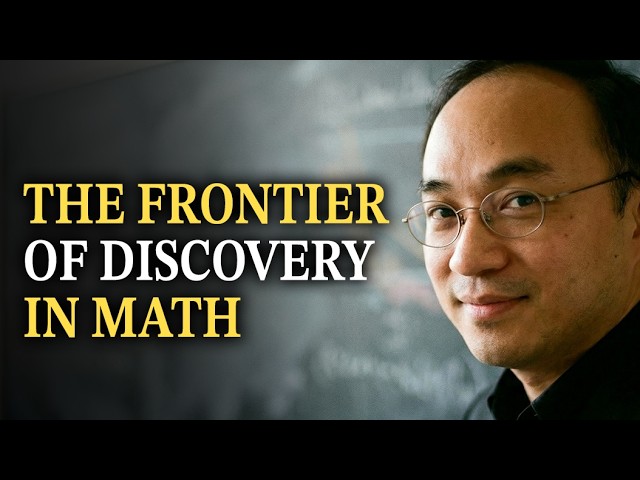
Yang-Hui He, a mathematical physicist whose work sits at the interface of algebraic geometry and string theory, explains how AI and machine learning are transforming mathematical discovery — not just as computational tools, but as pattern-recognition engines capable of generating new conjectures and insights that humans had not previously conceived. He frames mathematics in three modes: bottom-up (axiomatic, formal proof), top-down (intuitive, creative pattern recognition across fields), and meta (pure symbol manipulation without understanding), and argues that AI is most powerful in the top-down mode, where it can detect hidden structures in vast mathematical datasets. His own entry into AI came through a surprising route: a massive database of Calabi-Yau manifolds from string theory, which he realized could be treated as an image-processing problem, leading to a neural network that predicted topological invariants with striking accuracy. This opened a broader research program into what he calls the “Birch Test” — a standard for AI in mathematics that goes beyond the Turing Test, asking not whether a machine can imitate human conversation, but whether it can produce genuinely new, meaningful mathematical conjectures.
How He Got Into AI Through String Theory and Sleepless Nights
His background is in the mathematics of string theory — specifically algebraic geometry applied to Calabi-Yau manifolds — though he describes himself as “orthogonal” to the core string theory community, more interested in the mathematical structures it generates than in defending it as a physical theory.
He initially connected with Roger Penrose through co-editing a book, Topology in Physics, with C.N. Yang (then 102, the world’s oldest living Nobel laureate), which brought together leading figures across math and physics.
He sees string theory’s greatest achievement not as a physical theory of everything, but as a sustained engine of cross-disciplinary mathematical insight — producing ideas like mirror symmetry and vertex algebras that pure mathematicians find indispensable, even if the physical theory remains experimentally unverified.
In 2017, while bottle-feeding his newborn son during sleepless nights, he began experimenting with machine learning, feeding pixelated representations of Calabi-Yau manifold data into a standard neural network designed for image recognition (MNIST-style).
To his surprise, the network predicted topological invariants of these manifolds with high accuracy, despite having no knowledge of algebraic geometry — suggesting that much of algebraic geometry computation is, at its core, a pattern-recognition task that can be reframed as image processing.
This led him to a broader claim: bottom-up mathematics (formal proof) is essentially language processing, while top-down mathematics (creative conjecture) is essentially image processing — and AI excels at the latter.
The Three Modes of Mathematics and Where AI Fits
Bottom-up mathematics: The formal, axiomatic approach — definitions, lemmas, theorems, proofs — exemplified by Russell and Whitehead’s Principia Mathematica and modern automated theorem provers like Coq and Lean. Gödel’s incompleteness theorems showed the limits of full axiomatization, but in practice mathematicians work around this. AI tools like Lean act as “proof copilots,” verifying and sometimes helping construct formal proofs; Fields Medalists Gowers, Manners, and Tao have used Lean in recent work.
Top-down mathematics: The intuitive, creative mode — a practitioner looks across subfields, spots patterns, and makes conjectures before rigorous methods exist to prove them. Gauss conjectured the prime number theorem (that the number of primes less than x is approximately x/log x) at age 16, fifty years before complex analysis was invented to prove it. Birch and Swinnerton-Dyer conjectured their famous conjecture about elliptic curves in the 1960s by plotting data on a computer and noticing a pattern — a process He calls “computer-aided conjecture.”
Meta-mathematics: Pure symbol manipulation without understanding — the Chinese Room scenario. He associates this with how most undergraduates (and, he suggests, most humans) actually operate: pattern-matching and rule-following without deep comprehension. This is also where large language models for math operate, and it explains why GPT-3 could solve routine calculus problems (lots of training data, clear procedures) but failed on basic tasks like computing the 17th digit of 22/29 (which requires actual long division, not pattern matching).
He notes that LLMs have improved dramatically: DeepMind’s AlphaGeometry2 went from 53% to 84% on IMO-level geometry problems within a year, and OpenAI’s o3 reportedly reached 25% on Epoch AI’s FrontierMath benchmark (research-level problems) — up from 2% weeks earlier — though truly advanced research mathematics remains largely out of reach.
The Birch Test: From Pattern Recognition to New Mathematics
He proposes the “Birch Test” as a standard for AI in mathematics, named after Brian Birch, who in the 1960s used early computer data to spot a pattern in elliptic curves that became the Birch-Swinnerton-Dyer conjecture (one of the Clay Millennium Prize Problems). The test asks: can AI go beyond crunching numbers to produce genuinely new, human-meaningful mathematical conjectures?
Knot theory (Davies et al., 2021): AI analyzed large datasets of knot invariants and discovered previously unknown relationships between them, leading to new conjectures that mathematicians had not considered — one of the first clear examples of AI passing the Birch Test.
Formula prediction (Lample and Charton, 2019): An AI trained on vast datasets of mathematical formulas could accurately predict the next formula in a sequence, effectively learning the “grammar” of mathematics and suggesting new directions.
Calabi-Yau manifolds and algebraic geometry: He and collaborators showed that neural networks could predict topological invariants of Calabi-Yau manifolds (such as Hodge numbers) with over 99% accuracy by treating the defining polynomial data as pixelated images — bypassing the double-exponential complexity of traditional algebraic geometry computation.
Murmuration and elliptic curves: In work featured by Quanta as a 2024 breakthrough, He and collaborators (Lee, Oliver, and Pashnakov) used AI to analyze a massive dataset of elliptic curves and their associated L-functions. The AI discovered a new, unexpected pattern — a correlation the team named “murmuration” (after the coordinated flocking behavior of starlings) — that provides new evidence for the Birch-Swinnerton-Dyer conjecture and opens new research directions. This did not prove the conjecture but revealed a structural pattern no human had noticed.
The Calabi-Yau Connection: Why String Theory Produced the Right Data
Calabi-Yau manifolds are the six-dimensional shapes that string theory requires to compactify from 10 to 4 spacetime dimensions. They are Ricci-flat Kähler manifolds — the “boundary case” between positively curved (Fano) and negatively curved (general type) varieties in the classification of algebraic manifolds.
The name “Calabi-Yau” was coined in 1985 by physicists Candelas, Horowitz, Strominger, and Witten, after Strominger asked Yau (who had just won the Fields Medal for proving the Calabi conjecture) about the geometric condition their physics required. This was a chance collision of ideas from physics and mathematics that neither field would have produced alone.
By the year 2000, Candelas, Skaka, and Kreutzer had compiled databases of hundreds of millions of Calabi-Yau manifolds (using Pentium-era machines), computing their topological invariants — a feat that took the math community decades and gave He the raw dataset that launched his AI research.
He argues that the string theory community’s willingness to compile and share this data — something pure mathematicians had little incentive to do — is an example of how string theory breaks down silos between disciplines, bringing together algebraic geometry, number theory, quantum information, and now AI.
Implications and Open Questions
He is optimistic rather than fearful about AI in mathematics, seeing it as a tool that will save time, uncover hidden patterns, and act as a genuine collaborator in discovery — not a replacement for human mathematicians.
The deeper philosophical question — whether AI truly “understands” mathematics or is merely performing sophisticated symbol manipulation (the Chinese Room problem) — remains unresolved. He notes that most human mathematical work, especially at the undergraduate level, is itself pattern-matching without deep comprehension, which may explain why LLMs can perform so well on routine mathematical tasks.
He suggests that the future of mathematical proof may shift: traditionally deductive (building from axioms), it may increasingly incorporate inductive, data-driven reasoning where AI generates conjectures that humans then attempt to prove — a hybrid approach that raises questions about rigor and the nature of mathematical understanding.
The “murmuration” discovery in elliptic curve theory illustrates the new paradigm: AI as a digital explorer, mapping mathematical territory and pointing humans toward promising regions they would not have found on their own.