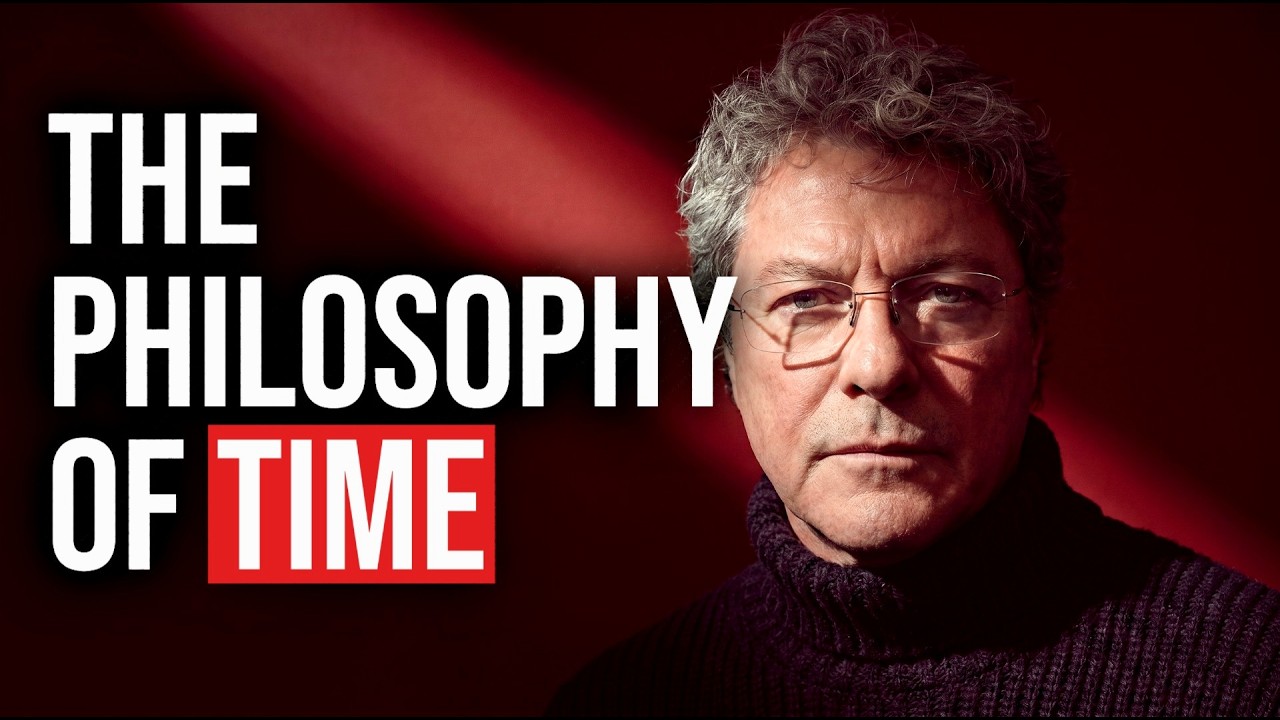
Professor Simon Saunders, Emeritus Fellow at Merton College, Oxford, is a leading philosopher of physics who works on the nature of time, the Everettian (many worlds) interpretation of quantum mechanics, and the foundations of quantum theory. This conversation ranges across the block universe, the problem of temporal passage, relativistic localization, decoherent histories, finite frequentism as an account of quantum probability, and even a quantum version of Leibniz’s monadology — all tied together by a central question: why does our experience of time as flowing and open conflict with our best physical models, and what does that tension teach us?
The Problem of Time and the Block Universe
Time remains the central concept in physics that is least understood. We manage it well in daily life and represent it adequately in physics, but at a fundamental level we do not altogether understand it.
Special relativity teaches that there is no global present. There is only a momentary present centered on each observer; there is no intersubjective, objective, three-dimensional spatial reality, because that would require a privileged frame of reference, which relativity forbids.
If there is no global three-dimensional reality, then the only public reality is one that takes in all the different presents — the block universe picture. Reality is a static, unchanging four-dimensional structure in which all events and worldlines are laid out, more like space than time.
This spatialized picture of time does not capture the felt experience of passage. Stephen Hawking’s question — “What breathes fire into the equations?” — expresses the sense that something essential about temporal becoming is missing from the representation.
General relativity and cosmology soften this slightly: the cosmic microwave background (CMB) nearly picks out a unique global time by finding, at each point, the velocity at which the CMB is isotropic, and knitting these together into a foliation. But this only works up to approximations; it cannot yield a precise instantaneous global time.
The core tension: we feel a privileged “now,” a flowingness or directionality to time, a fixed past, and an open future. All three seem in conflict with our physical models. The models require us to remove the personal perspective — to adopt a “view from nowhere” or “God’s eye view” — and this is deeply alien to ordinary sensibility.
Why Time Is Not Like Space
Space does not inherit the paradoxes of time, even though Minkowski spacetime treats them on a similar footing. A fundamental reason is that we can imagine a space that endures and that we can revisit any part of it. Time, by contrast, is one-dimensional and we cannot revisit any point along a timelike trajectory.
The notion of an object enduring or persisting is itself nontrivial. In spacetime terms, endurance is analyzed as a congruence of roughly parallel timelike lines — the successive states of an object or region that change only slowly. We can revisit spatial points defined relative to such a system of enduring rigid bodies (a coordinate grid of rods), but these are not spacetime points. We never revisit the same spacetime point, just as one never steps into the same river twice.
This distinction between spatial points (relative to a coordinate system of enduring bodies) and spacetime points is one of the things that makes special relativity difficult to teach in words, even though the equations handle it cleanly.
Why Philosophers of Physics Matter
Physicists can sometimes get away with relying only on equations and avoiding foundational discussion. When a philosopher of physics admits genuine ignorance and asks for explanation, physicists often discover they disagree on conceptual points they had never needed to articulate.
This is not about philosophers correcting physicists’ math; it is about surfacing hidden conceptual disagreements that the equations alone do not resolve. Steven Weinberg, late in life, expressed dissatisfaction with the foundations of quantum mechanics precisely because the experts could not agree.
Time, God’s Eye View, and Quantum Mechanics
The sense that something is missing in the representation of time — the absence of passage — is parallel to the sense that something is missing in the representation of probability in quantum mechanics. Both may reflect the difficulty of inhabiting a timeless, perspectiveless view.
Just as theology debates whether God exists outside of time, quantum mechanics adds a further removal: the God’s eye view not only takes in all times but also fails to take in particular actualities. In Everettian quantum mechanics, all particularities exist, so there is no single actual outcome to privilege.
Relativistic Quantum Field Theory and Localization
Many foundational questions in quantum mechanics can be articulated at low energies using nonrelativistic quantum mechanics, and the lessons carry over to relativistic quantum field theory (QFT) as long as one does not rely too heavily on structures that fail relativistically.
A key example of such a structure is particle localization. In nonrelativistic QM one can speak of particles localized in regions via a position operator. In relativistic QFT there is no covariant position operator — localization cannot be expressed in a way that respects Lorentz symmetry. The Newton-Wigner representation gives a notion of localization but breaks Lorentz invariance.
The Reeh-Schlieder theorem shows that the Minkowski vacuum has the extraordinary property that local operations can approximate any state in the whole state space. This has led to ongoing bafflement about its physical significance.
The complex numbers in covariant wave equations (Klein-Gordon, Dirac, Yang-Mills) play a different role from the complex numbers in the Hilbert-space representation. Decomposing covariant fields into positive and negative frequency parts — needed for the particle-number interpretation — is a nonlocal operation, and this is why a covariant position operator cannot exist.
Relativistic QFT is mathematically far more demanding than nonrelativistic QM, statistical mechanics, or general relativity. Remarkably, no nontrivial relativistic QFT satisfying the Wightman axioms is known to exist — the axioms are so constraining that only free-field theories seem to satisfy them.
The Dirac equation is singled out as a work of mathematical art with a cathedral-like beauty, especially when understood through its symmetries. It unifies a system of partial differential equations in a way that elevates it above an arbitrary PDE.
Everettian Quantum Mechanics and Branching
The multiplicity of moments in time is something we can learn to manage; the multiplicity in many worlds is not yet understood with the same familiarity. But ordinary life already involves managing contingency and branching possibilities — we negotiate probabilities and risks constantly.
From an Everettian point of view, this negotiation is an understanding of branching structure. Unitary evolution of the quantum state produces branching, and the Everettian takes all branches as actual, not merely possible. The branch we find ourselves in is just one.
Regarding whether “we” share a single branch: as long as two people are exchanging signals at ordinary conversational rates and not performing quantum experiments on each other, they can coherently be treated as a single extended observer in a common Everettian branch. Strictly, each is in their own branch, but they are tightly correlated. Only if they were to perform distant quantum experiments would the branching structure underlying Bell nonlocality become relevant.
Everett’s own most detailed model was close to a solar-system model: a few large masses in gravitational interaction, initially in localized states, developing into a superposition of motions each obeying classical equations of motion approximately. The key idea is that what you track over time is not a degree of freedom but a quantum state of that degree of freedom, evolving in a superposition with others.
Everett’s 1957 paper framed this in terms of measurement protocols (prepare instrument, measure spin, record, reset), but the deeper idea is that you recover sequences of states obeying definite rules — classical or otherwise — within a larger superposition.
A helpful analogy: switching on two torches creates two beams of light, not a single beam in a superposition of pointing in two directions. Similarly, many mobile phone conversations coexist in the electromagnetic field without contradiction. The Everett interpretation is the readiness to recognize multiple consistent stories in the evolving quantum state, rather than a single contradictory story.
Varieties of Many Worlds
There is no single “many worlds interpretation” but a family of views under an umbrella. What unifies them is the idea of multiplicity arising from unitary evolution without collapse.
Saunders’s own approach is closely tied to the decoherent histories (quantum histories) formalism, which he expected to become the standard framework for Everettian thinking. Instead, many researchers developed their own reconstructions of Everett, often without using decoherence theory at all.
David Wallace’s view was largely aligned with Saunders’s during their time together at Oxford, though they differed on some metaphysical details about the nature of divergence and branching.
Other views diverge more sharply: Sean Carroll’s picture, for instance, identifies worlds with the discrete spectrum of the energy operator, which Saunders finds quite different from Everett’s own thinking. Some propose hybrid models where worlds interact, requiring modifications to the quantum formalism. And some maintain that Everett was not genuinely committed to many worlds at all — a reading Saunders finds surprising but not unworthy of inquiry.
The core of Everett’s thinking was multiplicity, not necessarily “worlds” in the cosmological sense. The multiplicity could consist of trajectories of particles — sequences of localized quantum states in superposition — without being framed as full worlds.
Ontology: The Quantum State, Q-Numbers, and Structural Realism
The unitarily evolving quantum state of a closed system is an adequate ontology but not a perspicuous one. It does not by itself make the structure of what is happening transparent.
A perspicuous representation requires the full operator (Q-number) structure: quantum operators, algebraic structures, group representation theorems, projection operators, and sequences of such (quantum histories). These articulate the structure that is already present in the quantum state but not manifest in it.
Quantum histories with a measure over them provide a structured way to break down any quantum theory, including relativistic QFT, and to analyze whether decoherence obtains and whether probability can be applied.
Saunders identifies as an ontic structural realist: the structural, mathematical representation of reality is what is real. He takes the mathematics itself as primary, not as a description of some deeper set-theoretic substrate.
Finite Frequentism and Interval Probabilities
Saunders has developed an account of quantum probability based on finite frequentism. The universal quantum state is decomposed into a finite number of microstates of equal amplitude. For any property (represented by a projection operator), one asks what fraction of microstates yield “yes,” what fraction yield “no,” and how many are indeterminate (a Schrödinger-cat state for that projector).
This yields not a single probability value but an interval — a lower and upper bound. Probabilities are “blips” rather than points. The size of the interval reflects the informativeness of the probability assignment.
On any finitary analysis, very low-amplitude branches fall into the gray zone: the precision needed to resolve them cannot be achieved within the finite decomposition. This does not mean they do not exist, but it means their probability cannot be sharply assigned in this framework.
This connects to the Boltzmann brain problem: in this finite frequentist picture, the probability for Boltzmann brain scenarios cannot be captured by any finitary analysis, which may defuse some of the worry.
Deriving the Born Rule
Saunders offers a derivation of the Born rule from a new physical postulate: you cannot change the probability of X by a physically allowed action on Y when Y is disjoint from X, and the action preserves disjointness throughout. This extends a locality-like principle, translating disjointness into orthogonality.
If one accepts that there is such a thing as physical probability and that all physical changes are unitary (as in no-collapse quantum theory), then equal-amplitude states must have equal probability. This forces the Born rule.
Whether others will accept the new postulate is open, but the derivation shows that the Born rule can be obtained from a principle that the Born rule itself already obeys.
Leibnizian Quantum Monadology and the Mind-Body Problem
Saunders finds Leibniz’s monadology — a framework in which perception or representation is fundamental and the world is built up from perceptions — interesting as a way of resolving the mind-body problem. Leibniz saw the difficulty of mental causation clearly, long before modern formulations like the Chinese Room argument.
There may be a quantum version of the monadology in which these perceptual or correlational structures are fundamental, offering a way of seeing physical reality very differently in quantum mechanical terms. This is not quite idealism but a shift in which representation is basic.
Bertrand Russell, reading the monadology, noted that it implied there is no absolute simultaneity — a striking anticipation of relativistic ideas.
Living with Tension
Saunders acknowledges real tensions in his worldviews — between the experiential sense of time and the physical model, and between different intellectual commitments. He does not resolve these by dismissing one side. The stretching is mostly productive and is to be worked with, not alleviated by ignoring one or the other.
The conversation ends with the suggestion that intellectual tension, like physical stretching, can be fruitful even when uncomfortable.