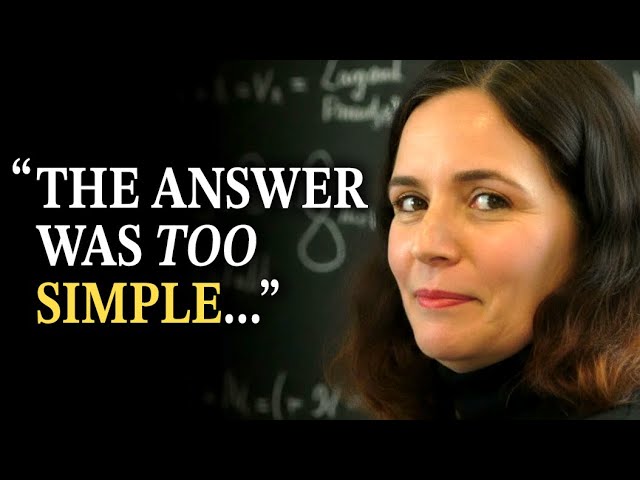
- Professor Ivette Fuentes is a theoretical physicist at the University of Southampton (and a fellow at Keble College, Oxford) who works at the intersection of quantum mechanics and general relativity. She specializes in proposing experiments that test relativistic quantum effects in the lab, and several of her predictions have already been verified. In this episode, she discusses her verified work on vacuum-induced geometric phases and the dynamical Casimir effect, explains entanglement and how it behaves in relativistic settings, and reveals she is developing a new “third way” to quantum gravity that modifies both quantum mechanics and general relativity rather than forcing one framework to dominate the other.
Verified Predictions: Making Impossible Physics Testable
-
Fuentes describes herself as a theorist who insists on proposing physics that can be tested experimentally, a standard she traces to her background in quantum optics, where theorists and experimentalists collaborate closely.
- She admits she sometimes held herself to an overly strict bar, abandoning ideas she thought were too far from experimental testing, only to see others publish similar work later.
- This self-imposed discipline, she believes, ultimately strengthened her work.
-
Vacuum-induced Berry phase (PhD work):
- As a PhD student at Imperial College with Peter Knight, Fuentes studied the Berry phase, a geometric phase acquired by a quantum state when its parameters are cyclically varied.
- Standard treatments used classical fields to drive the phase; Fuentes asked what happens when the driving field is itself quantum.
- She showed that the vacuum state of a quantum field can induce geometric phases in a system, even when no real particles are present. She called this the “vacuum-induced geometric phase.”
- After she published the result, other authors argued the effect did not exist. Fuentes moved on to other work and did not engage in the dispute.
- Years later, a postdoc at ETH Zurich (in Andreas Wallraff’s group) approached her at a conference to tell her they had just experimentally verified her prediction. The effect was real.
-
Dynamical Casimir effect and quantum gates:
- The Casimir effect (static version): two parallel mirrors placed in a quantum vacuum experience an attractive force due to the vacuum fluctuations of the electromagnetic field. This is a physical signature that the electromagnetic field is quantum.
- The dynamical Casimir effect: if the boundary conditions (e.g., mirror separation) are changed rapidly, the vacuum state at one configuration differs from the vacuum at another, and this mismatch excites real particles (photons) from the vacuum.
- Fuentes and collaborators showed theoretically that by modulating boundary conditions of a cavity in the right way, one could implement quantum gates, including cluster states (a universal resource for quantum computing).
- Per Delsing’s group at Chalmers and Chris Wilson’s group at the University of Waterloo demonstrated the dynamical Casimir effect using superconducting circuits, where fields (not physical mirrors) serve as boundary conditions and are modulated via SQUIDs at up to one-third the speed of light.
- This was controversial because some physicists argued the effect requires literal mirrors; Fuentes, as a theorist, viewed the boundary condition as the essential ingredient regardless of physical realization.
- Chris Wilson’s lab went on to verify Fuentes’s specific predictions about implementing quantum gates in such systems, with Fuentes as a co-author.
-
Fuentes notes that the common narrative of stagnation in fundamental physics often blames the lack of experimental progress, but she argues the real issue may be a lack of ingenuity in designing experiments. Her career demonstrates that effects once thought to require extreme conditions (mirrors moving near light speed) can be tested using clever analog systems like superconducting circuits or Bose-Einstein condensates.
Entanglement: What It Is and Why It’s Stronger Than Classical Correlation
-
Technical explanation (for physicists):
- A single quantum system is described by a state vector in a Hilbert space. For two systems, the total Hilbert space is the tensor product of the individual spaces.
- A separable state can be written as a product state (or mixture of product states); such states can be prepared using only local operations and classical communication (LOCC).
- An entangled state cannot be written in separable form; it requires some interaction between the systems (e.g., bringing particles together, or using an intermediary like a photon).
- When Alice and Bob share a maximally entangled Bell state, Alice’s measurement outcome instantaneously determines Bob’s outcome, no matter how far apart they are. These correlations violate Bell inequalities and cannot be reproduced by any classical strategy.
-
Why quantum correlations beat classical ones (the coin analogy):
- A classical coin gives 100% correlation on a single question: heads or tails. But that is the only question you can ask.
- A spin-half particle can be measured along any axis on the Bloch sphere, giving an infinite number of possible measurement bases.
- For an entangled pair, the outcomes are perfectly correlated in every basis Alice and Bob choose. Reproducing this classically would require sharing an infinite amount of pre-agreed information, which is impossible.
-
Lay explanation (Bertlmann’s socks):
- John Bell used the example of his student Reinhold Bertlmann, who always wears one red sock and one green sock. Observing one foot tells you the color of the other with certainty, but this is a fixed classical correlation.
- Quantum entanglement is like each person wearing socks that are undetermined (both red and green at once) until observed, yet the outcomes are always perfectly anti-correlated, and this holds for infinitely many possible “questions” (measurement bases), not just one.
Entanglement in Relativistic Settings
-
Fuentes became interested in what happens to entanglement when observers are in non-inertial motion or curved spacetimes, since relativity teaches that quantities like time intervals and lengths depend on the observer’s state of motion.
- In standard quantum mechanics (Galilean transformations), entanglement is conserved between inertial observers. But in relativity, this was not obvious.
-
Observer-dependent entanglement:
- In her early work at the Perimeter Institute (including a paper titled “Alice falls into a black hole”), Fuentes found that the degree of entanglement of a quantum state depends on the observer’s frame of reference when non-inertial motion or gravity is involved.
- This was surprising because entanglement had been treated as an intrinsic property of a system, but in relativistic settings it becomes observer-dependent.
-
Cosmological particle creation and entanglement:
- With collaborator Frederick Schiller, Fuentes studied toy models (Robertson-Walker universe) and found that the expansion of the universe can generate entanglement between particles that were initially in a separable state.
-
Conceptual difficulty: the problem of subsystems in curved spacetime:
- In quantum information, entanglement requires a bipartition (dividing the system into two subsystems). But in curved spacetime, different observers disagree on the particle content of a field (due to effects like the Unruh effect), making the notion of “subsystem” observer-dependent and complicating the definition of entanglement.
A Third Way to Quantum Gravity
-
The standard approaches to quantum gravity are string theory (starting from quantum field theory and extending it) and loop quantum gravity (starting from general relativity and quantizing it). Fuentes sees a third path.
- Roger Penrose has long argued for “gravitizing quantum theory”—modifying quantum mechanics to incorporate gravity—rather than quantizing gravity. Fuentes is inspired by this but goes further: she believes both quantum mechanics and general relativity must be modified to unify them.
- Her approach is distinct from Jonathan Oppenheim’s work and is entirely her own, developed with her PhD students and a postdoc.
-
The model has been a challenging, years-long effort. At one point, close to publication, the team discovered an inconsistency and had to go back to the drawing board.
- After reworking, they arrived back at the same core model but with a deeper understanding. Fuentes describes the final form as surprisingly simple, which both pleases and unsettles her—she wonders how she missed something so simple for so long.
- She references John Wheeler’s quote: “Behind it all is an idea so simple and so beautiful that when we find it, we’ll look at ourselves and wonder how we could have missed it.”
-
Fuentes emphasizes that any new model must ultimately be tested experimentally. She sees the physicist’s role as connecting mathematical formalism to elements of reality, then letting experiment decide whether nature agrees.
What Is Physics? Fuentes’s View
- Fuentes distinguishes between mathematicians, who explore infinite possible mathematical structures, and physicists, who must connect mathematical terms to physical reality (energy, mass, force, acceleration).
- This connection already rules out many mathematically consistent models (e.g., those that don’t conserve energy).
- But even a physically sensible model may not describe nature, which is why experiment is essential. Experiment can also guide model refinement when predictions fail.
Advice for Students
- Fuentes encourages her students to follow their own creative direction even when the broader community pushes them toward conventional approaches.
- She stresses the importance of rigor—both mathematical consistency and experimental testability—as the safety net that allows creativity to flourish without sacrificing scientific standards.