-
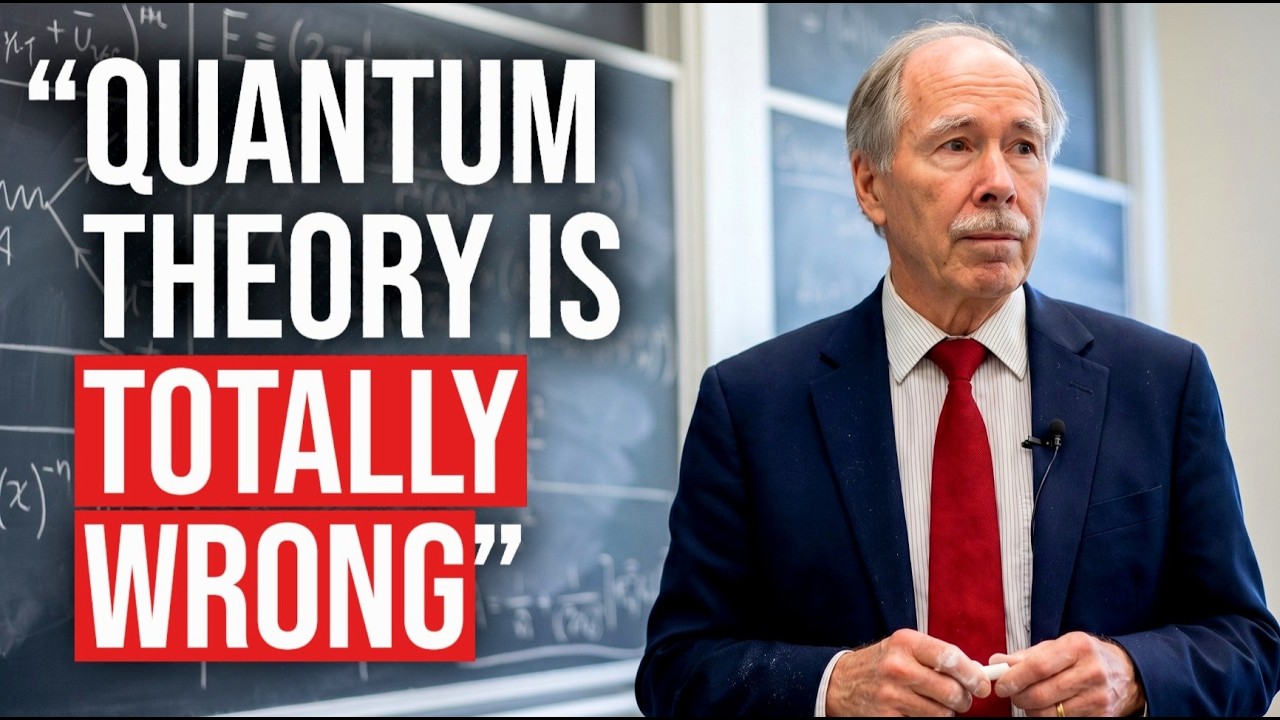
Nobel laureate Gerard ‘t Hooft argues that quantum mechanics is fundamentally wrong — not because its predictions fail (they are spectacularly accurate) but because the theory only gives probabilistic answers even when the initial state is precisely defined. He believes the universe is entirely deterministic, and quantum mechanics is merely a statistical tool that compensates for our ignorance of underlying discrete, deterministic laws.
- He won the 1999 Nobel Prize in Physics for his work on the electroweak interaction, making his critique of quantum mechanics particularly striking.
- His core claim: if we ever discover the “true equations” of nature, there will be no superposition, no wave functions, and no probabilities — only discrete variables evolving by fixed rules with absolute certainty.
-
‘t Hooft’s framework is built on cellular automata — discrete systems where space, time, and data all update in quantized steps using only integer values, with no real numbers, no continuity, and no fundamental randomness.
- The universe operates like a cosmic pinball machine: every ball follows a deterministic path, but we can’t track all the details, so we invented quantum mechanics to handle our ignorance.
- Real numbers do not exist in physics, according to ‘t Hooft. Every real number requires infinitely many decimal places to specify, which is impossible in a finite, discrete system. Only integers (and not even rationals, which still allow infinitely many values) can underlie a truly deterministic theory.
- Time may formally appear continuous (like the needle of an embroidery machine moving smoothly), but the actual physical states it produces are discrete — integer-labeled tiles, not a continuum.
- The rules governing nearest-neighbor interactions in the automaton are extremely simple and fixed, yet they can produce behavior as complex as the standard model of elementary particles.
-
He distinguishes his approach from other cellular automata researchers:
- Edward Fredkin is a rare exception among independent theorists — someone who understood the importance of not discarding the standard model while trying to go deeper.
- Steven Wolfram explored cellular automata earlier and more broadly, but ‘t Hooft criticizes him for trying random models rather than systematically connecting automata to the known particles and parameters of the standard model.
- Tim Palmer’s “rational quantum mechanics” goes partway in ‘t Hooft’s direction but not far enough — ‘t Hooft insists on integers only, not rationals.
- Unlike Wolfram, ‘t Hooft is also a committed superdeterminist, meaning he rejects statistical independence in Bell-type experiments (see below).
-
On hidden variables and the philosophy behind them:
- ‘t Hooft embraces the philosophy of hidden variables — that there are underlying deterministic variables we cannot yet identify — but argues that most hidden variable attempts fail because practitioners don’t follow their own philosophy consistently, leading to contradictions worse than those in quantum mechanics.
- He considers the wave function epistemic (a description of our knowledge), not ontic (a real physical entity). The Everett/many-worlds interpretation, which treats the wave function as real, he finds nonsensical.
- He aligns with Roger Penrose’s view that quantum mechanics is “wrong” (not merely incomplete), though he disagrees with Penrose on many specific proposals.
-
Superdeterminism is central to ‘t Hooft’s position — it is not something above or beyond determinism, but simply determinism applied consistently at all levels, including the choices made by experimenters.
- Bell’s theorem appears to rule out deterministic hidden variable theories, but it relies on an assumption of statistical independence: that Alice and Bob’s measurement settings are independent of the past state of the particles they measure.
- ‘t Hooft argues this assumption is false in a fully deterministic universe. Alice and Bob’s “free choice” of measurement settings is itself determined by prior physical states, which are correlated with the particle states. Bell’s theorem therefore does not apply.
- On the objection that superdeterminism would make experimental science meaningless (e.g., the mice/cancer/smoking example where the universe could “conspiracy” to put cancer-prone mice in the smoking group): ‘t Hooft responds that in practice, deterministic theories still produce the statistical distributions we expect. The complexity of the underlying dynamics makes conspiratorial correlations no more likely than random ones. Insurance companies, biologists, and doctors can still do science because the deterministic substrate produces effectively random outcomes at the macro level.
-
On quantum gravity and black holes:
- ‘t Hooft sees no fundamental distinction between gravity and the other forces. Gravitons exist, black holes are governed by the same deterministic laws, and there is no special problem with quantum gravity that requires overthrowing the framework — it is merely technically very difficult.
- He is skeptical of “no-go theorems” in general, noting that Bell’s theorem is itself a no-go theorem he believes can be “punched through.” He advises students to take such theorems seriously but not as absolute barriers.
- His recent work on black hole information uses the idea of quantum clones — identifying regions of spacetime that are duplicates of each other, effectively halving the degrees of freedom.
- In his model, the interior of a black hole is not a separate universe but a “clone” of the exterior. This identification resolves the information paradox because information doesn’t disappear — it maps deterministically from ingoing to outgoing states.
- The mapping involves a quantum-mechanical exchange between position and momentum as particles cross the horizon.
- This model predicts a Hawking temperature twice as large as the standard calculation, because the entropy is effectively halved when the two regions are identified as clones.
- The model produces only mild conical singularities (similar to those in string theory), not the severe singularities of classical general relativity.
- An infalling observer would not experience a smooth passage through the horizon — they would be shattered and emerge as outgoing radiation on the past horizon.
-
On the sociology of physics and why “crazy” ideas get more traction than simple ones:
- ‘t Hooft observes that wildly speculative ideas (extra dimensions, many worlds) are often accepted with enthusiasm, while the simple, “mundane” proposal that the universe is just deterministic meets fierce resistance.
- He attributes this to the fact that fantastic ideas are harder to falsify — it’s easier to find objections to a simple, concrete proposal than to a vague, far-reaching one.
- His own experience with dimensional regularization (proposing 3.99 or 4.01 dimensions instead of exactly 4) confirmed this: his advisor Veltman immediately embraced the wild idea, whereas suggesting quantum mechanics might be deterministic in disguise drew constant objections.
-
On the fine structure constant and what a successful theory must explain:
- The fine structure constant (approximately 1/137) is measured to extraordinary precision but cannot be derived from first principles. A true cellular automaton theory should be able to compute this number — and all other constants of nature — from its discrete rules.
- More generally, the theory should reproduce the masses of neutrinos, mass ratios between particles, and all other unexplained parameters of the standard model.
-
On falsifiability:
- ‘t Hooft acknowledges that his program is not yet falsifiable because the specific automaton equations are not known. The theory only becomes testable when it can make predictions about standard model parameters or black hole properties (such as the factor-of-two difference in Hawking temperature).
- He hopes that artificial intelligence may eventually help uncover the correct automaton rules by finding connections between quantum field theory and discrete systems.
-
On his near-discovery of asymptotic freedom:
- At a conference in Marseille, Kurt Symanzik told ‘t Hooft about theories with the “wrong sign” of coupling constants that exhibited a remarkable property (later called asymptotic freedom). ‘t Hooft realized gauge theories could achieve the same effect with the correct sign, but he delayed publishing because he wanted to explain his unconventional methods properly.
- Gross, Wilczek, and Politzer published first and received the 2004 Nobel Prize for the discovery. Symanzik noted that conference announcements count for priority, but ‘t Hooft had not written it up formally.
-
Advice to students and researchers:
- He maintains a self-study program for becoming a good theoretical physicist, covering essential topics from Newton’s laws through Maxwell, thermodynamics, quantum mechanics, and the standard model.
- His key advice: learn the existing, verified physics thoroughly before attempting to replace it. Most people who send him “theories of everything” fail because they cannot reproduce known results (like the magnetic moment of the electron).
- When you don’t understand something, take a step back and ask why people say what they say — look for the common denominator between seemingly different approaches.
- If your theory strongly disagrees with mainstream opinion, that may be a sign you’re on a new and important track — but you must eventually show how your theory reproduces or improves upon existing verified results.
The Nobel Laureate Who (Also) Says Quantum Theory Is "Totally Wrong"
Theories of Everything • • 1h30 → 6 min • #58