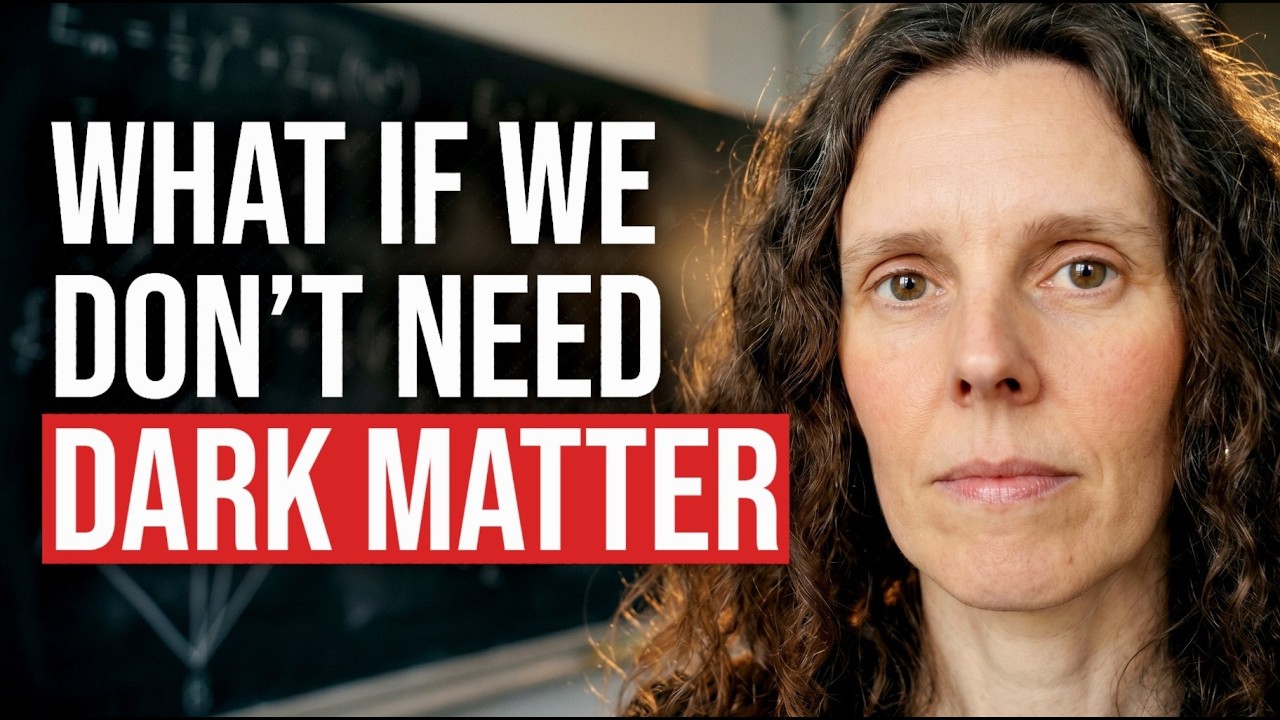
Dr. Jenny Wagner is a gravitational lensing scientist who argues that most of what counts as evidence for dark matter is driven by model assumptions rather than by the data itself. Her work shows that strong gravitational lensing — often called the “cleanest” probe of cosmic mass — only gives us local information about the lensing object. Every grand dark matter map you’ve ever seen is extrapolation built on top of that limited local data, not direct measurement. This doesn’t mean dark matter doesn’t exist, but it means the 85% figure and the detailed halo profiles are far less constrained by data than commonly presented.
The Core Problem: Forward vs. Inverse Modeling
Forward modeling means you start with a model (e.g., a dark matter halo profile), predict what the data should look like, and check if it matches. This is intuitive and popular, but when the prediction fails, you just try another model — and another — without a principled way to know when you’re close.
Inverse modeling means you start with the data and ask: what is the minimum model that the data actually requires? You build up from necessary assumptions rather than guessing from the top down.
Wagner’s key insight: the gravitational lensing formalism, when stripped of inserted models, reveals that the data only constrain local shearing strength (how much the lens distorts light at a given position) and relative magnification between multiple image positions. Nothing about total mass, nothing about global mass distribution.
She compares this to a shattered mug on the floor: the data tell you it fell from the table. That’s the necessary model. Who pushed it — dog, child, spouse — is an additional assumption not required by the evidence. Cosmology, she argues, routinely jumps straight to identifying the culprit.
Gravitational Lensing and Its Limits
Strong gravitational lensing occurs when a massive foreground object (like a galaxy cluster) bends spacetime enough to create multiple distorted images of a single background source. In principle, this is a “pure” probe relying only on general relativity.
But in practice, neither the source nor the lens is known independently. The source is far away and only visible through the distortion. The lens is mostly invisible if 85% of its mass is dark matter. This is a chicken-and-egg problem.
Standard practice inserts a model — typically a Navarro-Frenk-White (NFW) profile or similar power-law density distribution — to fill in what the data don’t constrain. Wagner showed that many different models can fit the same lensing data equally well. This is a known degeneracy in the field, but the implications are rarely foregrounded.
Her model-independent approach extracts only what the formalism itself gives: local distortion directions and relative image magnifications. Everything beyond that is model-driven extrapolation.
Why the Models Are Suspicious
The standard dark matter halo profiles (like NFW) originated from numerical simulations, not from first-principles physics. They are heuristic fits that happen to emerge in N-body simulations, but there is no fundamental derivation from gravitational theory for why they should take that form.
Wagner attempted such a derivation using a framework she calls DEMON (Dark Emergent Meta-halo Ontological Nexus), starting from the fact that Newtonian gravity is scale-free (depends only on distance, not on any intrinsic scale). Scale-free systems naturally produce power laws. This gives a physical reason to expect power-law-like density profiles — but without invoking statistical mechanics, which she argues is fundamentally unsuited to gravity because gravity is clumping (order-increasing) whereas statistical mechanics describes dispersal (entropy-increasing).
The deeper issue: statistical mechanics assumes systems evolve toward maximum entropy (uniform distribution). Gravity does the opposite — it collapses distributed matter into concentrated structures. Using statistical mechanics tools to derive gravitational structure profiles is applying a framework that does the opposite of what gravity does.
The Bullet Cluster and Other “Smoking Guns” Re-examined
The Bullet Cluster has been called the smoking gun for dark matter because the reconstructed mass (from lensing) appears offset from the X-ray-emitting gas, suggesting dark matter passed through the collision while baryonic gas was delayed.
A 2025 study using James Webb Space Telescope data mapped the intracluster light (stars stripped from galaxies during the merger) and found the merger was far more complex than two simple clumps colliding. The luminous matter in the intracluster light follows the merging structure, and the supposed offset between dark and luminous matter largely disappears when the full complexity is accounted for.
Similarly, galaxy cluster Abell 3827 was claimed to show dark matter offset from luminous matter. Wagner’s team applied their model-independent approach and showed the offset was entirely driven by the assumptions of the lens model, not by the data.
The CMB is often cited as independent evidence for dark matter through the relative heights of acoustic peaks. Wagner acknowledges it is a high-precision probe but notes that the data processing is extraordinarily complex — foreground subtraction, Milky Way band removal, simulation-assisted gap-filling — and the dark matter inference still depends on fitting a parametric model (Lambda CDM) to the data. Whether the CMB can be explained without dark matter remains an open question.
Connection to Broader Cosmological Tensions
Wagner collaborated on a 2023 review paper with 22-23 scientists collecting evidence against the cosmological principle (the assumption that the universe is homogeneous and isotropic). Several probes reached five-sigma significance:
Subir Sarkar’s matter dipole: the CMB defines a fundamental reference frame, but boosting into that frame using late-universe quasars does not produce the expected isotropic distribution.
Kostas Migkas’s bulk flows: galaxy clusters show coherent motion in a preferred direction that doesn’t average out, at five sigma.
Alexia Lopez’s giant arc and ring: structures on scales too large to have assembled since the Big Bang under standard cosmology.
CMB anomalies: axes of evil, asymmetries, and alignments in the CMB that shouldn’t exist under statistical isotropy.
Einstein himself, in his 1917 cosmology paper, explicitly stated that the homogeneous-isotropic assumption was a simplification he expected to be superseded with better data. Wagner argues we may now be at that point — not that cosmology is in crisis, but that after 100 years of the “spherical cow” model, we’re finally ready for the next level of detail.
Relation to Modified Gravity (MOND)
Wagner takes a deliberately agnostic stance on MOND vs. dark matter. Both have problems. MOND successfully predicts galaxy rotation curves from a single parameter but lacks a general relativistic formulation and struggles with cluster-scale phenomena. Dark matter has the right general-relativistic framework but no detected particle after decades of searching.
Her point is not to champion either side but to note that the data, taken at face value, do not definitively favor one over the other. Both are compatible with most data within their domains. The choice between them is currently driven more by model preference than by data discrimination.
The Sobolev Space Insight
Wagner’s mathematical breakthrough came from reading a friend’s quantum chemistry thesis. She recognized that the mathematics of electron distributions around ions in molecules is formally identical to the gravitational lensing problem — both involve the Laplace operator and Green’s functions.
This led her to Sobolev spaces in functional analysis. A Sobolev space defines how “nice” a function needs to be (how many derivatives it must have, whether it must be continuous) for the integrals in the formalism to be well-defined.
The striking result: if you only require the lensing potential to be integrable (the minimum requirement), you can change the function on a null set — a set of measure zero — without changing any observable. A null set can be a countable infinity of point masses. This means you can place infinitely many black holes in your lensing potential and the data cannot detect them.
This is not a physical claim that the universe contains infinite black holes. It is a mathematical statement about the limits of what lensing data can constrain. The formalism gives you this freedom, and choosing to exclude it is a model assumption, not a data requirement.
Implications for Scientific Method
Wagner advocates for a reorientation of scientific practice toward inverse problem-solving across fields — not just cosmology, but cancer research, particle physics, and biomedical science.
She describes this as building a tree of necessary models: the trunk is what the data absolutely require; branches are additional assumptions that extend the model further. If a branch assumption turns out wrong, you fall back to the trunk, not to the ground. Forward modeling, by contrast, often collapses entirely when a model is rejected.
This approach is more efficient: as you accumulate evidence, the number of viable models narrows (like eliminating suspects in a criminal case), requiring fewer resources at each successive level.
She is critical of the theoretical physics culture of model generation for its own sake — producing endless models on arXiv without a framework for relating them to each other or to the data. The productive work, she argues, is in finding where all models agree (the data-driven core) and where they diverge (the assumption-driven periphery).
Limits of AI in Cosmology
Wagner is not anti-AI, but she argues cosmology currently fails all three of Demis Hassabis’s criteria for successful AI application:
Feature space: unknown, because we don’t know what dark matter is or what ingredients the universe contains.
Goal function: unclear, because defining energy in general relativity is non-unique, and statistical mechanics doesn’t apply to gravity.
Data: insufficient. DESI has catalogued 11 million galaxies — impressive, but tiny compared to the complexity of the problem, and simulations used for training may not be realistic (AI trained on simulations for strong lensing achieved 95% recovery on simulated data but failed on real observations).
She argues AI will only be useful in cosmology after we understand the fundamental ingredients — not as a tool for exploration when we don’t yet know what we’re looking for.
What Comes Next
Wagner is now coupling her local lensing analysis with kinematics — the internal motions of galaxies within clusters — to build a more holistic, model-independent picture of cosmic structures. She has found a mathematical way to apply her local-information approach to kinematic data as well.
The goal is to piece together local information from multiple independent probes (lensing, kinematics, other observables) like a patchwork, where each piece is grounded in data rather than model extrapolation.
She emphasizes that this research direction needs more funding and institutional support, noting that grant reviewers sometimes dismiss the inverse problem approach because “nobody has made progress in 30 years” — which she takes as evidence that the direction is overdue for attention, not that it’s wrong.