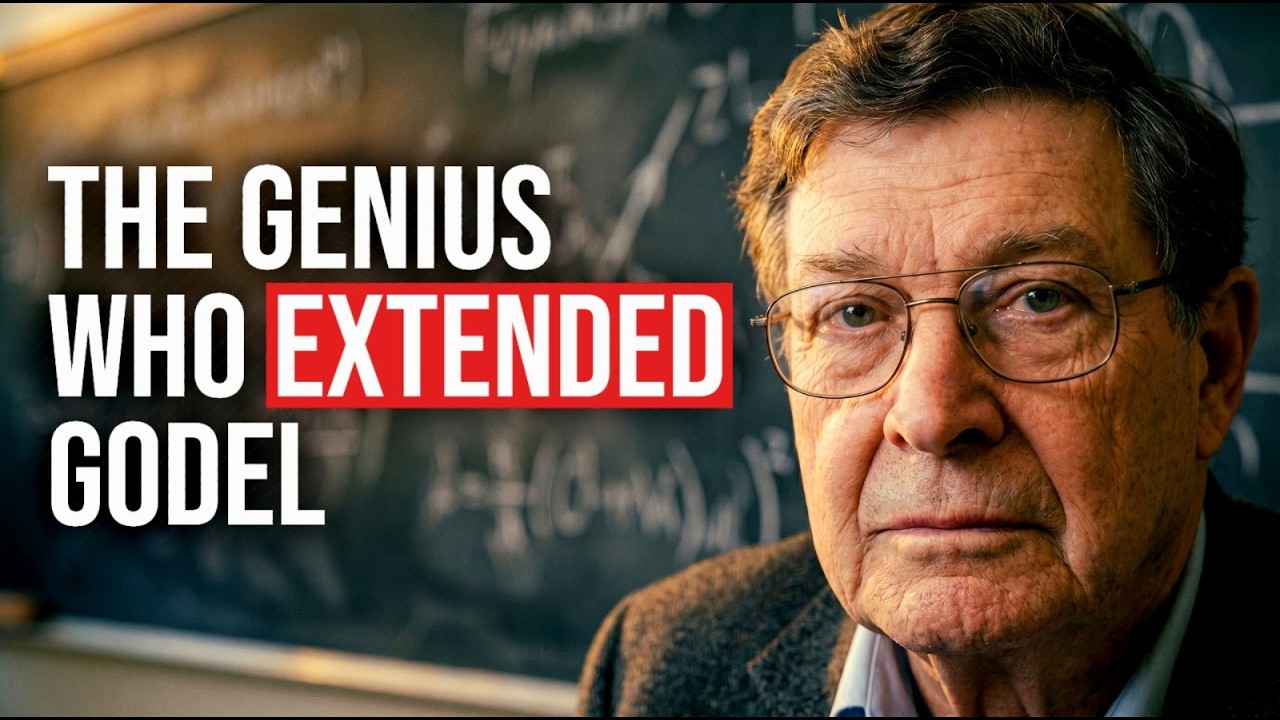
Harvey Friedman is a legendary figure in mathematical logic — the youngest professor ever listed in the Guinness Book of World Records (appointed at Stanford at age 18), a PhD from MIT, and the founder of reverse mathematics, a field that asks: what are the minimal axioms required to prove a given theorem? Kurt Gödel personally sponsored his last paper for the Proceedings of the National Academy of Sciences. In this wide-ranging conversation, Friedman argues that the foundations of mathematics are “totally up in the air” — that even ordinary, finite mathematics cannot be fully trusted to the standard axiom system ZFC, and that incompleteness reaches far deeper into concrete mathematics than most mathematicians realize.
Gödel’s Incompleteness Theorems and Their Misinterpretations
Gödel’s first incompleteness theorem says that in any sufficiently strong formal system, there exist statements that can neither be proved nor refuted within that system — not that “we can’t know things for sure” in general. Many statements remain perfectly provable or refutable; only some escape the system’s reach.
Gödel’s second incompleteness theorem is entirely different: it says a sufficiently strong system cannot prove its own consistency. This is a much stronger and more troubling claim than the first.
The most common misinterpretation is collapsing these two distinct theorems into a vague claim about universal unknowability, when in fact they are precise, separate results about formal systems.
Gödel’s original unprovable statements were far removed from everyday mathematics — self-referential logical curiosities that working mathematicians never encounter. The real question is: how far does incompleteness reach into the mathematics people actually care about?
Concrete (Tangible) Incompleteness
After Gödel, mathematicians wanted to know whether incompleteness could be found in ordinary mathematical practice, not just in abstract set-theoretic constructions.
The continuum hypothesis (whether the real numbers are the second-smallest infinity) was shown by Gödel (1940) and Cohen (1963) to be independent of ZFC — but it involves arbitrary sets of real numbers, which most mathematicians regard as several levels of abstraction removed from their daily work.
Friedman’s life’s work, spanning over 60 years, has been to find uncontrived, naturally motivated mathematical statements — involving concrete, combinatorial, or geometric objects — that are independent of ZFC or require strong axioms beyond it.
He calls this tangible incompleteness (formerly “concrete incompleteness”): the discovery that even finite, discrete, combinatorial mathematics can require axioms far stronger than ZFC to prove.
Borel Determinacy and Early Breakthroughs
Borel determinacy is a theorem in infinite game theory about whether certain infinite games have winning strategies. Donald Martin proved it using axioms far beyond ZFC, and most mathematicians assumed this was overkill.
Friedman proved that Borel determinacy cannot be proved in Zermelo set theory (ZFC without the replacement axiom) and in fact requires infinitely many uncountable cardinals — a huge fragment of ZFC.
This result was so striking that Tony Martin used Friedman’s insight to find a new proof of Borel determinacy within ZFC, exactly at the boundary of what Friedman had shown was necessary. This was a landmark interaction between foundational research and mainstream mathematics.
Friedman later found many other statements about Borel measurable sets (a well-behaved class of sets of real numbers) that also require large cardinal axioms, further pushing incompleteness into concrete mathematical territory.
Reverse Mathematics
Reverse mathematics, founded by Friedman, inverts the usual direction of mathematical practice. Normally one starts with axioms and derives theorems. Reverse mathematics starts with a theorem and asks: what axioms are necessary to prove it?
The field was partly born from Friedman’s frustration with mathematicians who dismissed formal systems as irrelevant. He wanted to show that the choice of axioms is forced by the mathematics itself — that if you want to prove certain attractive theorems, you must accept certain axioms.
A famous example is the Paris-Harrington theorem: a natural strengthening of the finite Ramsey theorem that is true but unprovable in Peano arithmetic. Leo Harrington refined an earlier clumsy version into an elegant result, demonstrating the kind of artistry involved in making incompleteness mathematically natural.
Embedded Maximality — Friedman’s Current Research
Friedman’s current book project is called Embedded Maximality, and he considers it his most convincing attack on the sufficiency of ZFC.
The subject combines two fundamental mathematical concepts — embedding (one structure fitting inside another) and maximality (the existence of maximal objects) — in the context of the rational numbers with their ordering (no addition or multiplication, just “less than”). This is among the most concrete settings in all of mathematics.
The finite version of embedded maximality involves attractive, purely combinatorial mathematics that any mathematician can relate to. Friedman analyzes this finite theory in 30–40 pages of detailed work.
When extended to infinite maps on the rationals (specifically, maps that are the identity almost everywhere, with a finite perturbation), the same questions suddenly become independent of ZFC — provable only with axioms involving monster large cardinals far beyond ZFC.
The key result is the Outer Extension Usability Theorem (OEU): it has been proved using large cardinals, and ZFC is provably insufficient. The mathematical community must now decide whether to accept this as legitimate mathematics — a direct challenge to the complacency about foundations.
Friedman has rewritten the book four times, each time making the presentation more natural and compelling. He has 30–40 one-hour lectures on the subject available online, along with unpublished manuscripts.
Tree(3) and the Relationship Between Finite and Infinite
Tree(3) is a famously enormous finite number arising from Kruskal’s theorem about embeddings of finite trees. Kruskal’s theorem states that in any infinite sequence of finite trees (with vertices colored using three colors), one tree can be embedded into a later one.
Tree(3) is the finite approximation: if the i-th tree is required to have at most i vertices, how far must you go before one embeds into a later one? The answer is Tree(3) — a number so vast that it cannot be proved to exist even with two to the trillion pieces of paper (i.e., proofs of that length).
Tree(3) is infinitesimal compared to Graham’s number — Graham’s number is “epsilon” by comparison.
The deeper point is that the outrageously large finite and the smallest infinity (ω) are intimately connected. Kruskal’s theorem is a statement about infinite sequences, yet its finite approximations produce numbers that dwarf anything encountered in ordinary mathematics. This pattern — big finite approximating small infinite — recurs throughout Friedman’s work.
Finitism and Large Cardinals
Friedman adopts what he calls his “crazy head” or finitist hat: the thesis that all of mathematics — real numbers, partial differential equations, set theory, even large cardinals — is fundamentally finite and can be properly represented in finite terms.
In the most radical form, he suggests that all mathematical ideas can be realized on a computer screen (pixels with colors), since the human mind itself operates within finite information bounds.
Large cardinals are levels of infinity beyond the real number line — obtained by iterating exponentiation of cardinals (2^ℵ₀, 2^(2^ℵ₀), etc.). The smallest large cardinals are already far beyond what most mathematicians use; measurable cardinals (a type of large cardinal) are equivalent to the existence of certain ultrafilters.
Friedman’s work shows that these seemingly abstract infinite concepts have finite combinatorial shadows — that the structure of large cardinals is already present in finite mathematics, just as Tree(3) shadows Kruskal’s theorem.
Divine Consistency Proof — Angels as a Weak Form of God
Friedman developed a set-theoretic analog of theological arguments for God’s existence, inspired by Gödel’s ontological proof and the ancient idea of classifying all properties as positive or negative.
In theology, God is the unique entity possessing all and only positive properties. In set theory, an ultrafilter divides all subsets into “big” and “little” — a mathematical analog of positive and negative.
A measurable cardinal (a large cardinal) is equivalent to the existence of a particularly strong ultrafilter — one where the intersection of countably many “big” sets is still “big.”
Friedman defines an angel as a weak form of God: an entity that belongs to all definably positive properties (all nameable “good” sets), but not necessarily all positive properties. This is weaker than God but still remarkably powerful.
He constructs a formal system with an axiom asserting the existence of at least one angel, along with standard mathematical infrastructure (a choice operator). In this system, one can prove that ZFC is consistent.
The consistency of this “angel system” can itself be proved using a measurable cardinal — which set theorists widely believe to be consistent, even though it cannot be proved in ZFC.
This gives a consistency proof of ZFC via angels — a mathematically serious result dressed in theological language. It was refereed and accepted, with at least one strong set theorist responding positively.
Friedman believes every theological attribute of God (omnipotence, omniscience, etc.) has a serious set-theoretic analog, and he had ambitions to develop all of these connections.
Contrast with Hugh Woodin
Hugh Woodin is a leading set theorist who believes the continuum hypothesis has a definite truth value, even though ZFC cannot settle it. He works to uncover the “true” universe of sets through abstract, high-level axioms involving large cardinals.
Friedman contrasts his approach with Woodin’s: Woodin takes the abstract road, seeking truth about the entire set-theoretic universe, while Friedman takes the concrete road, asking whether ZFC is sufficient for ordinary mathematical objects and intuitions.
Friedman attacks ZFC not for lacking abstract large cardinals (as Woodin does) but for being insufficient even for finitary, combinatorial mathematics that every mathematician can relate to.
They have known each other for decades and represent opposing directions in foundations: abstract truth versus concrete adequacy.
Category Theory vs. Logic
Category theory offers an alternative foundation for mathematics. Some category theorists (especially topos theorists) claim that logic is a special case of category theory, not the other way around.
Logicians respond that category theory is just another mathematical structure definable within set theory (ZFC). Saunders Mac Lane, a founder of category theory, defined categories in terms of set theory in his classic text.
Friedman notes that the major results in foundations — including concrete incompleteness, Gödel’s theorems, Cohen’s forcing — were all achieved by the logic/set-theory side, not by category theorists. The language and people of big foundational events have been on “his side,” even though the results can be rephrased in categorical terms.
Constructive Mathematics and Intuitionism
Constructive mathematics rejects certain classical logical principles (like the law of excluded middle in unrestricted form) and requires that proofs provide explicit constructions.
A key success of constructive systems is the disjunction property: if you can prove “A or B,” then you can prove A or you can prove B. This fails in classical systems (e.g., “the continuum hypothesis or its negation” is provable as a tautology, but neither disjunct is provable).
A stronger result is the numerical existence property: if you can prove “there exists an N with property P,” then you can exhibit a specific N with property P.
Friedman proved that for any reasonable constructive system, the disjunction property automatically implies the numerical existence property — a surprising and powerful result. The proof used a bizarre diagonalization argument that even Friedman says he doesn’t fully understand today.
This was the last paper Gödel sponsored for the Proceedings of the National Academy of Sciences. Friedman visited Gödel afterward and considers it a great honor.
How Friedman Does Mathematics
Friedman describes his method as starting with contrived, pseudo-mathematical situations that he knows are connected to heavy set theory, and then reworking them into purely mathematical, attractive forms that even logic skeptics can appreciate.
He exploits Gödel’s second incompleteness theorem constantly: if a mathematical statement implies the consistency of ZFC, then it cannot be proved in ZFC — so he looks for mathematically natural statements that have this property.
He is particularly skilled at finding attractive mathematical forms of things that initially seem artificial — a talent he shares with Leo Harrington (of Paris-Harrington fame) but which he considers rare in the field.
He spends roughly 12 hours a day on mathematics in retirement, focused primarily on perfecting the exposition and rollout of Embedded Maximality.
Advice to Young Students
Friedman recommends that students interested in foundations study tangible incompleteness and embedded maximality — a rich subject with many open questions that is brand new and more accessible than traditional foundations.
When attacking a specific problem, it’s important to develop intuition about which side is more likely true and to allocate effort accordingly, since picking the wrong side could waste years.
He favors an approach of clawing at weak forms first and building up, rather than attacking the full problem immediately.
He also emphasizes the importance of learning all standard material first before specializing in foundations.
Theology, Consciousness, and AI Immortality
Friedman does not adhere to any organized religion but maintains a connection with a local rabbi and is open to theological speculation. He finds Einstein’s non-standard notions of God (inspired by Spinoza) intriguing.
He believes that until we understand the origin of life and consciousness, all conceptions of God remain on the table — everything is up in the air.
On AI and immortality: Friedman observes that a person’s internet contributions (like this interview) could be used by AI to create a realistic simulation of that person after death — a form of digital immortality through “internet deposits.” He notes that his late mentor Patrick Suppes speculated about exactly this before the current AI explosion.
He sees this as a commonly purchasable future technology — a way for loved ones to continue having realistic conversations with the deceased.
Personal Background and Reflections
Friedman was a child prodigy: assistant professor of philosophy at Stanford at age 18, PhD from MIT. He describes himself as a mathematical philosopher who happened to be strong mathematically.
As a young child (around age 6 or 7), he told his mother a dictionary was “worthless” because looking up words led to circular definitions — an early sign of his foundational instincts.
He is a musician (music runs through his head constantly), runs a chess club, and has started a book on the mathematics of chess.
His ultimate ambition was always general foundations — not just mathematics, but physics, law, economics, and biology. He had this vision as a teenager and called his planned ultimate book The Foundational Life. Mathematics came first because it was the most developed, but he always intended to go further.