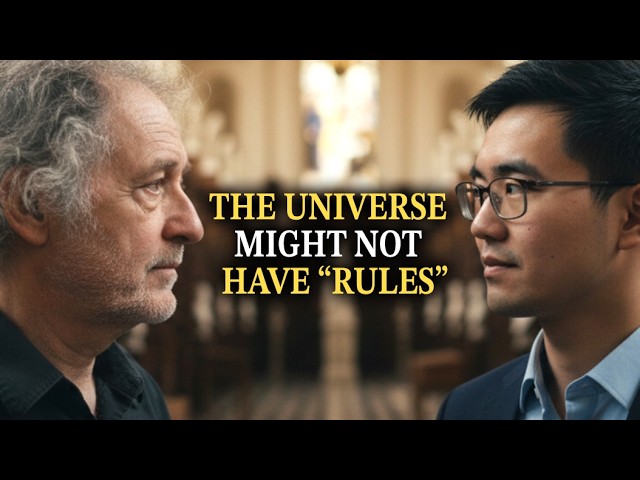
This episode is a debate about what “laws of physics” fundamentally are — not which specific laws are true, but the metaphysical status of lawhood itself. Two philosophers represent opposing camps: Barry Loewer (Rutgers) defends a broadly Humean view that laws are sophisticated summaries of everything that happens, with no power to compel anything; Eddy Chen (UC San Diego) defends minimal primitivism (MIMP), the view that laws are fundamental, irreducible facts that genuinely govern and constrain what is physically possible. The two are friends and former mentor/student (Loewer co-supervised Chen’s PhD), so the disagreement is sharp but collegial. The central fault line is whether laws constrain reality or merely describe it, and the discussion ranges into probability, the wave function, free will, and how this debate connects to modern machine learning.
The Two Core Positions
Eddy Chen — minimal primitivism (developed with Sheldon Goldstein)
Laws of nature are fundamental, primitive facts that exist in the world and don’t depend on anything else — akin in spirit (though less robust) to laws of mathematics and logic.
Laws govern and constrain: they determine which possibilities are physically possible, with the actual universe being one possibility allowed among many.
Laws and the “mosaic” (the universe’s spacetime contents) are both fundamental and coexist; the laws sit at the basic level of reality, not derived from the mosaic.
Governing need not be temporal/causal step-by-step — modern physics (general relativity, Lagrangian/action principles, quantum mechanics) suggests laws constrain the whole spacetime “all at once.”
Barry Loewer — the Humean / “package deal” view
He accepts much of Chen’s vocabulary (laws constrain, support counterfactuals, explain) but means something deflationary by it: to “constrain” just means events satisfy the laws, nothing more.
Laws are not primitive facts. He finds the notion of laws literally constraining or governing “un-understandable” — a “crutch” no one needs and a metaphor “gone on holiday.”
The only thing fundamental is reality itself, which can be described in many valid ways (scientific, artistic, ethical). Laws are the best systematization of reality.
A History of “Laws of Nature” (Loewer)
No proper history of the concept of laws of nature has been written (histories of probability and chance exist; the law concept is “ripe to be plucked”). Closest scholars: Peter Harrison, John Milton (not the poet), Walter Ott.
Descartes is the father of the modern concept. His vision: a few mathematical principles describing how God moves matter around. Laws had two features:
Constraining/governing — but for Descartes it was God doing the enforcing, not the laws themselves (laws merely described God’s activity).
Unifying — organizing all of nature under common principles; mathematical because God, a mathematician, must be one.
Chen and Loewer each inherit one half of Descartes’ picture: Chen keeps the constraining aspect; Loewer keeps the unifying aspect and discards constraining as unnecessary.
Descartes’ own laws were “an abysmal failure.” ~80 years later Newton largely fulfilled the dream with a few simple unifying laws — good enough for pendulum clocks and cannonballs, later shown incomplete.
The “super-law” problem: if laws govern, what makes them govern? Is there a higher law? For Descartes, the analogue of the super-law is God. Loewer presses that the constraining view needs ever more primitives to connect primitives to ordinary facts.
The Central Analogy and Disagreement
Kurt’s framing (which Loewer praised): traffic laws seem to cause/orchestrate car motion (Chen’s view), whereas a weather report merely documents patterns (Loewer’s view).
A key contrast: you can break the laws of man (Loewer got a ticket in Budapest), but nature “cannot violate” the laws of God. Loewer’s answer: there’s nothing to violate because laws merely unify — the “no-exceptions” feature just is the unifying feature.
They agree there is no empirical experiment that could distinguish their views. The dispute is metaphysical, not scientific — which is partly why some find it “useless,” yet still illuminating.
David Lewis, the Mosaic, and Best Systems
Loewer expounds David Lewis’s view (not his own): all that fundamentally exists is the mosaic — perfectly natural properties (mass, charge, spin) instantiated at points throughout spacetime, with spatial/temporal relations.
God created the whole expanse “all at once”; the laws are then the best systematization of this mosaic — the account that best balances simplicity, comprehensiveness, and informativeness.
Lewis preferred “systematization”; Loewer prefers “unifying”; others (inaccurately) say “summary.”
How best systems explain (Loewer’s example): ice melting, smoke dispersing, ink diffusing, people aging — seemingly unrelated — are all unified as particles moving roughly by Newtonian laws plus a probability distribution. Recognizing the connection is the “aha” of explanation. Explanation = unification, not enforcement.
The opposing camp’s worry: in a pure-mosaic world, nothing enforces the pattern. Loewer rejects “nothing” — the laws do “enforce” in the sense of supporting counterfactuals — but says Chen is “hankering after God.”
The 13-year-old answer: Loewer says if God told him there were no primitive laws, he’d respond as he did at 13 (off-air); Chen says if God told him laws were primitive, he’d accept he was simply wrong about the metaphysics — but scientists wouldn’t stop doing science either way.
The Münchhausen/Agrippa Trilemma and Circularity
Any justification faces three options: foundationalism (an unjustifiable axiom), infinite regress, or circularity.
Chen’s MIMP is foundationalist: laws are the real, fundamental axioms of reality — not mere truths supervening on the mosaic. On the Humean view, by contrast, laws supervene on the mosaic and aren’t at the basic level.
Loewer endorses Otto Neurath’s image (used by Quine): science is a ship rebuilt at sea, with no dry dock or foundation — a virtuous circularity aimed at an ever-better ship, guided by simplicity, comprehensiveness, and informativeness.
Chen presses a circularity worry against Loewer: defining laws via “ideal scientific practice” requires counterfactuals, probabilities, abilities, and social factors — all modal notions usually understood through laws. Loewer accepts the circle but calls it virtuous (“it all hangs together”).
Realism, Idealism, and the “Package Deal Account”
Both are realists. Chen’s slogan (after Putnam) is realism; Loewer’s is “realism with a scientific face” (echoing Putnam’s “realism with a human face”). Both say science requires intelligent creatures, but that doesn’t make laws idealist.
Chen’s worry about traditional Humeanism: if which sentences count as laws depends on our standards of simplicity, then changing those standards changes the laws — which seems to make laws subjective. Lewis himself feared this and called it “rat-bag idealism” (Loewer reports “rat bag” is Australian for disreputable).
Loewer’s reply: there is a fixed, objective standard — the goal of the ideal completed science (simplicity, unification, informativeness, symmetries) — so laws aren’t whimsically subjective even though humans articulate the criteria.
Loewer’s own view (“package deal account”): he goes more minimal than Lewis — he rejects even the mosaic and perfectly natural properties as fundamental “crutches.”
Fundamental is just reality (he names Spinoza as a kindred spirit — reality describable in many ways, without God).
Science starts from the manifest image (the macroscopic world as it appears) and builds toward the scientific image (after Wilfrid Sellars), introducing unobservable microscopic entities only to better systematize the observable. The macroscopic is epistemically fundamental but not ontologically fundamental.
He separates ontology (what exists and its relations) from ideology/“conceptuology” (how concepts are axiomatized) — noting geometry, number theory, and mechanics (Lagrangian vs. Hamiltonian) can be axiomatized many ways, so axiom choice is partly free, unlike facts about what exists.
Probability and the “Supreme Law”
Probability is what made Loewer enter philosophy; he and Chen think they nearly agree on objective probability.
Russell quip: “Probability is the most important concept in modern science, especially since nobody knows what it means.” (Loewer claims to know what entropy means, unlike von Neumann’s similar quip.)
Probability lets science extract huge information about incompressible details. Boltzmann assumed the simplest possible probability distribution over microstates; Arthur Eddington called the (probabilistic) second law of thermodynamics the “supreme law of nature” because it provides the enduring probabilistic bridge between microscopic and macroscopic facts, surviving all changes in the dynamical laws.
A Humean reading (Lewis): a long coin sequence (HTHTTT…) is systematized by noting ~half come up heads in any subsequence picked without a biasing rule — indicating independent events of probability ½. This gives strong, informative degrees of belief (e.g., near-certainty of 48–52 heads in 100 tosses).
Both note remaining open work on how to cash out probabilistic laws, chances, credences, the Principal Principle, and the choice of entropy (Boltzmann vs. Gibbs vs. von Neumann).
Maudlin’s Contrast and the Configuration-Space Dispute
Tim Maudlin’s non-Humean view differs from Chen’s: Maudlin’s laws are dynamical (“FLOTEs” — fundamental laws of temporal evolution) that produce later states from earlier ones, requiring time as a primitive. Chen and Goldstein’s laws govern all of spacetime timelessly, needing no primitive time.
Loewer says he understands “producing” in a factory but not laws “producing” anything — and rejects primitive time, claiming he can derive time (including its direction) from his general scheme.
Configuration space and the wave function (Chen):
The wave function lives in an enormous (~10^(billions)) configuration space; being a realist about it tempts one to treat that high-dimensional space as fundamental, making ordinary 3D objects derivative or illusory.
Chen prefers a low-dimensional fundamental space (ordinary spacetime, or ~20-something dimensions) to recover tables, chairs, and us straightforwardly.
His move: treat the wave function as a law (like a Hamiltonian/Lagrangian, which also lives on high-dimensional spaces) — a law telling things how to move, not a concrete field. His “mentaculous” view (term borrowed, originally from David Albert / the film A Serious Man) takes the density matrix as a fundamental law, simple enough to be law-like, with ordinary stuff in ordinary spacetime.
Loewer is agnostic here, noting David Albert is a key proponent of high-dimensional fundamentality, and quipping that Chen “may know better than reality.”
Possible Worlds, Free Will, and Causation
Possible worlds: Leibniz introduced them (and was nearly called a heretic). Lewis treated all possible worlds as concretely real parallel (non-interacting) spacetime manifolds, with “actual” being merely indexical (pointing at our own world). Loewer is deflationary: he rejects concrete possible worlds and the heavy notions of metaphysical necessity/possibility, which he thinks have mainly served fallacious ontological proofs of God; he sees them as needless headaches.
Free will / causation (Loewer): some inherited concepts must be modified or jettisoned (e.g., the ether). Causation should be kept but isn’t fundamental — Russell likened causation to the British monarchy, “kept around because it’s mistakenly thought to do no harm.” Loewer reconstructs causation via counterfactuals and correlations.
He is a compatibilist, citing Jenann Ismael’sHow Physics Makes Us Free — the laws of physics themselves contain the basis for compatibilism. There’s a real distinction between acting freely and acting under a genuine constraint (someone threatening you), but nothing “shoots a particle in the head” for disobeying F=ma.
Connection to Machine Learning and Induction (Chen)
Modern AI excels at picking up simple, informative patterns that generalize beyond training data — a form of induction. Its ground isn’t a uniformity principle (nature isn’t uniform everywhere) but, Chen suggests, the existence of simple, informative law-like structure giving rise to effective descriptions.
That transformer models succeed on untrained tasks is a kind of “miracle” echoing the larger marvel that the universe lets us “discover so much from so little.” Chen stresses this links the metaphysics and epistemology of laws to contemporary practice — though he insists it’s not by itself an argument for non-Humeanism.
Loewer largely agrees but again: no “crutch” is needed. Nature is uniform in some respects and not others; science (and AI) just seek uniformity in the right respects, with no guarantees — a point both emphatically share.
Where They Converge and Why the Debate Matters
They agree there’s no practical or empirical difference between the views — same scientific practice, same predictions. Loewer concludes you can therefore drop the “crutch”; Chen counsels agnosticism about the crutch rather than outright denial.
Chen’s methodological credo: seek the neutral ground between Humeanism and non-Humeanism, solve problems there, then transfer back. He spent years as a Humean (learning it from Loewer and Albert), and MIMP emerged from stripping non-Humean views of excess “baggage” to be as minimal and scientifically motivated as possible — Loewer notes Chen took the minimalism from him.
Loewer concedes some philosophical disputes are genuinely useless (e.g., “how many objects are in a bowl with a bobbing ball?”), but this one is useful (it produced his package deal account) even if perhaps “used up.” Chen argues sharpening the disagreement gives a fixed reference point: if downstream debates (quantum foundations, statistical mechanics, the past hypothesis, vagueness) trace back to the law question, and yet the law question makes no empirical difference, that’s reassuring — disagreements must trace to something else.
The Mentor–Student Relationship
Loewer says Chen was unusually self-motivated and accomplished, knew exactly what he wanted to investigate, and developed MIMP with mathematician Sheldon Goldstein (who, Loewer suspects, holds it with less fervor than Chen). Loewer’s difficulty is with unmotivated students, not dissenting ones.
Chen credits the rich Rutgers/Princeton/CUNY environment and the constant objections from Loewer and Albert for training his “ear” for weaknesses — criticism that is “a blessing and a curse,” eventually internalized as imagined critics in one’s own head.
His intellectual arc: a Humean (and high-dimensional realist) for some years, he became non-Humean only when working out a unified view of quantum mechanics, statistical mechanics, the past hypothesis, vagueness, and laws together — landing on a position “as scientifically motivated and as minimal as can be.” Loewer’s parting joke: the road to Damascus runs both ways, but at least Chen never became a (disgraceful) “super-Humean” (a view associated with Michael Esfeld).