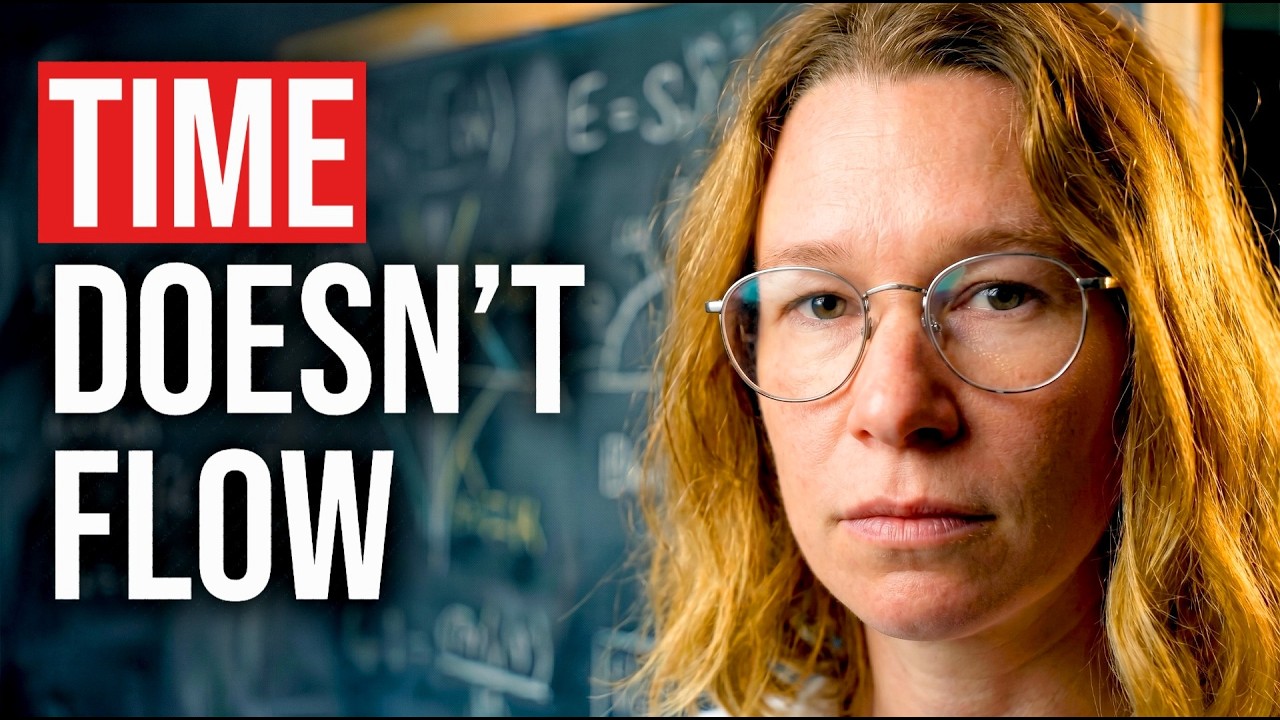
Physicist and philosopher Emily Adlam argues that the deepest assumption in modern physics — that the universe evolves forward in time from an initial state — is a dogma that is actively holding back progress. Instead, she proposes an “all-at-once” view of physical law, where the laws of nature apply as global constraints to the entire history of the universe simultaneously, much like the rules of a Sudoku puzzle constrain the whole grid at once rather than dictating how you fill it in step by step. This perspective draws on evidence from quantum foundations, relativity, and quantum gravity, and has radical implications for causality, observers, free will, and the nature of physical law itself.
The Measurement Problem and the Role of Observers
The measurement problem in quantum mechanics remains the central unsolved problem for Adlam, not merely as an intellectual curiosity because it is closely tied to concrete issues in quantum gravity — particularly the problem of time and the challenge of understanding how observers and their local observations arise in a fundamentally timeless framework.
There is no agreed-upon definition of what counts as an observer or a measurement in quantum mechanics; different interpretations represent observers differently, and this has cascading consequences for how one approaches quantum gravity.
In quantum gravity, the “problem of time” arises because canonical quantization of gravity makes time evolution look like a gauge transformation — not physically real — leaving us with a timeless model that must somehow account for our experience of temporal succession and definite outcomes.
Adlam believes the solution to the measurement problem will likely be an all-at-once style solution, but this does not uniquely determine the answer — the challenge of modeling observers within that framework remains open.
The Sudoku Universe: All-At-Once Laws
The traditional picture of physics is computational: you input an initial state and the laws evolve it forward to produce the course of history. Adlam argues this time-evolution picture is a poor fit for what modern physics actually shows.
In the “Sudoku universe” picture, laws are constraints that select valid entire histories all at once. They do not tell you how to build up the universe step by step; they simply rule out whole histories that violate the constraints.
This goes beyond mere consistency conditions — Adlam acknowledges that consistency alone is probably insufficient to derive the specific laws we observe, and that additional constraints are needed.
The all-at-once framework naturally accommodates temporal nonlocality (constraints that relate events across time without mediation by a state evolving forward), which Adlam argues is just as natural as spatial nonlocality once you abandon the time-evolution dogma.
Causation Is Not Fundamental
Adlam holds that causation is a macroscopic phenomenon tied to thermodynamics (the entropy arrow), perspective, and the kinds of interventions available to macroscopic agents — it does not adhere in the microscopic world.
She therefore opposes efforts to give causal accounts of quantum phenomena, whether classical or quantum-causal, arguing that forcing quantum mechanics into a causal structure misrepresents the actual structure of the physics.
In the all-at-once picture, what looks like retrocausality from a macroscopic point of view is not truly causal at the fundamental level — there is no causality in fundamental physics, only more general modal constraints that select the history.
Temporal Nonlocality vs. Spatial Nonlocality
Spatial nonlocality (as in standard accounts of Bell nonlocality) involves a global state that carries information across space instantly — Alice’s measurement collapses the wave function everywhere, affecting Bob’s results.
Temporal nonlocality involves direct constraints between events at different times without mediation by a state evolving forward — Alice’s measurement and Bob’s later measurement are related by a global constraint, not by information carried through intermediate states.
In a relativistic setting, spatial nonlocality in one reference frame becomes temporal nonlocality in another, so the two are interconvertible; Adlam argues it is inconsistent to accept one while rejecting the other.
Physicists focus on spatial nonlocality largely because quantum mechanics is traditionally formulated as a time-evolution theory; reformulating it as a non-time-evolution theory makes temporal nonlocality natural.
Retrocausality and the Transactional Interpretation
Adlam distinguishes between “dynamical retrocausality” (influences propagating backward step-by-step through time) and “all-at-once retrocausality” (global constraints relating past and future events without any mediating process).
The transactional interpretation of quantum mechanics, which involves backward-in-time waves, runs into consistency problems raised by Tim Maudlin — for example, when a preliminary measurement in the middle of an experiment is used to set final conditions, creating a contradiction in the naive transactional picture.
Adlam argues that resolving such problems pushes the transactional interpretation toward an all-at-once picture where the whole history is determined atemporally, ensuring consistency without literal temporal transactions.
Reductionism, Renormalization, and Scale
Adlam co-authored a paper exploring whether reductionism — the idea that smaller-scale phenomena explain larger-scale ones — might be false or at least not necessarily true, motivated by fine-tuning problems in quantum field theory.
In quantum field theory, certain fundamental constants at different scales must be carefully adjusted to produce observed values; Adlam observed that if the higher-scale constant is taken as fundamental and the lower-scale ones derived from it, the fine-tuning is explained naturally.
Renormalization group transformations are (outside fixed points) one-to-one mappings, meaning one can go from small scales to large or large to small with equal mathematical legitimacy — there is no sense in which the physics privileges the smallest scales as more fundamental.
This challenges the standard reductionist direction of explanation and is consistent with the all-at-once view, where global (large-scale) constraints can determine local (small-scale) features.
Probabilities and the Gnomic Frequentist Approach
Adlam is unsatisfied with standard interpretations of probability: frequentism has philosophical problems with edge cases, subjective Bayesianism fails to capture the mind-independence of physical probabilities, and dispositionalist accounts are mysterious and hard to reconcile with all-at-once physics.
She is most enthusiastic about “gnomic frequentism” (due to John Roberts) and related work by Eddie Chen and John Barrett, which reformulates probabilistic laws as constraints on relative frequencies across all of history — the laws require that the frequencies of outcomes across all instances of a measurement type across all of spacetime must fall within a certain range.
This fits naturally within the all-at-once constraint-based view: probabilities are not about what happens to be frequent, but about what the laws demand the frequencies to be.
Modal Structure and the Nature of Laws
Adlam’s approach is grounded in structural realism: she views the all-at-once constraints as a form of modal structure — facts about what is possible and impossible — which is more general than causal structure (since she does not regard causation as fundamental).
She contrasts her view with that of Eddie Chen and Shelver Goldstein, who are inclined to take all-at-once constraints as fundamental primitives, whereas she sees them as modal structure within a structural realist framework — a difference of emphasis rather than a deep incompatibility.
Philosophical analysis of lawhood, she argues, is essential for clarifying what kind of laws modern physics actually presents and for guiding future research directions.
Philosophy and Physics: A Productive Dialogue
Adlam pushes back against the attitude that philosophy has contributed nothing to physics in the past century, pointing to Bell’s theorem and the study of nonlocality as a case where philosophical work (by Abner Shimony and others) helped establish what is now mainstream, Nobel-recognized physics.
She trained in both physics and physics and philosophy as an undergraduate, completed a PhD in physics, and ultimately found her work sits more naturally within philosophy of physics.
Foundations of physics, as she defines it, means focusing on basic conceptual questions, underlying structures, and why theories have the form they do — in contrast to applied work focused on building new technologies.
The Taxonomy Paper: Clarifying Retrocausality and Superdeterminism
Adlam co-authored a paper with Sabine Hossenfelder and Tim Palmer providing a taxonomy of different approaches to retrocausality and superdeterminism, motivated by a conference where people were using these terms in different ways and talking past each other.
The goal was to establish clearer community-wide definitions so that discussions about whether retrocausality or superdeterminism can eliminate nonlocality could proceed more productively.
Free Will in an All-at-Once Universe
The all-at-once picture has implications for free will: if the entire history of the universe is fixed atemporally, then at any moment there is already a fact (from the atemporal perspective) about what your future actions will be — the future is not “open” in the way some accounts of free will require.
This holds even for probabilistic models: if probabilities are frequency constraints across all of history, or if the history is selected probabilistically from a set of possibilities, the course of history is still determined all at once.
Adlam argues this does not eliminate free will but requires a more careful analysis — causation is a higher-level, macroscopic phenomenon, and agents can still be the causes of their actions at that level of description even if the fundamental history is atemporally fixed.
Self-Locating Uncertainty and the Sleeping Beauty Problem
Self-location refers to uncertainty about where (or when, or in which universe) you are within a larger structure. Adlam distinguishes two types:
Pure self-locating uncertainty: uncertainty about which location you occupy among multiple locations within the same world (e.g., Dr. Evil not knowing whether he is the original or a duplicate — both exist in the same world).
Superficial self-locating uncertainty: uncertainty about which possible world you are in, where each possible location belongs to a different possible world (e.g., not knowing what time it is — each possible time corresponds to a different possible world).
The Sleeping Beauty problem involves both types: the coin flip outcome is a superficial self-locating matter, while the day-of-waking is a pure self-locating matter.
Adlam’s solution is the “halfer” position: assign superficial credences first (inherited from the scientific theory — the coin is fair, so probability half), then assign pure credences arbitrarily. Since pure information cannot change superficial information, learning what day it is should not change your credence in heads — it remains one-half.
This has serious implications for multiverse theories (cosmological multiverse and many-worlds quantum mechanics), which depend on there being objectively correct ways to assign pure self-locating credences. Adlam argues there are no rational constraints on pure self-locating credences, meaning such theories cannot yield meaningful predictions.
Process Matrices and Generalized Causal Structure
Process matrices are a formalism developed in quantum foundations to study causal processes more general than those constrained by ordinary spacetime. Agents perform operations in laboratories with no predefined spacetime locations; the only requirement is logical consistency.
This framework retains quantum formalism but abandons the time-evolution story, allowing exploration of processes that might be relevant in regimes where spacetime breaks down (e.g., quantum gravity).
A classical equivalent — the process function formalism — exists, showing the conceptual structure does not depend on quantum mechanics per se.
The Born rule’s place in the process matrix formalism remains an open question.
Humean Supervenience and Adlam’s Ontology
Humean supervenience is the view that the world is nothing but a distribution of categorical properties over spacetime (“one thing after another”), with laws being mere convenient summaries of these facts.
Adlam’s picture starts from a space of possible courses of history (which could be Humean mosaics — distributions of facts across spacetime), applies constraints that narrow down which histories are lawful, and then has one history selected and made actual.
Spacetime itself is not fundamental in this picture but is expected to emerge from something deeper, consistent with what quantum gravity suggests — though the precise story of how spacetime emerges from the constraint-based framework remains a work in progress.
Consistency Constraints and the Structure of Spacetime
Adlam argues that many features of spacetime structure can be understood as consistency requirements: the need for a well-defined temporal order prevents causal loops and contradictions; the impossibility of superluminal signaling (which could create logical paradoxes) gives rise to something like the relativistic light cone structure.
She is optimistic that the dimensionality and signature of spacetime (three spatial dimensions plus one time dimension) might also be derivable from consistency constraints, though she does not yet see how to derive exactly three spatial dimensions.
The possibility of deriving fundamental constants from global constraint-based laws remains open; Eddie Chen’s “strong determinism” (the idea that laws might uniquely fix the entire course of history) is a direction Adlam finds intriguing but is skeptical we can fully achieve.
Underappreciated Topics and Advice for Young Researchers
Adlam is on a crusade to shift discussions of the measurement problem from ontology (“what is really there?”) to epistemology (“how could we possibly know what we claim to know?”). She argues that many-worlds and observer-relative interpretations have severe epistemic problems — particularly the difficulty of justifying why we should expect to see high-probability outcomes, which undermines the possibility of using observations as evidence for the theory.
Her advice to young researchers: work on what you love rather than chasing hot topics. Establish a research program around questions you genuinely care about, even if it takes longer to gain attention.
She herself left academia for a few years after her PhD because she was pessimistic about whether her foundational and philosophical work could sustain a career, but eventually returned after receiving positive feedback, doing a productive postdoc at the University of Western Ontario.