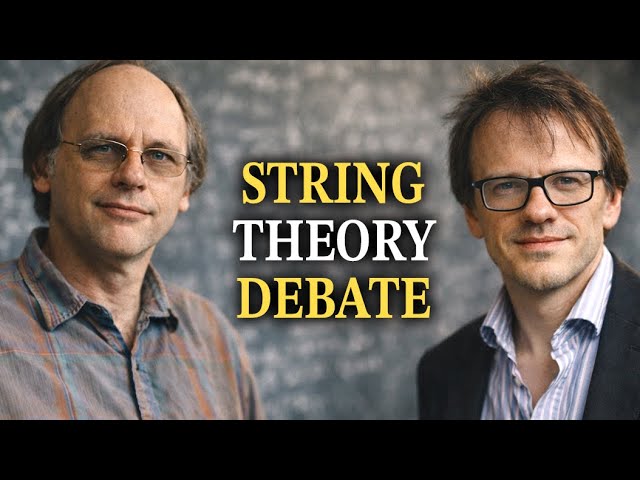
- This episode is a debate between Peter Woit (Columbia University, author of Not Even Wrong and a leading critic of string theory) and Joseph Conlon (Oxford University, author of Why String Theory and a prominent defender of the theory), moderated by Curt Jaimungal. The central question is whether string theory is a productive path for fundamental physics or a seductive dead end, but the conversation broadens into a rare, technically serious discussion about the structural health of theoretical physics as a field—how it trains students, evaluates ideas, rewards careers, and communicates with the public in the absence of experimental guidance.
What both agree on
- Structural problems in fundamental physics. Both see a growing disconnect between theoretical work and experimental data. Conlon uses a “muscles” analogy: generations of researchers trained in highly mathematical, data-free environments lose the ability to think about how real measurements work. Woit adds that students often skip deep engagement with quantum field theory and the Standard Model in order to work on currently fashionable topics, leaving them without a solid grasp of the central unsolved problems.
- The field is not optimally organized for progress. Conlon gives string theory as a sociological phenomenon a “C” grade. Woit agrees that the lack of experimental feedback makes it easy to fool oneself, and that hype—promotional claims about progress that is not really happening—damages public trust and the internal intellectual integrity of the field. Both quote the idea that “to live outside the law, you must be honest,” emphasizing that without experiment to keep you honest, you must be unusually rigorous with yourself.
- String theory as a label has become amorphous. Both acknowledge that “string theory” now refers less to a specific proposal (quantized strings in ten dimensions, compactified to four) and more to a community and a set of tools. Conlon admits the term is “nebulous” and that much of what is done at strings conferences has little to do with four-dimensional particle physics. Woit notes that it is often impossible to distinguish who is a string theorist and what string theory actually is.
- Tribalism and career pressure are toxic. Woit describes people who privately agree with his criticisms but will not say so publicly for fear of career repercussions, and even string theorists who feel they need anonymity to criticize the theory. Both agree that experiment normally acts as a “tamer” of strong personalities and hype, and that its absence is structurally dangerous.
- Funding and hiring favor fashion. Woit argues that in the US system especially, hiring focuses on people working on the latest, hottest idea, making it hard for young researchers to pursue independent or unfashionable directions. Conlon notes that European hiring may be somewhat less fashion-driven. Both see the disproportionate concentration of resources on senior researchers as a problem for young talent, though Conlon frames it as a broader structural issue across many sciences.
What they disagree on
- Whether string theory is likely to be a true theory of nature. Conlon gives string theory as a physical theory an A+ on a centuries-long timescale, believing the intellectual structure almost certainly sits underneath nature at small scales. Woit gives it a very low grade, arguing that the more you look at it, the less it is doing what you need it to do, and that the last thirty years have not been kind to the idea.
- Whether AdS/CFT and holography support the string-theory program. Conlon defends AdS/CFT as a profound discovery and argues that the best-understood examples are string-theoretic. Woit sees much of the AdS/CFT research program as a rabbit hole into low-dimensional toy models (JT gravity, AdS₃/CFT₂) that are increasingly complex and increasingly removed from the real world, and he is critical of Ed Witten’s promotional “What every physicist should know about string theory” talks as an ideology that does not work out well in practice.
- Whether the landscape of string compactifications is a fatal problem. Woit raises the standard critique: with on the order of 10⁵⁰⁰ flux vacua, every giving different low-energy physics, the framework has no predictive power and you would never know if you found the right one. Conlon responds that many physical features are universal across the landscape—in particular, the existence of light moduli particles with gravitational-strength interactions—and that these have real, testable consequences for early-universe cosmology and gravitational-wave signatures, so the work is not pointless.
- Whether mathematical richness counts in favor of string theory as physics. Conlon argues that the theory’s intellectual depth, its internal coherence, and its deep connections to things already known to be true (quantum field theory, general relativity) are reasons to think nature does not leave such structures out—while admitting this is an aesthetic judgment, not a logical proof. Woit counters that the most beautiful and mathematically compelling parts of string theory (mirror symmetry, AdS/CFT in five dimensions) are precisely the parts that do not connect well to the real world, and that moving toward realistic physics requires moving away from the aesthetically pleasing directions.
- Whether the diminishing returns of mathematical physics are a problem. Conlon agrees that mathematical physics has seen diminishing returns over the last few decades (with AdS/CFT as a major peak), but he still finds the intellectual structure of string theory so rich that continued study is justified. Woit sees the same trend as evidence that the subject is not working and that the field needs to look elsewhere for inspiration.
Key technical and conceptual points
- The strong CP problem and the axion. Conlon identifies the strong CP problem—the question of why the neutron’s electric dipole moment appears to be zero—as the most experimentally promising puzzle in the Standard Model. He favors the axion as the simplest explanation and expects experimental searches to cover the relevant parameter space within ten to twenty years. Woit is more cautious, noting that the arguments about theta dependence rely on assumptions about quantum field theory that may not be fully understood, and that the explanation may lie in something more subtle than a dynamical field.
- Moduli and early-universe cosmology. Conlon’s main research argument against the landscape critique is that string compactifications generically produce light moduli particles that interact only gravitationally. These could have dominated the universe during the long period between inflation and Big Bang nucleosynthesis—roughly thirty orders of magnitude in time that are currently observationally unconstrained—and could leave detectable signatures, for example in gravitational-wave observations.
- The role of experiment and the danger of hype. Both agree that the lack of new experimental data since the LHC has left the field in a difficult position. Conlon stresses that he is being honest about the absence of direct experimental evidence for string theory, and that the intellectual case for the theory rests on its depth and internal coherence rather than on experimental confirmation. Woit argues that this absence makes it all the more important to be honest about what is and is not working, and that the promotional culture around string theory is a genuine intellectual problem.
- The definition problem. A recurring theme is that “string theory” is no longer a well-defined theory but a moving target—it can mean ten-dimensional superstrings, M-theory, AdS/CFT, holography, or simply the research done by a certain community. This makes it hard to evaluate or falsify, and both participants see this ambiguity as a real obstacle to clear debate.
Closing exchange
- At the end, Jaimungal asks each to state what they agree and disagree on. Conlon says they disagree on the overall intellectual substance of string theory but agree that there are problems in how fundamental physics is organized and how progress is made. Woit agrees, saying their fundamental disagreement is about what is a promising direction for the field and what role string theory should play, while they share a concern about the structural health of the discipline.