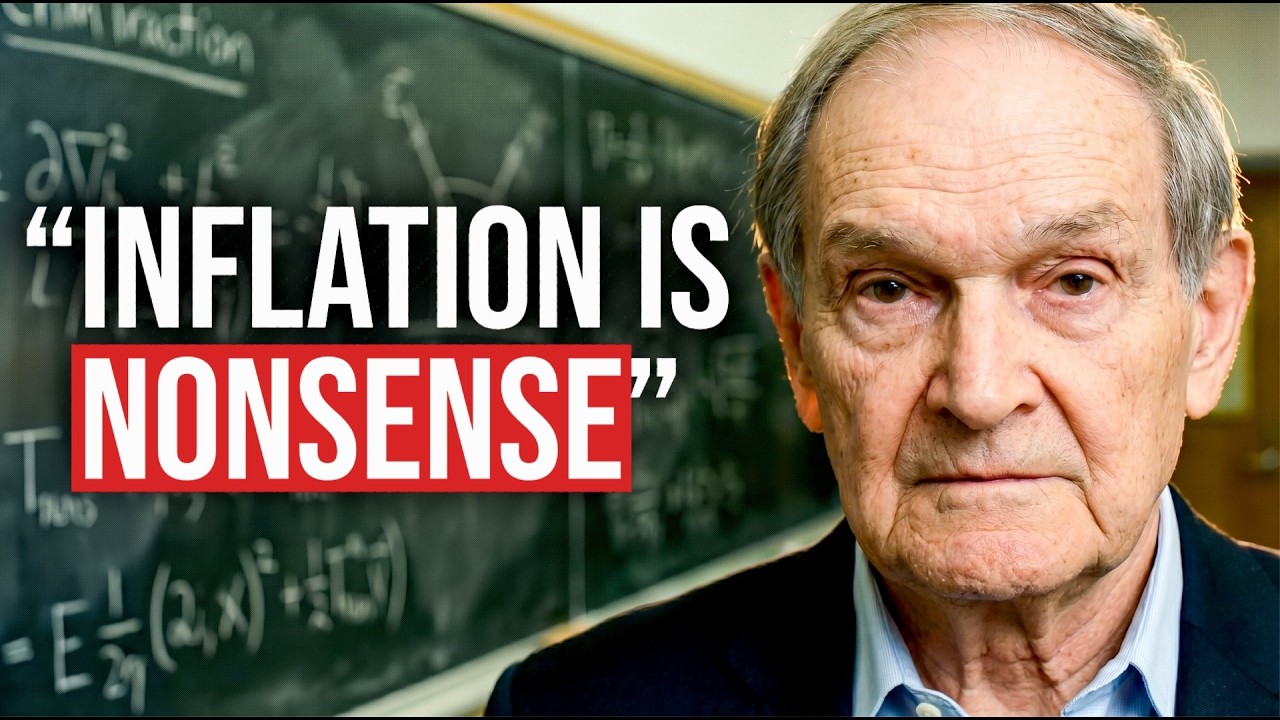
Sir Roger Penrose, Nobel laureate in physics, challenges two pillars of modern physics: the standard cosmological model and the completeness of quantum mechanics.
He argues the Big Bang was not the absolute beginning but part of a cyclic universe, and that quantum mechanics is fundamentally wrong—not just incomplete—because it lacks a physical mechanism for wave function collapse.
His views stem from deep mathematical reasoning, a commitment to following logic over consensus, and a lifelong pattern of dissenting from mainstream physics when he finds its arguments unconvincing.
Conformal Cyclic Cosmology (CCC)
Penrose rejects the standard cosmological narrative that the universe began with a Big Bang followed by inflation.
Inflation fails to explain why the Big Bang was so smooth and uniform, especially compared to the chaotic singularities expected inside black holes.
Instead, he proposes conformal cyclic cosmology: the universe undergoes infinite cycles (“eons”), each beginning with a Big Bang and ending in a remote future.
The key insight is that mass becomes irrelevant at both ends of an eon, allowing the geometry to become scale-invariant (conformal).
At the Big Bang, extreme temperatures make particle rest mass negligible compared to kinetic energy.
In the remote future, only massless particles (like photons) remain, and massive Dirac particles (e.g., electrons) effectively lose their mass due to scaling behavior.
Without mass, there is no fixed scale—only angles and light cones matter—so the remote future of one eon can be smoothly matched to the stretched-out Big Bang of the next.
This explains the low entropy and smoothness of our Big Bang without invoking inflation.
Gravitational degrees of freedom vanish at both boundaries, preserving smoothness across cycles.
The Collapse of the Wave Function
Penrose insists that quantum mechanics is fundamentally wrong, not merely incomplete.
While Schrödinger and Einstein said it was incomplete, Penrose goes further: the theory’s framework must be overhauled because it lacks a physical account of wave function collapse.
Most physicists ignore or sidestep the measurement problem; Penrose sees it as a critical gap.
He proposes that wave function collapse is a real, physical process driven by gravity.
When a quantum superposition involves sufficient mass displacement, general relativity demands that the state collapses.
This is not caused by consciousness (contrary to Wigner’s suggestion), but rather collapse enables consciousness.
He derives a collapse timescale (independently found by Diósi) based on gravitational energy differences between superposed states.
For macroscopic objects (like a cup), collapse is instantaneous.
For microscopic systems (like molecules), it can take much longer.
His model avoids the “heating problem” that ruled out Diósi’s version by introducing a distinction between quantum reality and classical reality.
Quantum reality obeys retrocausal logic but cannot transmit usable information backward in time, avoiding paradoxes.
Classical reality emerges when mass displacement triggers irreversible collapse.
Consciousness and Physics
Penrose is a physicalist: he believes consciousness arises from physical laws, but not yet known ones.
He was inspired by Gödel’s incompleteness theorems, which show that mathematical understanding transcends formal computation.
Understanding requires awareness; thus, consciousness cannot be purely computational.
He argues that consciousness depends on wave function collapse, which is non-computable and rooted in quantum gravity.
This led him to collaborate with Stuart Hameroff on microtubules as potential sites for quantum effects in the brain, though he admits biology is not his expertise.
He remains skeptical of AI: current LLMs mimic intelligence without understanding or awareness.
They fail simple tests (e.g., counting letters in “strawberry”) and lack genuine comprehension.
He worries people may mistake persuasive outputs for real intelligence or even form emotional attachments to AI.
Critique of Modern Physics
Penrose sees quantum gravity as less urgent than the gravitization of quantum mechanics.
Quantum gravity might describe black hole interiors, but we can’t observe them.
The real mystery is how gravity affects quantum systems—specifically, how it causes wave function collapse.
He criticizes mainstream trends:
String theory relies on unobserved extra dimensions and a negative cosmological constant, contradicting evidence for a positive one.
Inflation is widely accepted but doesn’t solve the core problem of initial smoothness.
Many-worlds interpretation is philosophically extravagant and untestable.
He notes that quantum experiments confirming the theory involve negligible mass displacement, so they don’t probe the regime where his corrections apply.
Personal and Historical Reflections
Penrose’s scientific courage comes from trusting his own reasoning over consensus.
His singularity theorems (which contributed to his Nobel Prize) emerged from rejecting the then-popular belief that singularities were artifacts of symmetry.
He values intellectual independence, even when isolated from colleagues.
He recounts key interactions:
With Eugene Wigner, who entertained but wasn’t dogmatic about consciousness causing collapse.
With John Wheeler, whose emphasis on “information” he found vague and unconvincing.
With Ed Witten, who sought his support for a negative cosmological constant (which Penrose refused based on observational evidence).
With Stephen Hawking, with whom he had a complex relationship—Hawking initially took credit for Penrose’s black hole area theorem idea, later acknowledged it publicly.
He expresses regret about never meeting Erwin Schrödinger, whose writing inspired his own science communication.
The Three Worlds and Three Mysteries
Penrose frames reality as a triangle of three domains:
Platonic world (mathematical truths)—eternal, static, discovered not invented.
Physical world—governed by laws that use only a small part of mathematics.
Mental world (consciousness)—only partially explained by physics.
The connections between them are the “three mysteries”:
Why does physics use such beautiful, specific mathematics?
Why is only part of physics associated with consciousness?
How does consciousness access mathematical truth beyond computation?
He rejects the idea that Platonic objects have dynamics—they exist timelessly.
Final Thoughts
Penrose remains convinced that a major revolution in physics is needed, centered on the interplay between gravity and quantum mechanics.
Current quantum theory works brilliantly in low-mass regimes but fails when gravity matters.
The missing piece is a theory of gravitationally induced wave function collapse.
He is collaborating with Ivette Fuentes on a new experiment testing these ideas, results of which are pending publication.
Despite criticism, he maintains confidence in his reasoning: “The conventional ideas don’t work. You need something crazy.”