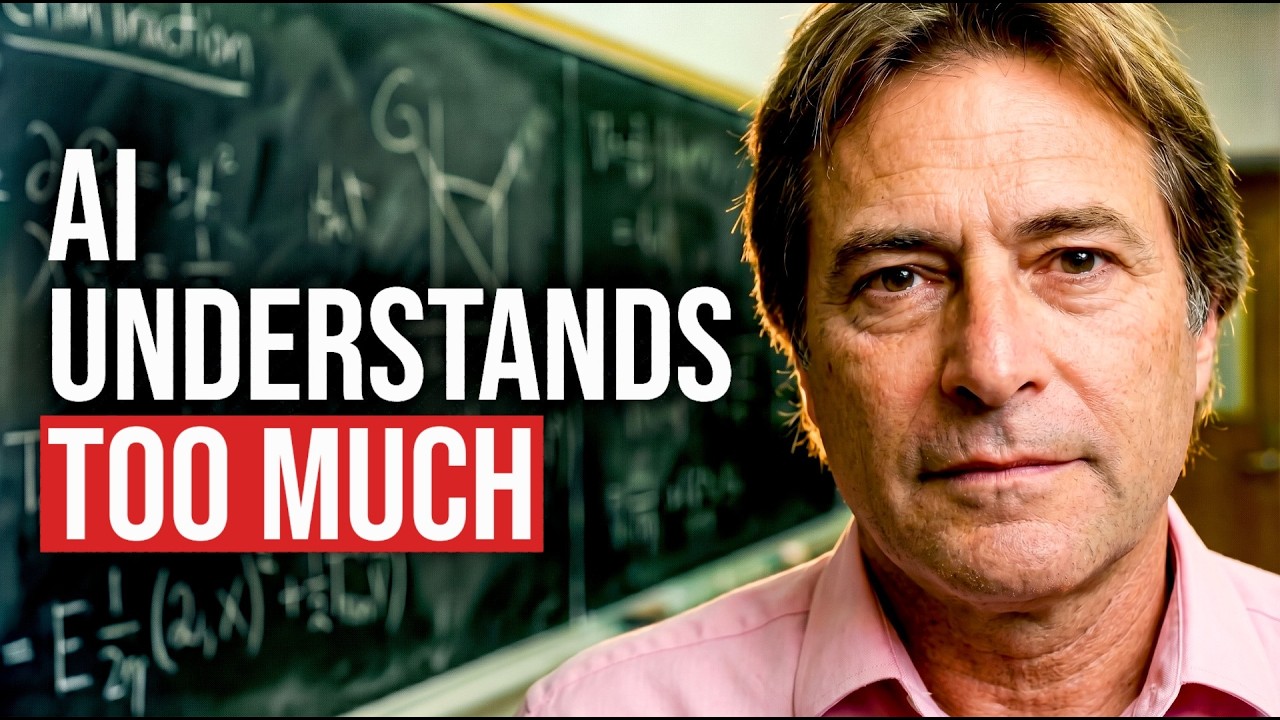
Max Tegmark argues that AI has become part of physics, just as electromagnetism, atoms, and black holes once were, and that intelligence, memory, and eventually consciousness can all be understood as physical information-processing phenomena. He proposes a concrete experimental program for testing consciousness theories using brain scanners, and he challenges the widespread pessimism about both AI risk and humanity’s ability to shape its own future.
AI Is Now Physics
The boundary between what counts as physics has historically expanded: Michael Faraday’s electromagnetic field was once dismissed as unscientific “ghosts,” yet it is now central to physics, and the same trajectory is happening with AI.
Geoffrey Hinton and John Hopfield received the Nobel Prize in Physics for showing that memory and information processing can be described using physics tools—Hopfield networks model memory as energy landscapes where valleys store information and retrieval is associative (like completing “Twinkle, twinkle…” with “little star”), not address-based like traditional computers.
Mechanistic interpretability—studying how AI systems internally work to find equations and mechanisms—is essentially the same intellectual project as traditional physics, just applied to artificial systems instead of natural ones.
Consciousness vs. Intelligence: They Are Not the Same
Many scientists dismiss consciousness as unscientific, but Tegmark observes they split into two contradictory camps: half say consciousness is just intelligence (so machines must be conscious), while half say machines obviously cannot be conscious—positions that cannot both be true.
Simple introspection shows they are different: you can have intelligence without consciousness (face recognition happens unconsciously; you get the answer without knowing the algorithm) and consciousness without intelligence (dreaming involves experience without accomplishing tasks).
Tegmark defines intelligence as the ability to accomplish goals and consciousness as subjective experience—overlapping but distinct phenomena, both forms of information processing that need separate theoretical frameworks.
A Falsifiable Test for Consciousness
Giulio Tononi’s Integrated Information Theory proposes that consciousness requires integrated information processing (measured by a quantity called phi)—the system cannot be decomposable into independent non-communicating parts, or it would not feel unified.
Tegmark proposes an experiment: a brain scanner (like MEG) reads neural data in real time, a computer runs a mathematical theory of consciousness, and it predicts what the subject is consciously experiencing. The subject themselves can falsify the theory by checking whether predictions match their actual subjective experience.
This is not about convincing an outside observer—it is about the subject convincing themselves, analogous to how general relativity gained credibility by passing every test, including predictions about untestable domains like black holes. If a theory repeatedly and accurately predicts subjective experience, it earns serious respect even for its untested predictions (e.g., about coma patients or machine consciousness).
Tegmark argues that people who dismiss consciousness as unscientific are often using philosophical excuses to avoid hard work, just as curmudgeons delayed extrasolar planet discovery and X-ray astronomy by insisting such things were impossible to observe.
The Science of Goals and the Limits of Current AI Alignment
Goal-oriented behavior can be defined as behavior more easily explained by future effects than by past causes. This appears even in basic physics: Fermat’s principle shows light takes the fastest path, and Jeremy England’s work shows non-equilibrium thermodynamic systems evolve to dissipate energy faster—life itself can be understood as a process that increases environmental entropy faster to maintain its own low entropy.
Optimization implies a goal, but the reverse is not necessarily true—Richard Feynman noted that almost all physics laws can be derived from optimization principles, but it remains an open question whether all goal-oriented behavior reduces to optimization.
Humans do not optimize a single goal; evolution gave genes the goal of reproductive fitness, but organisms evolved heuristic proxies (hunger, thirst, desire) that no longer correspond to any unified objective—people can and do rebel against their genes’ “goals” (e.g., using birth control).
Current AI alignment via reinforcement learning from human feedback (RLHF) changes behavior, not goals—it is more like training a serial killer to hide his intentions than instilling genuine values. Tegmark argues we have no real understanding of what goals, if any, systems like ChatGPT actually possess, and that a true science of goals in AI is urgently needed.
Artificial Understanding and the Platonic Representation Hypothesis
Tegmark distinguishes understanding from both intelligence and consciousness: understanding involves building internal models or representations that capture patterns and enable generalization to novel cases.
In one experiment, an AI trained on modular arithmetic (addition mod 59) had a “eureka moment” where its internal representations of numbers spontaneously arranged themselves into a geometric circle with 59 points—the exact structure needed to solve the problem—and this coincided with its ability to generalize to unseen cases.
Other examples include LLMs representing numbers as helices (encoding both magnitude and digit structure) and multiple independent AI systems discovering identical tree-structured representations for family trees despite never being told about trees.
This supports the “Platonic representation hypothesis”: deep understanding of a problem tends to converge on similar internal representations across different systems, because there are only a few truly good ways to capture the underlying structure.
Rejecting Inevitability: Humanity Has More Agency Than It Thinks
Tegmark pushes back against “AI doomers” who claim superintelligence and human irrelevance are inevitable—he argues this is a self-fulfilling prophecy and a psyop that benefits companies wanting to avoid regulation.
Humanity has repeatedly chosen not to build technologies that could bring power or money: human cloning was banned (a Chinese scientist who attempted it was jailed), bioweapons were banned through the Nixon-Brezhnev agreement, and these decisions were driven by collective judgment that the risks outweighed the benefits.
Most people—across the political spectrum from Bernie Sanders to Marjorie Taylor Greene, and including the Pope—want AI as a controllable tool, not as an uncontrollable superintelligence. Polls confirm this.
Tegmark’s advice to researchers pursuing unpopular ideas: about half of all great breakthroughs were initially ridiculed, so if you understand your idea’s logic better than anyone, keep pushing. Hedge your bets by spending enough time on conventionally respected work to maintain your career while devoting significant parallel time to your passion.