Geometric Unity (GU) is Eric Weinstein’s proposed “theory of everything” — a framework that attempts to unify general relativity (gravity) with the Standard Model of particle physics, starting from a single 4-dimensional manifold and deriving all known particles, forces, and structures from the geometry of a higher-dimensional “observer’s” space (a 14-dimensional metric bundle), rather than adding them by hand.
The core idea is that instead of fixing a metric on spacetime (as in general relativity), GU considers the space of all possible metrics at each point — a fiber bundle called the observer’s (Y¹⁴) — and shows that the ingredients of modern physics (gauge groups, fermions, the Higgs, generations of matter, mixing matrices, the cosmological constant) emerge naturally from the geometry of this larger space when pulled back to the base 4-manifold via “observation maps.”
The theory is built using standard tools from differential geometry — fiber bundles, connections, spinors, index theory — but introduces novel constructions (the chimeric bundle, the Zorro construction, the Shiab operator, the augmented torsion tensor, and a Dirac–Rarita–Schwinger complex) to resolve long-standing incompatibilities between gravity and gauge theory, most notably the twin origins problem (Einstein’s contraction of the Riemann tensor does not respect gauge symmetry) and the chicken-and-egg problem of quantum gravity (spinors require a metric to be defined, but the metric itself is dynamical).
GU claims to derive, rather than postulate: the Standard Model gauge group SU(3)×SU(2)×U(1) as the maximal compact subgroup of a larger non-compact group coming from spin(7,7); three generations of fermions from the decomposition of a novel Dirac–Rarita–Schwinger complex; the Higgs field as the vertical component of the gauge potential; the Yukawa coupling as minimal coupling; the Higgs quartic (Mexican hat) potential from the Yang-Mills structure; and the CKM/PMNS mixing matrices and cosmological constant from components of the gauge potential.
The Problem GU Addresses
Modern physics rests on two incompatible pillars:
General relativity: gravity as spacetime curvature, described by the Einstein field equations derived from the Einstein–Hilbert action (Ricci scalar curvature).
The Standard Model: three of the four fundamental forces (strong, weak, electromagnetic) described by Yang–Mills gauge theory with gauge group SU(3)×SU(2)×U(1), plus fermions (Dirac equation), the Higgs mechanism, Yukawa couplings, three generations of matter, and CKM/PMNS mixing.
A true theory of everything must encompass both, starting from minimal assumptions and recovering all these ingredients — not merely quantizing gravity (which is not a TOE).
The speaker argues that quantum field theory has developed in an unbalanced way, relying too heavily on analysis (calculus) and neglecting geometric, topological, and algebraic structures — a trend being corrected over the last 50 years by work connecting geometry to physics (Simons, Witten, Atiyah, Singer, etc.).
The Observer’s Construction (Y¹⁴)
Start with a smooth 4-dimensional manifold X⁴ — no metric, no connection, just topology (assumed spin/orientable/connected).
Construct the metric bundle (observer’s) Y¹⁴: at each point of X⁴, attach the space of all possible symmetric non-degenerate bilinear forms (metrics) on the tangent space.
A symmetric 4×4 matrix has 10 independent components, so each fiber is 10-dimensional; combined with the 4-dimensional base, Y¹⁴ is 14-dimensional.
Rather than choosing one metric (as in GR), GU works with the entire space of metrics simultaneously.
Observation maps (local sections ι: X⁴ → Y¹⁴) pick out a specific metric at each point; pullback via ι brings geometric data from Y¹⁴ down to X⁴.
This resolves the chicken-and-egg problem: spinors can be defined on Y¹⁴ without first choosing a metric on X⁴.
The Frame Bundle and Its Double Cover
Construct the frame bundle over X⁴: fibers are all ordered bases (frames) for the tangent space; structure group is GL(4,ℝ).
GL(4,ℝ) has no finite-dimensional spinor representation (because squaring to −I has no real solution), so pass to the double cover (the meta-linear group) to enable spinors.
This is standard in differential geometry but essential for defining fermions.
The Chimeric Bundle
The tangent space of Y¹⁴ at a point splits into:
Vertical subspace V: tangent to the fiber (variations of the metric at a fixed point); 10-dimensional.
Horizontal subspace H: directions along the base X⁴; requires a choice of connection to define; 4-dimensional.
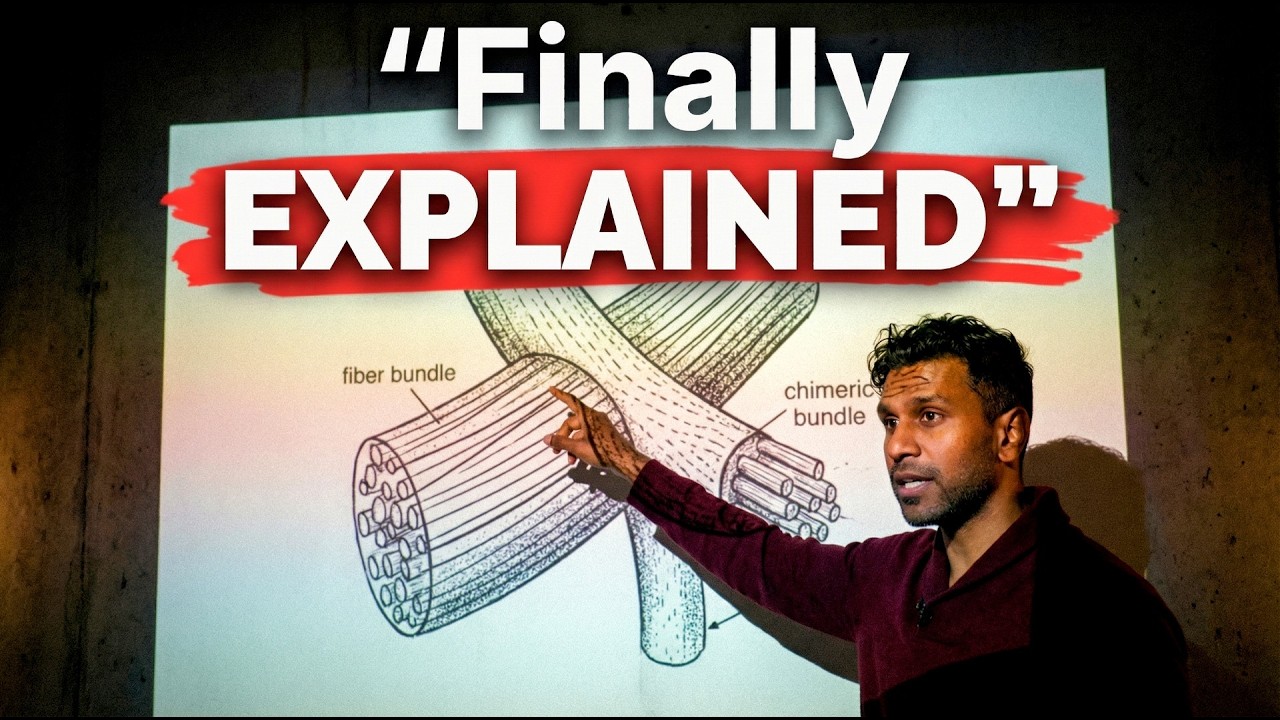
The chimeric bundle C is defined as V ⊕ H* (vertical plus the dual of the horizontal), not V ⊕ H — this asymmetry is crucial for unifying gravity with gauge theory.
The vertical space inherits a natural metric via the Frobenius inner product on symmetric matrices: ⟨A,B⟩ = Tr(AB).
This gives V a signature (4,6) or (3,7); GU chooses (4,6).
The horizontal space inherits signature (1,3) from spacetime.
Total signature of the chimeric bundle: (7,7).
Spinors Without a Metric
The signature (7,7) determines the structure group Spin(7,7).
The real spinor representation of Spin(7,7) has dimension 2⁷ = 128; complexified, this splits into two 64-dimensional Weyl spinor representations of split signature (32,32) ⊕ (32,32).
Using the exponential property of spinors (the spinor bundle of a direct sum is the tensor product of the spinor bundles), the spinor bundle on the chimeric bundle decomposes as S(C) ≅ S(V) ⊗ S(H*).
When pulled back to X⁴ via an observation map, this yields spacetime spinors ⊗ internal quantum numbers — exactly the structure needed for Standard Model fermions.
Spinors exist on Y¹⁴ prior to any metric choice on X⁴; the metric on X⁴ is only selected upon observation (pullback).
The Structure Group and Gauge Symmetry
The full symmetry group acting on the complex spinor space is U(64,64) (preserving a Hermitian form of signature (64,64)).
GU introduces the inhomogeneous gauge group 𝒢 = ℋ ⋉ 𝒩:
𝒩 represents “translations” in the space of connections (the space of connections is an affine space, not a vector space).
This parallels how the Poincaré group combines Lorentz transformations with spacetime translations, but here in the context of gauge theory.
A right action of 𝒢 on the space of connections 𝒜 is defined to make 𝒜 into a right 𝒢-space.
The Zorro Construction
To define the horizontal subspace H canonically (without arbitrary choices), GU uses the Zorro construction (named for its zigzag pattern):
Choose a global section (a metric on X⁴).
This determines a unique Levi-Civita connection ℵ on X⁴ (by the fundamental theorem of Riemannian geometry).
The Frobenius inner product on the fibers induces a metric G_ℵ on Y¹⁴.
G_ℵ determines its own Levi-Civita connection A_ℵ on Y¹⁴.
A_ℵ defines a canonical horizontal distribution on Y¹⁴.
This gives a natural way to “lift” vectors from X⁴ to Y¹⁴ and to split TY¹⁴ into vertical and horizontal parts.
The Augmented Torsion Tensor
GU defines an augmented torsion tensor T_ω that combines aspects of gravity (torsion) and gauge theory (covariant derivatives) while maintaining gauge covariance.
Under gauge transformations, T_ω transforms covariantly — resolving the twin origins problem (Einstein’s contraction of the Riemann tensor does not commute with gauge transformations).
This is the gauge-covariant analog of the Einstein tensor construction.
The Shiab Operator
The Shiab operator (named by Weinstein) generalizes Einstein’s contraction of the Riemann tensor to a gauge-covariant operation.
It acts on gauge-covariant 2-forms and produces a Ricci-like term and a scalar-curvature-like term, while respecting gauge symmetry.
It is constructed using wedge products, Hodge stars, and conjugation by gauge parameters (ε) to ensure covariance.
The Shiab operator is the key mechanism that allows GU to treat gravity and gauge theory in a unified geometric language.
The Action Principle and Field Equations
The GU action is first-order in derivatives (like Chern–Simons), unlike the second-order Einstein–Hilbert action.
Field variables are ω = (ε, π), where ε is a gauge transformation and π is a gauge potential.
The action combines the augmented torsion tensor with curvature through the Shiab operator, plus a mass-like term for torsion with coupling constant κ.
Varying the action yields field equations analogous to Einstein’s equations and Yang–Mills equations, but gauge-covariant.
A quadratic term in the augmented torsion is required for gauge covariance, analogous to the A∧A term in Yang–Mills field strength.
Fermions and the Dirac–Rarita–Schwinger Complex
Fermions are described by spinor-valued forms on Y¹⁴: a spinor-valued 0-form (ψ) and a spinor-valued 1-form (ζ).
GU introduces a novel Dirac–Rarita–Schwinger operator (a block-matrix operator mixing 0-forms and 1-forms), which is a new construction not found in the prior literature.
The upper-left block involves the Shiab operator acting on the derivative of ζ.
Off-diagonal blocks couple ψ to ζ, analogous to supersymmetry transformations.
This operator acts on the pair (ζ, ν) where ζ is a spinor-valued 1-form and ν is a spinor-valued 0-form.
The square of this operator yields a Laplacian-like operator (up to curvature terms), just as the ordinary Dirac operator is the “square root” of the Klein–Gordon operator.
Three Generations of Matter
The kernel of the Dirac–Rarita–Schwinger operator on Y¹⁴ decomposes into three distinct sectors, each 16-dimensional when pulled back to X⁴:
First generation: scalar spinors (spinor-valued 0-forms) — electron, electron neutrino, up quark, down quark.
Second generation: the gamma-traceless part of the spinor-valued 1-form ζ.
Third generation (called the “imposter generation” by Weinstein): the gamma-trace part of ζ (a Rarita–Schwinger field).
Each sector is 16-dimensional, matching the fermion content of one generation in conventional SO(10) grand unification.
The decomposition arises from the Clifford algebra structure: a spinor-valued 1-form splits into a part that vanishes upon contraction with gamma matrices (gamma-traceless) and a complementary gamma-trace part.
An index-theoretic argument (using the Atiyah–Singer index theorem, adapted to this context) shows that the net index forces exactly three sectors.
Spin(1,3) ≅ SL(2,ℂ) is the double cover of the Lorentz group.
Spin(6,4) has Spin(6) × Spin(4) as its unique maximal compact subgroup.
Spin(6) ≅ SU(4), Spin(4) ≅ SU(2) × SU(2) → this is the Pati–Salam model.
Further reduction: SU(4) → SU(3) × U(1), and the correct embedding of the residual U(1) yields SU(3) × SU(2) × U(1) (up to discrete identifications).
Alternatively, GU can use the non-compact real form SU(3,2) (a real form of SL(5,ℂ)), whose maximal compact subgroup is U(3)×U(2); imposing the “special” condition (determinant = 1) recovers the Standard Model gauge group.
The Standard Model gauge group is thus not arbitrarily chosen but is the maximal compact subgroup of the geometric structure group.
The Higgs Field from Gauge Geometry
The Higgs field in GU is not an independent scalar field but arises as a component of the gauge potential π (the adjoint-valued 1-form on Y¹⁴).
When π is pulled back to X⁴ via an observation map, the tangent vector splits into horizontal and vertical components:
The horizontal part gives the Yang–Mills gauge fields (spin-1).
The vertical part (variations of the metric at a fixed point) loses its vectorial character and becomes a scalar field (spin-0) — this is the Higgs field.
Specifically, symmetric 2-tensors decompose into trace and traceless parts:
The trace part (1-dimensional) gives the Higgs (spin-0).
The traceless part (9-dimensional) gives spin-2 contributions (graviton-like).
The Higgs kinetic term (dφ)² comes from the Yang–Mills action on Y¹⁴ after decomposition.
The quartic (Mexican hat) potential φ⁴ arises from the Yang–Mills self-interaction term ⟨A∧A, A∧A⟩ when A contains the Higgs component — it is not put in by hand but emerges from gauge geometry.
The negative mass-squared term (giving the Mexican hat shape) comes from coupling between φ and other components of A.
Yukawa Coupling as Minimal Coupling
The Yukawa coupling (giving fermions mass) is not introduced by hand in GU.
It arises from the minimal coupling (gauge covariant derivative) in the Dirac operator on the chimeric spinor bundle: D̸_A = D̸_{A₀} + γ^μ A_μ.
When A contains the Higgs component φ, the term γ^μ φ_μ ψ is precisely the Yukawa interaction.
Fermion masses arise when the Higgs acquires a vacuum expectation value, as in the Standard Model, but here the entire structure is derived from geometry.
The Cosmological Constant and CKM/PMNS Matrices
The gauge potential π, when pulled back to X⁴, has multiple components:
One component gives the Standard Model gauge fields.
One gives the Higgs field.
One contributes a constant term to the Einstein equations — identified with the cosmological constant (dark energy).
Another determines mixing between generations — giving the CKM matrix (quark mixing) and PMNS matrix (neutrino oscillations).
These are not independent parameters but intrinsic parts of the geometric structure.
The CKM matrix arises because the internal 16-dimensional representation spaces permit gauge transformations that mix the three families; the misalignment between the unitary matrices diagonalizing up-type and down-type quark mass matrices produces the physical mixing matrix.
The Deformation Complex and Seesaw Mechanism
GU constructs a deformation complex to study small perturbations around solutions:
The first map encodes infinitesimal gauge transformations.
The second map gives the linearized field equations.
The cohomology (kernel modulo image) describes physical degrees of freedom.
The Dirac–Rarita–Schwinger operator has a seesaw-like structure (block matrix with a zero in the lower-right corner), which allows for mass hierarchies between different fermion sectors — potentially explaining why the three generations have such different masses.
Recovering Known Physics
Einstein field equations: Obtained by applying the Shiab operator (or a restriction of it, called P_E) to the curvature of the distinguished connection on Y¹⁴, then pulling back to X⁴. The result is a gauge-covariant Einstein tensor G + Λg = κT.
Yang–Mills equations: The Yang–Mills action on Y¹⁴, contracted via the Shiab operator, reduces to the standard Yang–Mills action on X⁴ after pullback.
Dirac equation: The Dirac operator on the chimeric spinor bundle, when pulled back, gives the standard Dirac equation coupled to gauge fields and the Higgs.
Klein–Gordon equation: The kinetic and potential terms for the Higgs-like scalar field reproduce the Klein–Gordon equation with a nonlinear (Mexican hat) potential.
Lorentz group: Spin(1,3) from the horizontal part of Spin(7,7).
Family quantum numbers: The 16 internal degrees of freedom per generation come from the vertical spinor representation (64-dimensional, factoring out the 4-dimensional spacetime spinor, giving 16).
Open Questions
What is the phenomenology of the predicted but currently unobserved decoupled sectors (dark sectors)? Could high-energy gravitational interactions reveal them?
How does GU account for matter-antimatter asymmetry? Is antimatter hidden in a decoupled chiral sector, or is the asymmetry an initial condition?
How far do the numerical coincidences go (e.g., the 16-dimensional fermion multiplets, connections between spinor structures and the Einstein equations)? What is a red herring versus a smoking gun?
The theory currently has open questions comparable to those in string theory, loop quantum gravity, and asymptotic safety — this is expected for any framework of this scope.
The speaker notes that roughly 30–40% of GU’s content was not covered in the episode, indicating the theory is still being explored and developed.