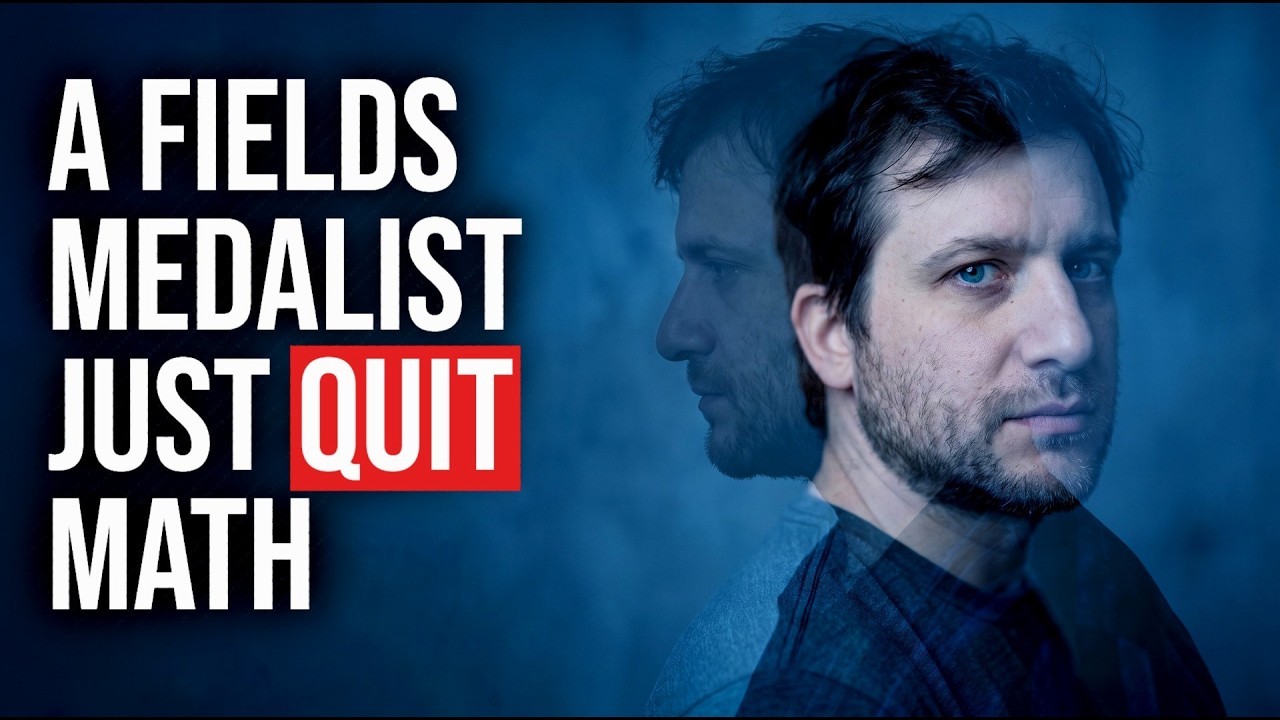
Jacob Tsimerman, a Fields Medalist mathematician, discusses his decision to leave academia for OpenAI’s AI safety team days after receiving math’s highest honor, framing it as a response to AI’s rapid transformation of mathematics and a grief for the traditional mathematician’s way of working.
Fields Medal and Career Transition
Jacob won the Fields Medal for work on O-minimality and the André-Oort and Griffiths conjectures, projects spanning 10–13 years each.
On the award stage, he announced a temporary leave to join OpenAI’s AI safety team, stating he wants to work on what he considers the most important problem.
He describes grieving the loss of the traditional mathematician’s identity: year-long projects, slow aha moments, and deep specialization.
He believes mathematics as a field will navigate the change, but the profession — especially for young people entering PhDs — is being upended.
He declined to sign the Leiden Declaration on responsible AI use in math, disagreeing with parts of it, though he acknowledges its risk assessments are important.
He views the Fields Medal as encouragement for future achievement and intends to use the platform to advocate for AI safety work.
AI’s Impact on Mathematics
AI is advancing in math faster than expected because math is a closed system requiring no experiments or materials.
OpenAI recently released solutions to 10 more conjectures, including construction of non-solvable groups.
Jacob expects a brief period where mathematicians prompt LLMs to solve problems, then a shift where human contribution becomes minimal.
Current AI proofs build on human work and use familiar ideas, though they are more disorganized and require substantial rewriting.
The larger issue is not incomprehensible proofs but the volume of comprehensible proofs produced faster than humans can absorb.
Mathematicians currently maintain a division of labor across narrow subfields; AI will collapse this by producing results across all areas simultaneously.
Credit assignment, PhD training, and the definition of mathematical work are already in tumult.
Jacob anticipates a transition where AI systems run continuously, making conjectures, solving problems, and building theories autonomously.
Nature of Mathematical Understanding and Proof
A Lean-verified proof that no human understands is technically a proof (a valid deduction sequence) but fails the social function of conveying understanding.
Mathematicians already rely on “black boxes” — accepted theorems they cannot re-prove from scratch — as Fefferman noted: knowledge exists in tiers from deep mastery to vague awareness.
Understanding is measured by ability to apply concepts to test cases; Jacob carries toy examples in his head to evaluate new ideas.
The “click” of understanding often comes from mapping an explanation onto internal examples, not from working through full formal details.
General proofs are often a worse test of understanding than checking a few concrete examples; abstraction can obscure rather than clarify.
Gödel’s incompleteness theorems illustrate the gap between big-picture intuition and nitty-gritty formalization; Jacob can sketch the proof but does not hold it all in working memory at once.
Pure Math, Physics, and Applications
Math explores structures limited only by logical coherence, unlike physics or chemistry which are constrained by physical reality.
A successful theory is one where rigor outgrows intuition: definitions become precise enough to test and refine intuition (e.g., topology’s open/closed sets).
The loop between pure math and applications (e.g., information theory, Calabi-Yau manifolds in physics) currently takes decades; AI could accelerate it dramatically.
Yu Deng’s Fields Medal work — rigorously deriving global behavior from Boltzmann equations — exemplifies previously intractable physics-math bridges now becoming reachable.
Physics theories require modeling the physical world correctly before formalization; Lean can verify internal consistency but not physical correspondence.
Cognitive Mechanics of Understanding
Mathematicians use hyper-aggressive shorthand; understanding often means recognizing which object a term refers to (e.g., “X is a variety, not a sheaf”).
Toy examples serve as internal testbeds: if a method works on a known hard case, it gains credibility.
Writing full general proofs is rarely done until the paper stage; day-to-day work relies on checking key examples.
Working memory limits differentiate top experts (who hold proofs in compressed form) from others (who reconstruct stepwise).
In his own specialty (unlikely intersections), Jacob understands his contributions concisely, but newer developments (e.g., G-functions) require re-immersion to master.
Improv, Collaboration, and Competition
Jacob came from math competitions (solo, competitive) but now always collaborates — more fun and more effective.
Improv attracted him for its empathy, presence, and off-the-cuff nature — a dual to math’s slow, control-seeking grind.
Math is both collaborative and solo: confusions are personal, but friends help resolve them.
Stand-up feels like homework (memorizing sets); improv feels like play (no preparation, vulnerability encouraged).
In math, Jacob seeks total control and simplicity; in improv, he practices giving up control — a complementary balance.
AI Access, Meritocracy, and Power Dynamics
Early AI access is given to top researchers meritocratically, compounding their advantage — a pattern seen in all fields (grants, labs, collaborators).
Jacob acknowledges the fairness concern but notes no clear alternative: companies have profit motives, governments can become authoritarian.
He sees motivated reasoning in AI skepticism: mathematicians fear job loss and meaning loss, and some respond with vitriol rather than compassion.
The question is not whether mathematicians lose jobs, but how society structures human roles when AI surpasses humans at more tasks.
Tim Gowers’ response to the Leiden Declaration grapples with the difficulty of finding a stable human role that AI cannot also master.
AI Safety and Societal Response
Jacob advocates for a distributed “Manhattan Project” for AI safety: theory, government, social work, formal verification, diverse institutions.
He praises the UK’s AISI (AI Safety/Security Institute) for grants, mentorship, and cross-lab collaboration.
Unrestricted optimization — continuously ceding control to smarter AI — is a risky proposition; society must impose deliberate limits.
The meta-answer to uncertainty is broad, early debate: think tanks, government commissions, public discourse to hedge bets before the transition hits.
Current AI capabilities (coding agents, theorem provers) would have seemed like magic 5–10 years ago; society must recalibrate expectations.
Career Advice for Young Mathematicians
Jacob stopped taking non-AI-focused students because he cannot ethically promise a career path that may not exist in its current form.
He advises hedging: engage with math but also learn AI, computer science, and how the world is changing.
Pure math already has more grad students than tenure-track jobs; AI will exacerbate this mismatch.
Passion for math should be pursued, but not with eyes closed to the shifting landscape.
The biggest advice: get oriented now — use AI tools, experience the managerial shift, build transferable skills before they become necessary.
The Managerial Shift in Knowledge Work
Jacob’s first coding agent experience (Claude Code) produced a complete typing game in 6 hours — overwhelming speed requiring curation, not creation.
He now acts as a manager: directing, correcting, deciding next steps, without reading all generated code.
This mirrors the coming shift in math: mathematicians will direct AI, digest outputs, and choose directions rather than execute steps.
Karpathy and others report similar shifts in programming: from writing code to managing AI-generated features and prototypes.
The skill set becomes managerial: defining goals, evaluating outputs, steering iteration.
Cognitive Offloading and Adaptation
Students already depend on LLMs for answers within seconds; Jacob sees this as an incentive problem, not a cognitive catastrophe.
Midterms forced honest self-assessment; exams will continue to reveal gaps when AI is unavailable.
People adapt to incentives: if a skill becomes unnecessary (log tables, mental multiplication), it atrophies without harm; if it remains practical, people retain it.
Historical panic over calculators, writing, etc. proved unfounded; Jacob trusts human adaptability more than most.
Excitement About AI’s Potential
Jacob loves learning and sees AI as removing skill bottlenecks: personalized tutors for chemistry, physics, music, game design, D&D, writing.
He composes music in Logic Pro without mastering scales; AI will extend this to more domains.
The promise is a world where anyone can engage with what they find fun, unblocked by prerequisite drudgery.
Beyond near-term tools, qualitative improvements in human experience — currently sci-fi — may arrive rapidly.