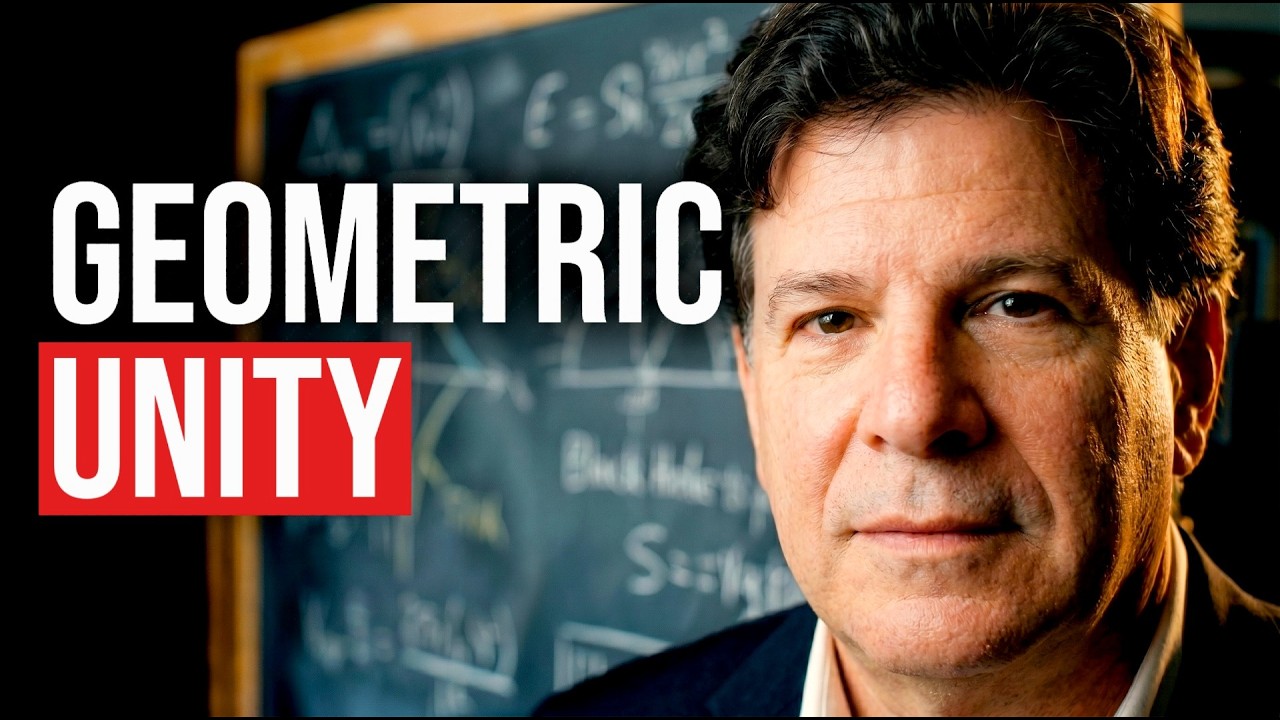
Eric Weinstein’s Geometric Unity (GU) is a proposed “theory of everything” that attempts to derive the full complexity of the Standard Model and general relativity from an almost minimal starting point: a four-dimensional manifold with just four degrees of freedom and a small amount of additional structural information (such as spin structure and number of temporal dimensions). The theory has been developed privately by Weinstein since the mid-1980s and was first publicly discussed in a 2013 Oxford lecture. It remains unpublished in peer-reviewed journals and has not been formally evaluated by the mainstream physics community. This conversation—between Weinstein and mathematician Curt Jaimungal—is described as the first in-depth technical discussion of GU in podcast form, covering its core ideas, its relationship to known physics, the missing generations of matter, dark matter, quantization challenges, and Weinstein’s fraught experiences with academic credit and peer review.
Core Architecture of Geometric Unity
The fundamental arena is not spacetime itself, but a fiber bundle relationship between two spaces:
The base space is a four-dimensional manifold (X₄), where classical physics lives.
The total space is a 14-dimensional manifold (Y₁₄), where quantum phenomena are naturally defined.
This separation is meant to reduce the conflict between quantum mechanics and general relativity by not forcing both onto the same geometric stage.
The bundle structure replaces the classical notion of an “ether”—the medium in which waves (particles) propagate is the bundle itself, not spacetime.
The theory is built from the “inhomogeneous gauge group” (gauge group ⋉ gauge potentials), which is then “supersymmetrized” algebraically—not via spacetime supersymmetry, but by adjoining fractional-spin fields whose (anti)commutators land back in the Lie algebra of the gauge group.
This is described as “taking the square root of connections” rather than taking the square root of momentum (as in conventional supersymmetry).
Weinstein explicitly rejects spacetime supersymmetry and the existence of superpartners at LHC energies.
The 14-manifold behaves like a 3-manifold in two distinct ways:
Through a Chern-Simons-like structure (bosonic magic).
Through a “rolled-up” Dirac complex (fermionic magic), where the full 0-to-14 form sequence is collapsed to essentially 0 → 1 → 13 → 14 by contracting intermediate degrees, mimicking a 3-complex.
This dimensional collapse is what produces the three generations of fermions.
The Origin of Three Generations
The three generations of Standard Model fermions arise from the decomposition of spinor-valued differential forms on the 14-manifold:
First generation: Spinor fields tensored with 0-forms (ordinary spinors, technically “0-form-valued spinors”).
Second generation: Spinor fields tensored with 1-forms, then Clifford-contracted across the tensor product (the “gamma trace” part).
Third generation: The kernel of that contraction map—the “gamma traceless” part, which is representation-theoretically distinct from the first two.
At the level of the broken subgroup (the Standard Model gauge group), two of these generations look isomorphic in their representation spaces, while the third is different—this is a prediction about lepton universality violations at higher energies.
At higher energy/curvature scales, the theory predicts new particles:
Spin-3/2 fermions coupled to a 16-dimensional complex vector space (conjugate to the Standard Model fermion representation).
Additional spin-1/2 fermions coupled to a previously unobserved 144-dimensional complex representation.
These would become coupled to the observed third generation when the symmetry rises to the Pati-Salam level (Spin(6) × Spin(4), equivalent to SU(4) × SU(2) × SU(2)).
The Pati-Salam Structure and Grand Unification
GU naturally produces a Pati-Salam model, but insists on the correct real form: Spin(6) × Spin(4), not SU(4) × SU(2) × SU(2).
The distinction matters because the embedding in GU uses Spin groups (double covers), which affects spinor representations and the global structure of the theory.
The observed SU(3) × SU(2) × U(1) is a maximal compact subgroup of a non-compact real form of Spin(10).
The theory uses an indefinite Killing form, which nature “hides” by only showing us the compact subgroup at currently accessible energies.
The Frobenius inner product used in GU is the trace-reversed version—one of exactly four possible metrics on the space of metrics; the two obvious ones are ruled out by experiment.
This trace reversal echoes Einstein’s initial (un-trace-reversed) Ricci tensor, which Weinstein calls a mistake he would be proud to have independently reproduced.
Dark Energy and the Cosmological Constant
GU replaces the cosmological constant (Λgμν) with a dynamical term built from an adjoint-valued 1-form (denoted varpi):
The replacement is: varpi minus an epsilon-gauge-transformed, counter-rotating exterior derivative coupled to the “olive” connection, applied to the epsilon gauge transformation.
This term does not need to be constant; it can respond to curvature, potentially solving the cosmological constant problem by making dark energy a vacuum expectation value (VEV) rather than a fixed parameter.
Recent DESI data suggesting the cosmological constant may be variable is consistent with this structure.
The Dirac-Rarita-Schwinger Operator and Chirality
The fermion sector of GU uses a “rolled-up” Dirac-type operator (analogous to the Dirac-Rarita-Schwinger operator) that combines the exterior derivative, its Hodge dual, and a connection into a single first-order operator on even and odd forms.
GU is fundamentally non-chiral, but produces an effective chiral theory at low energies:
A VEV in a Dirac-like operator couples the two chiral halves.
When scalar curvature drops (low gravity regime), the operator decouples into Weyl-type operators, and the chiral sectors separate.
What we call “luminous” matter would be coupled to “dark” matter when gravity (curvature) is strong enough—suggesting a gravitational mechanism for dark matter.
The Observers and the Metric Bundle
The “Observers” in GU is the full package of two spaces, a fiber, sections connecting them, and bundles over both—analogous to a class in object-oriented programming with member variables (data) and bound methods (operations).
Most of the theory’s action takes place on the spinor bundle over Y₁₄, not on the tangent bundle of X₄ as in general relativity.
The action has homology (structural similarity) to both the Einstein-Hilbert action and the Chern-Simons action, plus additional components.
The theory uses a “gauge-rotated Levi-Civita connection” (related to contortion rather than torsion) because of its superior equivariance properties under the inhomogeneous gauge group.
Quantization and Technical Debt
GU is currently a classical theory; its quantization procedure is not yet known.
The main obstacle is that with multiple temporal dimensions on the base space, one encounters ultra-hyperbolic equations, for which the Cauchy problem is poorly understood.
Weinstein openly acknowledges this as “technical debt”—a stopgap measure that must be resolved, but one that should not invalidate the classical structure.
The classical theory is argued to be more fundamental than the quantum:
Classical phase space “bootstraps” its own quantization medium through geometric quantization (the symplectic form is the curvature of a connection on a bundle over phase space).
Weinstein calls the community’s focus on quantum mechanics a “quantum fetish” and argues that the classical action already contains everything needed—quantization is a consequence, not a prerequisite.
Predictions and Falsifiability
GU makes several concrete predictions:
Spin-3/2 matter coupled to a 16-dimensional representation (conjugate to Standard Model fermions).
A 144-dimensional complex representation of additional spin-1/2 fermions.
Lepton universality violations at higher energies (two generations are representation-theoretically distinct from the third).
Dynamical (non-constant) dark energy.
No superpartners at LHC energies.
New physics is expected in three regimes (following Sabine Hossenfelder’s classification):
Very high masses (beyond current collider energies).
Very weak coupling (like neutrinos).
Special configurations accessible at low energies but requiring novel experimental designs (like the Aharonov-Bohm effect).
The Seiberg-Witten Equations Controversy
Weinstein claims that the Seiberg-Witten equations—central to modern differential topology and mathematical physics—originated as a “flake” of GU around 1987 at Harvard.
He presented them as Einstein-type equations (not Yang-Mills-type), but was told they were “insufficiently nonlinear” and dismissed.
When Seiberg and Witten independently published the same equations in 1994, they were celebrated; Weinstein was not credited.
He does not accuse Witten or Seiberg of theft (both are acknowledged as brilliant), but criticizes the academic system for its handling of priority and credit.
The equations were called “insufficiently nonlinear” for seven years before being vindicated; Weinstein jokes that he would like them renamed “the insufficiently nonlinear equations.”
Critique of Academic Culture and Peer Review
Weinstein has a deeply adversarial relationship with academic institutions:
He was denied access to the arXiv (requires .edu affiliation), was offered a special exemption (which he refused on principle), and ultimately chose not to submit.
He describes peer review as “peer injunction”—a system that suppresses novelty rather than evaluating it.
He argues that peer review did not exist as a formal practice before 1965 and was originally a defense by physicians against government oversight of medical pricing.
He proposes replacing peer review with powerful, accountable editors (like the old system at Nature, where the double helix paper was published without external review).
He identifies systemic problems in physics:
The “Matthew effect” (credit accumulates to those who already have it) and the “Matilda effect” (women’s contributions are systematically uncredited).
The “Sudarshan effect” (giants like George Sudarshan, who co-discovered the V-A structure and made foundational contributions, are denied Nobel recognition).
String theory’s dominance described as “the only game in town”—an ethically problematic suppression of alternatives.
He calls modern fundamental physics “NERF physics”—a degraded, safe version of the real subject—and proposes criteria for what constitutes genuine physics:
Must be on a 4-manifold (not 10 or 11 dimensions).
Must have exactly one temporal dimension.
Must include SU(3) (quantum chromodynamics).
Must include three generations of fermions.
Must have the Higgs in the adjoint representation.
Must be phrased in the language of bundles and connections.
He claims that essentially zero current papers satisfy all these criteria.
Personal Dimensions and Motivation
Weinstein’s notation choices are deeply personal:
Greek letters π, ζ, ν, ε represent his wife, son, daughter, and himself.
Hebrew letters (Gimel, Aleph) honor his Jewish heritage; a Devanagari character was considered to honor his family’s Indian heritage.
He describes 40 years of working in isolation, with no one to have a real technical conversation with—this podcast being the first such exchange.
His stated goals extend beyond personal recognition:
Breaking open peer review.
Opening the arXiv to anyone regardless of credentials.
Forcing transparency around the national security classification of theoretical physics (the “born secret” doctrine under the Atomic Energy Acts, which he claims means certain theoretical work can be automatically Q-classified, with severe legal consequences).
Restoring the scientific method over what he calls the “academic method” (impact factors, H-indices, consensus narratives).
He draws a parallel to Alexander Grothendieck’s rejection of the Crafoord Prize—refusing to participate in a culture that normalizes theft from young researchers.
Reception and the Path Forward
Academic reception of GU has been mostly silence:
Weinstein regularly meets with top academics (at Caltech, UCLA, Hebrew University, the Institute for Advanced Study), but no one has invested the time needed to fully digest the theory.
The skill set required—deep knowledge of both the Standard Model and bundle geometry—is nearly extinct; these communities have diverged.
The “pop academic” reception is split:
Some (like Stefan Alexander, Edward Frenkel, Marcus du Sautoy, Brian Keating) have engaged seriously.
Others dismiss it heuristically: an older, non-academic person making extraordinary claims without playing by institutional rules is treated as a classic crank failure mode.
Weinstein’s response to criticism is to steelman other theories (Garrett Lisi, Peter Woit, string theory, loop quantum gravity) and to note that GU has never been steelmanned in return.
The conversation ends with Weinstein reflecting on the strangeness of having a real technical discussion after a lifetime of solitary work, and with Eugenio Bianchi’s observation that GU contains not one but many new ideas—“an entire field” in a single concept—which makes it cognitively difficult for the community to process.