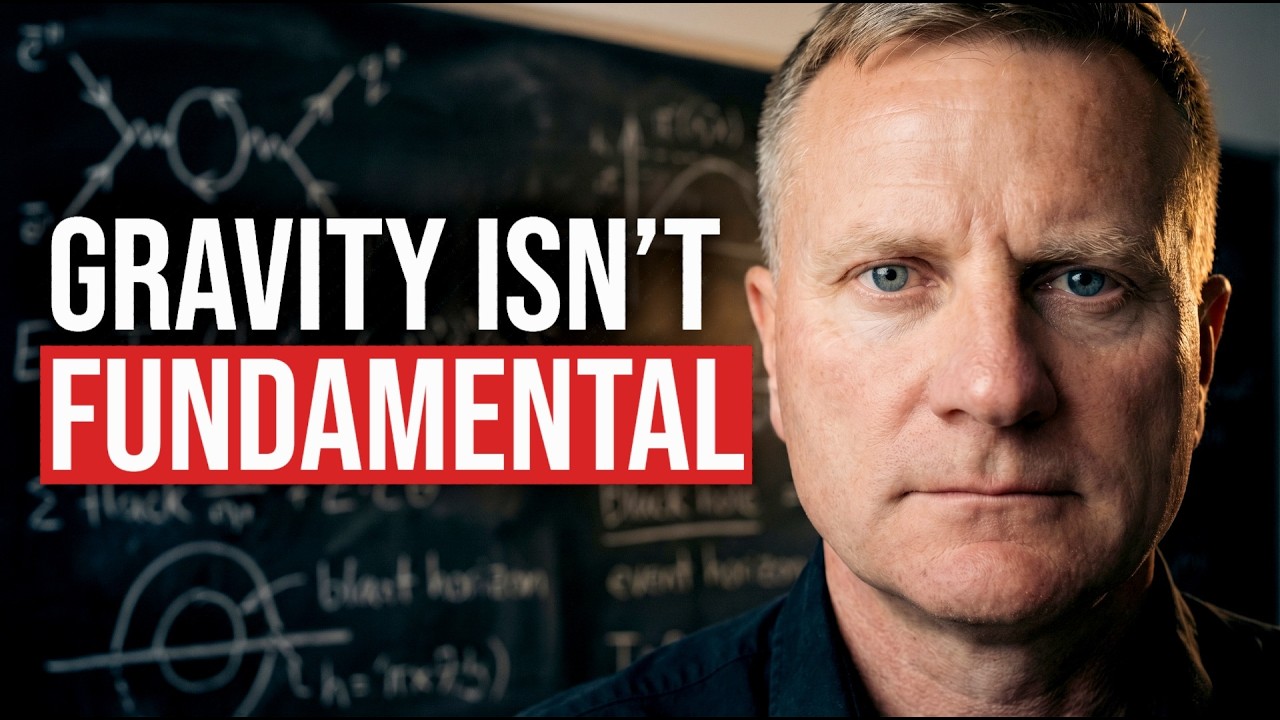
- Frederic Schuller is a theoretical physicist and celebrated teacher known for deriving Einstein’s general relativity from Maxwell’s electromagnetism alone — not postulating gravity separately, but showing that the Einstein-Hilbert action emerges inevitably when you demand that matter dynamics and spacetime geometry evolve together predictively on shared Cauchy surfaces. He is also developing a new approach to the measurement problem in quantum mechanics, importing a formalism from engineering called the port Hamiltonian approach, which reframes physical systems in terms of energy or probability flows through boundary ports rather than treating them as monolithic closed systems.
Deriving Gravity from Matter Dynamics
-
Schuller’s key insight is called constructive gravity: rather than postulating both a gravity action and a matter action independently, you start with a matter action on an unspecified geometric background and ask what dynamics that background must have in order for the combined system to be predictive — meaning initial data on a Cauchy surface evolves to data on a future Cauchy surface shared by both matter and geometry.
- Starting with Maxwell electrodynamics on an arbitrary metric background, the requirement of a well-defined Cauchy problem forces the metric to have Lorentzian signature — this is not assumed but derived.
- Solving what Schuller calls the “construction equations” — equations built purely from information extracted from the matter action — yields the Einstein-Hilbert action (with undetermined gravitational constant and cosmological constant). The dynamics of gravity are not postulated; they are derived.
- The same result holds for other standard model fields, including non-abelian gauge theories, which was verified by Schuller’s former master’s student Alexander Wirtz.
- The method converts the physical question “what gravity theory supports this matter?” into a mathematical one: solve the construction equations whose coefficients are built from properties of the matter action.
-
Why this matters: If an observation were made that is incompatible with a Lorentzian metric — such as vacuum birefringence (light rays splitting into different polarizations in empty space) or faster-than-light neutrinos — general relativity would be immediately falsified. But Schuller’s framework is prepared for this: a phenomenologist could propose a new geometric background (for example, a fourth-rank tensor with Riemann-like symmetries), and the construction equations would yield the corresponding gravity action. This has not yet been needed, but the machinery is in place.
-
The work builds on earlier contributions by Kuchař, Teitelboim, and the ADM formalism, but pushes further by using the predictive-structure requirement to fully determine the gravitational dynamics rather than leaving them as a free choice.
A New Approach to the Measurement Problem
- Schuller’s current research applies the port Hamiltonian formalism — developed in engineering by Arjan van der Schaft, Bernhard Maschke, and others — to quantum mechanics. In classical engineering contexts, this formalism captures how energy flows between subsystems through “ports” (boundary interfaces), which is essential for controlling robots interacting with humans or managing large electrical networks.
- In quantum mechanics, however, energy does not flow between subsystems in any meaningful continuous way. Most states in a finite-dimensional Hilbert space are not energy eigenstates, so energy is not a well-defined quantity for a general quantum state — it only takes definite values upon measurement.
- What does flow in quantum systems is probability. Schuller and collaborators are developing a formalism based on probability ports rather than energy ports, which captures how probability redistributes between subsystems.
- This must be compatible with the fact that composite quantum systems are described by tensor products of Hilbert spaces, which include entangled states that cannot be decomposed into separate subsystem states. Any port-based decomposition must coexist with this structure.
- The goal is modest but concrete: not to deviate from quantum mechanics, but to formalize the talk — much of the language around measurement (“if you measure now,” “the outcome will occur”) is not reflected in the standard formalism. By building measurement-related concepts into the formalism itself, the approach aims to make the theory’s structure more transparent.
- Schuller believes they have cracked at least two of the three most prominent problems in this program, with the hardest remaining task being a full reformulation of the measurement axioms within the port Hamiltonian language.
On Research Philosophy: Modest Ideas and Conceptual Rigor
-
Schuller advocates for what he calls “modest ideas” — pursuing one idea deeply rather than combining many speculative modifications. He argues that if an idea is any good, trying to implement it will force the problem to dictate the next step, leading to further insights organically.
- He contrasts this with Einstein’s later career: after successfully taking Maxwell’s theory seriously (which led to special and general relativity), Einstein spent years trying to incorporate electromagnetism into geometric gravity via non-symmetric metrics — an approach that failed because it lacked the guiding constraint from nature that Maxwell’s theory had provided.
- Schuller distinguishes between formal generalization (e.g., making the metric non-symmetric because the electromagnetic field strength tensor is not symmetric) and conceptual generalization (asking why the metric was symmetric in the first place and whether a different answer is possible). He argues that formal generalizations typically fail; one must understand the deeper conceptual reason behind a structure before generalizing it.
-
He is critical of hand-waving in physics arguments. As an example, he notes that the concept of “center of mass” is often invoked casually even in special relativity, but it is actually ill-defined because it requires simultaneity, which is frame-dependent. What seems like a plausible argument can be fundamentally wrong if the underlying concepts are not precisely defined.
On Quantum Gravity: Should Gravity Be Quantized?
- Schuller is skeptical of the default assumption that gravity must be quantized. His reasoning:
- The standard model of particle physics is built on representations of the symmetry group of classical spacetime (the Poincaré group). Wigner showed that elementary particles correspond to irreducible representations of the universal covering group of this classical symmetry group. This means quantum matter theory fundamentally relies on a classical spacetime background.
- If you quantize the spacetime geometry, you undermine the very foundation — the classical space — on which the representation-theoretic construction of quantum matter rests.
- The quantum axioms themselves never instruct us to quantize spacetime; they only tell us that measurement outcomes are probabilistic. This opens the door to alternatives, such as the proposal by Oppenheim and collaborators that gravity remains a classical (possibly stochastic) theory interacting with quantum matter.
- Schuller does not claim to know the right answer, but he argues there are intelligent counterarguments to quantizing gravity, and the lack of progress in quantum gravity over many decades suggests something very different may be at work.
On Academic Freedom and the Bureaucracy of Science
- Schuller is a strong advocate for freedom of research and teaching, rooted in the Humboldtian university tradition. He is concerned that the modern grant system — particularly in the European Union — increasingly funnels research toward politically and bureaucratically determined topics (such as energy research), creating a monoculture that suppresses out-of-the-box thinking.
- He points out that nuclear power came from blue-sky research, not from government programs targeting energy. The most transformative breakthroughs cannot be planned by committees.
- He extends this principle to teaching: professors should have total freedom to design their courses as they see fit. This produces some terrible lectures but also the most brilliant ones, and the net effect is far better than centrally accredited, committee-designed curricula that produce uniformly average results.
On String Theory and Fashionable Research
- Schuller was not drawn to string theory as a student, despite it being the dominant direction for top students at the time. His discomfort was not prescience but a feeling that the setup was too ad hoc — for instance, using a Minkowski metric in 26-dimensional space because “Einstein told us so,” when Einstein’s reasoning was based on point particles and light clocks in four dimensions, not strings. He also questioned whether a fundamental string theory should measure area rather than length.
- He emphasizes that research choices are partly emotional and that he has no judgment of those who pursued string theory — he would have been delighted if it had succeeded. But he prefers to follow ideas he and his collaborators generate rather than joining mainstream fields where thousands of people are already working.
Teaching Philosophy: From Propositional Logic to Differential Geometry
- Schuller’s celebrated lecture series, “Geometric Anatomy of Theoretical Physics,” starts from propositional logic and builds up through set theory, topology, and differential geometry — a starting point virtually no other physics course uses. His reasoning: to define a smooth manifold, you need topology; to define a topological space, you need set theory; and naive set theory is contradictory, so you need axiomatic set theory, which requires a formal language — hence propositional logic.
- His two foundational assumptions in teaching: (1) students know nothing (so he starts from scratch rather than assuming background), and (2) students are infinitely intelligent (so he never dumbs things down).
- He never uses motivating examples to introduce new concepts. His reason: motivating examples are always special cases that embed misleading intuitions. For instance, introducing vectors as “little arrows” makes students think vectors are recognizable objects rather than elements of an abstract set satisfying axioms. He prefers to give the definition first, then show 15 diverse examples afterward — including exotic ones like positive real numbers forming a vector space under multiplication as addition and exponentiation as scaling.
- He insists that only active researchers should teach advanced courses, because only they know where the subject is going and can redesign the presentation with research-grade thinking. He redesigns established courses from scratch each time, often changing the order of topics — for example, teaching classical mechanics through differential geometry so that students understand from the start that canonical momenta are covectors, not vectors.
- He teaches from the blackboard, never from slides, because the evolving drama of a live derivation — including the possibility of making and correcting mistakes in real time — is essential for student engagement and learning. He derives everything live in front of students as a sanity check: if he cannot develop it freely after morning preparation, he cannot expect students to do it at exam time.
On Learning and Understanding
- As a student, Schuller learned by checking every equal sign in every derivation — asking precisely why each step is valid. As a graduate student, he would sit in the cafeteria with blank paper and try to reconstruct entire subjects (classical mechanics, electrodynamics, quantum mechanics, statistical physics) from memory, which revealed all the gaps in his understanding.
- He applies the same method today when engaging with new material: he reads the gist, then tries to redevelop it himself. About 80% of the time, he realizes he simply didn’t understand the original; about 20% of the time, he finds the original argument naive and succeeds in setting it up better.
- He believes that the greatest privilege for a physics student is having great teachers — ranking it immediately after running water and air conditioning — and that students need physical presence to model themselves on teachers and to see peers both struggling and excelling. He is not a proponent of remote or online learning as a substitute for in-person education, though he is glad his freely available lectures help those who would otherwise have no access to such teaching.
On the Value of Universities and Teaching
- Schuller has won the Ars Legendi prize, one of Germany’s top university teaching awards, and his YouTube lectures have garnered millions of views and thousands of emails. But his motivation is not fame or outreach — it is a genuine desire to make students as good as possible, which he sees as a core responsibility of academic life.
- He believes that even if a researcher never makes a groundbreaking discovery, improving how the next generation learns a subject by even 5% is a major contribution to society, because knowledge is lost if it is not passed on efficiently.
- He views the great theories of physics — classical mechanics, general relativity, quantum field theory — as masterpieces comparable to works by Picasso or Rembrandt, shaped by geniuses and refined by thousands of excellent minds. Part of his teaching mission is to show students what a finished masterpiece looks like, so they can eventually create new ones.