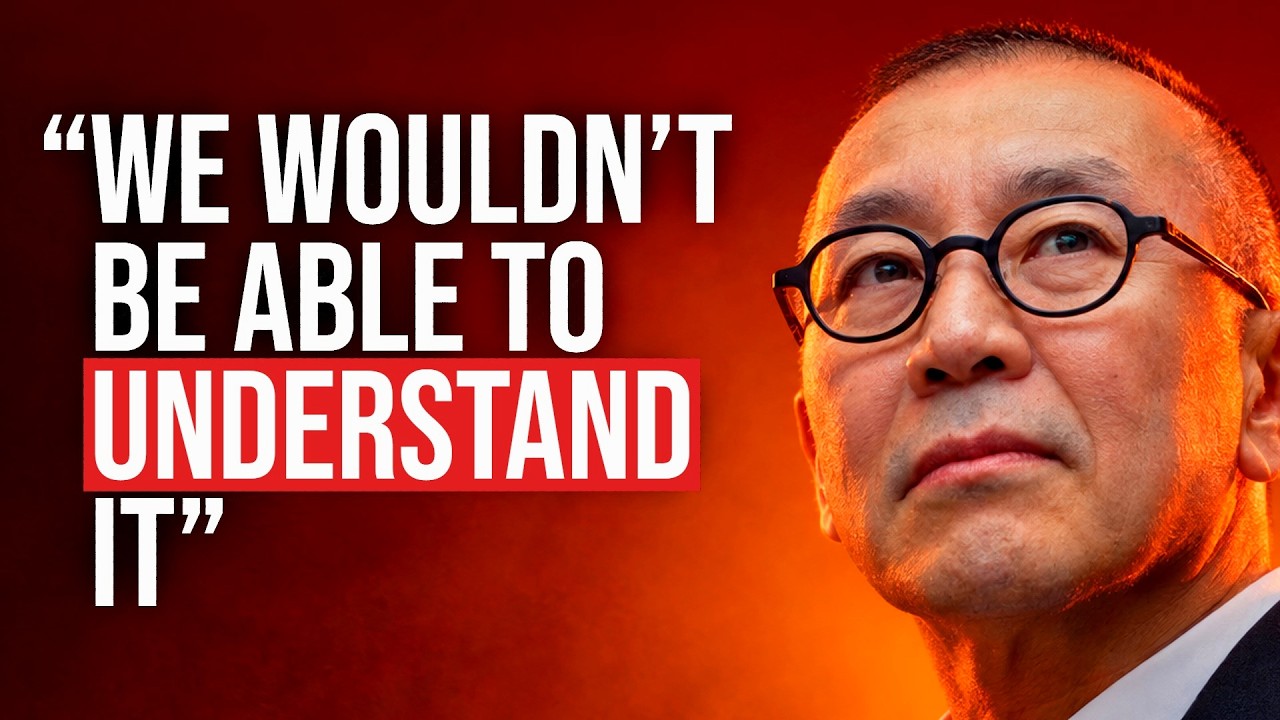
Hirosi Ooguri, Chair of Caltech’s Division of Physics, Mathematics, and Astronomy, discusses his path to theoretical physics, the relationship between physics and mathematics, the prospects and limitations of AI in fundamental physics, the swampland program and AdS/CFT correspondence, the timeline for verifying string theory, and his current research and daily routine.
Early inspiration and the nature of truth
A fifth-grade geometry exercise — measuring a telephone tower’s height using similar triangles — sparked Ooguri’s realization that careful observation and mathematics can reveal fundamental truths about the world.
He later estimated the Earth’s radius by measuring the distance to the horizon from a revolving restaurant, using his father’s knowledge of the distance to his hometown; the order of magnitude matched the encyclopedia value, reinforcing his conviction that “there is a truth in the world, and we can know about it.”
He chose physics over mathematics because he wanted to understand this world, not the Platonic world of all mathematical possibilities; physics picks out the one mathematical structure realized in nature.
Mathematical truth is exact and timeless given axioms; physical truth is always approximate, based on empirical observation within the accessible range (10⁻¹⁸ m to the cosmic horizon), but appears universally consistent within that range.
He distinguishes knowable truth from unknowable ontology: if a distinction makes no observable difference, it is not meaningful for science.
Physics versus mathematics: language, models, and verification
Mathematics is an artificial language designed to describe all possible worlds; natural language evolved for everyday scales and fails at extremes, making mathematics essential for physics.
Physics maps phenomena into a subspace of the Platonic mathematical world; the map is the model (e.g., the Standard Model), and its validation requires empirical testing, not just internal consistency.
LLMs excel in mathematics and coding because statements are precise and verifiable (Lean proofs, code execution); in theoretical physics, statements are approximate and lack algorithmic verification, making reinforcement learning difficult.
Quantum field theory — the language of particle physics — still lacks rigorous mathematical foundation; the Yang-Mills mass gap is a Millennium Problem precisely because formulating QFT in 4D rigorously remains open.
Statistical mechanics also has infinite degrees of freedom but is Euclidean; the oscillatory path integral in Lorentzian QFT adds unique difficulty.
AI in physics: current capabilities and future prospects
As of March 2026, Ooguri found LLMs comparable to a beginning graduate student in theoretical physics but far more advanced in mathematics, where they solve problems once known to be tractable with existing techniques (e.g., Navier-Stokes solved after rumors of a solution).
The key bottleneck: physics requires inventing concepts (mass, force) latent in data but not explicit; LLMs have few examples of this conceptual leap.
Yang-Mills is a mathematical problem (formalizing a theory physicists already use), not a physics problem (discovering the model); solving it may yield new mathematical tools useful for strongly coupled phenomena.
If AI eventually solves unification, there is a risk humans cannot understand the answer — like Ooguri’s dog Rosie knowing food is in the refrigerator but not why it stays cold.
AdS/CFT, the swampland program, and quantum gravity constraints
Wilson’s paradigm: low-energy effective theories need not know UV details; any Lagrangian can be completed. Gravity breaks this — the “final boss” of unification ends the hierarchy of scales at the Planck length.
Swampland conjectures (Vafa, Ooguri, Arkani-Hamed, et al.): not all low-energy gravity theories have consistent UV completions; consistency imprints constraints on the IR (e.g., no global symmetries, the Distance Conjecture).
AdS/CFT provides a non-perturbative definition of quantum gravity in anti-de Sitter space via a dual CFT, allowing rigorous tests of swampland criteria (e.g., Ooguri & Harlow proved no global symmetries in AdS gravity).
Ooguri and collaborators recently proved part of the Distance Conjecture in specific AdS/CFT setups; this constrains inflation models and predicts signatures in CMB polarization measurable in the next decade.
Nati Seiberg argues the Lagrangian formulation is too restrictive: many QFTs (especially conformal ones) satisfy all physical axioms but lack a Lagrangian description; string theory constructions reveal such theories.
String theory timeline and the role of AI
Historical scaling: unifying special relativity and QM took ~2 years; building the Standard Model and verifying it took ~90 years. Unifying GR and QM is ~25× harder → ~1,250 years to construct a realistic string model, ~1,000 more to test it (total ~2,250 years, comparable to atomic theory from Greeks to verification).
AI may compress this dramatically, but understanding the result is not guaranteed.
Ooguri’s commitment is to understanding nature’s fundamental laws, not to string theory per se; he studied alternatives (including loop quantum gravity) and still finds string theory the most promising path.
Current research projects
Distance Conjecture in AdS/CFT: Proving the full scope of how field expectation values varying beyond the Planck scale constrain inflation and CMB polarization; working with students and postdocs at Caltech.
Entanglement entropy inequalities via AI: After a Tokyo talk, a UTokyo professor introduced an optimization expert (ex-Stanford, startup founder, returned to grad school); together they developed vastly stronger reinforcement learning methods to classify entropy cones for holographic systems, revealing new entanglement patterns.
Mathieu Moonshine: Numbers from Ooguri’s PhD thesis (on K3 surfaces, organized as mock modular forms) matched the Mathieu group M₂₄ — a “moonshine” phenomenon akin to Monstrous Moonshine. Collaborating with mathematician Mayuko Yamashita (Perimeter Institute) to find the geometric origin of this correspondence.
Daily routine and work philosophy
Mornings reserved for deep thinking (wakes ~7 AM, breakfast with wife, physics until noon); afternoons for administration (Division Chair duties), seminars, collaborators; evenings for exercise, dinner, reading, more physics.
Administrative work offers quick gratification; fundamental physics is “traveling in a desert without a map” (Yukawa) — most days yield nothing, but rare discoveries give a “spectacular feeling” (e.g., seeing the Mathieu group numbers match his thesis).
Needs uninterrupted blocks; follows Mikio Sato’s advice: go to sleep thinking about the problem, wake up already in that world.
Exercise: virtual personal trainer (Japan-based) for Pilates/yoga/cardio, once weekly live + recorded sessions for accountability and posture correction.
What would change his approach?
No allegiance to string theory; allegiance is to the truth. If a more promising approach to unifying GR and QM appears, he would switch — science as a “market economy of ideas.”
The driving force remains: “There is a truth in the world, and we can know about it.”