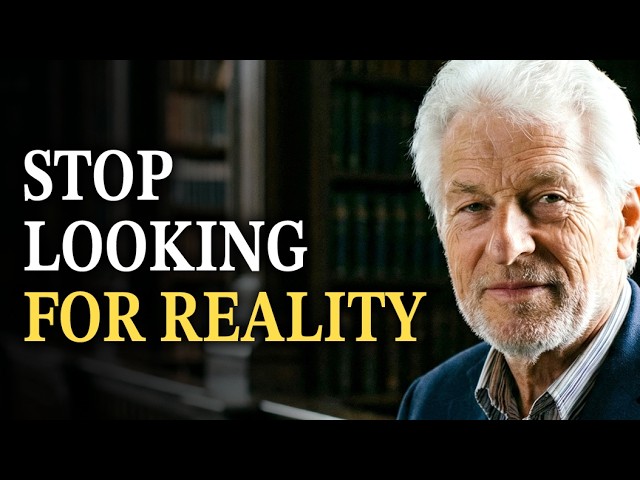
Bas van Fraassen is one of the most influential living philosophers of science, best known for his 1980 book The Scientific Image, which challenged the dominant view of scientific realism. He argues that science does not aim to deliver literally true descriptions of unobservable reality; instead, its sole aim is empirical adequacy — producing models that correctly predict observable phenomena. This position, called constructive empiricism, treats all theoretical entities (quarks, wave functions, etc.) as useful representational tools rather than literal truths about what exists. The conversation explores the implications of this view across science, language, the self, free will, faith, and the limits of representation.
Science, Models, and Anti-Realism
Scientific models are representations of phenomena, not mirrors of reality. They may trade on resemblance selectively (like a subway map), but they always involve choices about what to include and omit.
Van Fraassen distinguishes between direct measurements and theoretical quantities (those only measurable via theory-guided calculations). Empirical success concerns only the former, leaving open whether the theory is true about unobservables.
He is a common-sense realist about observable objects (rocks, trees, cups) but an anti-realist about unobservable posits of science. This is not agnosticism about truth — it is a claim about what the scientific enterprise is.
The “no miracles” argument for scientific realism (that predictive success would be miraculous if theories weren’t approximately true) fails because scientists always explain a theory’s success by appeal to a later or better theory — you cannot do this for science as a whole without stepping outside science.
He draws an analogy to natural selection: theories that fail empirical tests are discarded or modified; the ones that survive are empirically successful, but survival does not imply truth.
The Reality of Appearances and Common-Sense Realism
Van Fraassen rejects the appearance/reality distinction as traditionally conceived. What appears to us is real. The fact that perception is perspectival does not make it illusory.
He criticizes the view (expressed by Robert Lawrence Kuhn on Closer to Truth) that because photons and neural processes mediate perception, we cannot trust the reality of what we see. His response: you must trust your instruments (which are observable, tangible objects) before you can trust the theories derived from them. To do otherwise is to put the theoretical cart before the empirical horse.
A cup is solid. That it can be modeled as mostly empty space at the molecular level does not negate its solidity — it simply means the model serves a different purpose.
Determinism, Models, and Free Will
Determinism and indeterminism are features of models, not of the world. For any set of phenomena, there is always logical leeway to construct both deterministic and indeterministic representations. The question of which one applies to reality “as such” does not arise.
He affirms free will, drawing on Sartre: we are free up to the point where rational consciousness ends (e.g., extreme pain that eliminates choice). Sartre’s point is that you can never say “I could not have done otherwise” — any such claim is bad faith (false consciousness).
He disagrees with attempts to argue against free will from physics, noting that physics does not contain causal claims. Equations of motion describe; they do not cause. Causal language belongs to the personal, intentional domain (deliberation, planning, accountability), not to physics models.
He disputes Nancy Cartwright’s view that physics is inherently causal, arguing that causal readings of physical models are projections of human intentional language onto formal equations.
The Limits of Language and Tarski’s Theorems
Language is not merely a conduit for pre-existing thoughts — it is a medium of creation. We often do not know what we think until we write or speak it. Einstein’s redefinition of “simultaneous” as a three-term relation is an example of language changing conceptual structure irreversibly.
Drawing on Tarski’s limitative theorems, van Fraassen argues that no language can contain an adequate representation of itself. You cannot construct a true, complete semantic representation of your own language from within it.
Since we are language-endowed creatures, this implies we cannot construct an adequate representation of ourselves. The question “What am I?” cannot be fully answered — it is logically impossible to do so.
The Self Is Not a Thing
Van Fraassen’s central claim about the self: “I am not a thing. I am not a thing of any kind — not physical, not abstract, not supernatural. I am not a thing. Period.” Yet he insists he is not nothing — he exists, acts, has a body, has a past.
He uses Italo Calvino’s The Nonexistent Knight as an illustration: a knight who is only armor, nothing inside, yet performs all the functions of knighthood through faith and willpower. The point is that existence does not require being a thing.
He rejects the categories of monism, dualism, and pluralism as self-generated metaphysical puzzles — “analytic metaphysics” is a language game with no real stakes, where every problem can be solved by adding more metaphysics.
Faith, God, and Kierkegaard
Van Fraassen is a Catholic (converted from Protestantism) who describes himself as a religious existentialist. He says “yes” to the question of God’s existence but immediately distances himself from traditional theology, which he regards as metaphysics.
His faith is Kierkegaardian in spirit — a call to decision, not a set of propositions to be defended rationally. He compares being asked to “prove” God’s existence to being asked to “write a thesis about love” after falling in love.
He welcomes atheist critiques (e.g., Herman Philipse’s) as clearing away fallacies and superstitions, leaving what remains intact.
He was drawn to Catholicism through the ritual and continuity of the Mass — the same liturgy for nearly 2,000 years — and through figures like St. Francis, rather than through theological argument.
Disagreement on the Monty Hall Problem
Van Fraassen disagrees with the standard solution to the Monty Hall problem (that you should switch doors). He argues the prisoner variant (where a jailer names one other prisoner who will die) shows the information is empty and does not change the probability — a position that contradicts the standard Bayesian analysis and experimental evidence. He acknowledges he needs to think about it more.
How He Wants to Be Remembered
As a philosopher who was not just talking about scientific realism or constructive empiricism — but who engaged broadly with logic, language, faith, and the human condition.