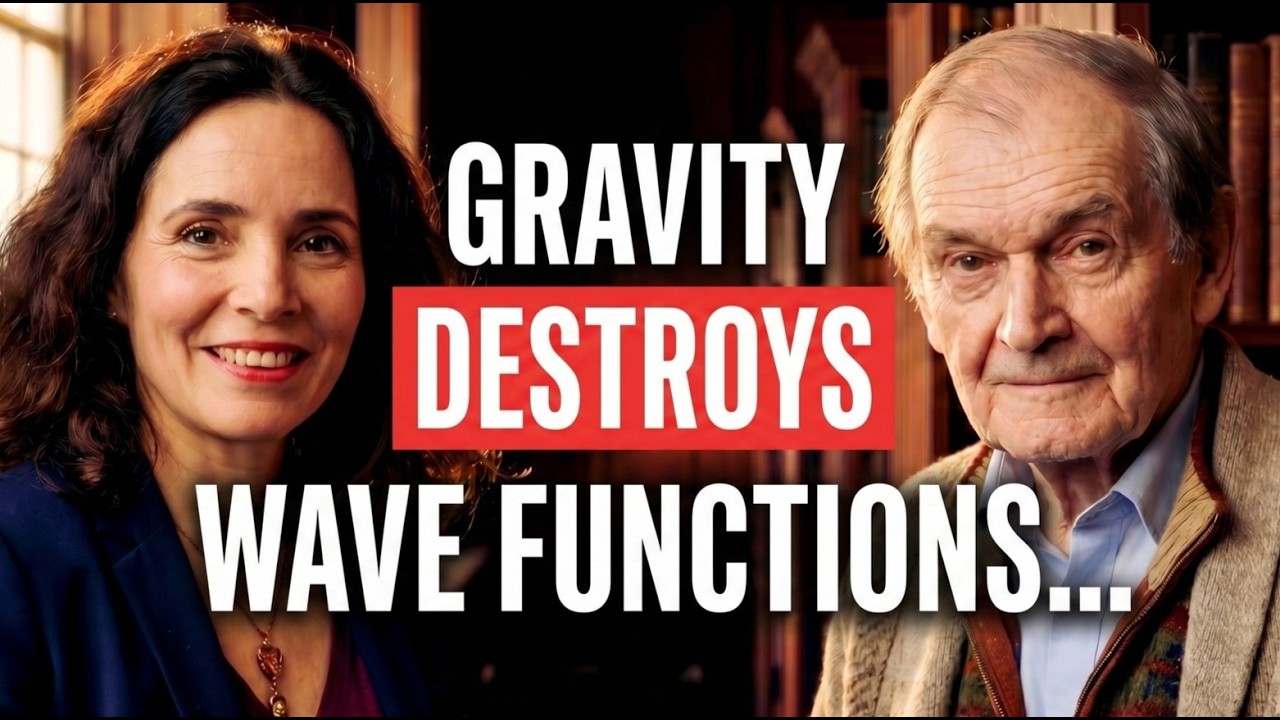
This episode features Sir Roger Penrose and Professor Ivette Fuentes discussing a new atom interferometer experiment by Ron Folman, its implications for whether the equivalence principle holds in quantum mechanics, and the broader question of whether gravity causes wave function collapse. The conversation also covers gravitons, dark matter, cyclic cosmology, and the challenges of testing quantum gravity experimentally.
The Ron Folman T-Cubed Experiment
Ron Folman’s experiment is a hybrid atom interferometer using a Bose-Einstein condensate of rubidium-87 atoms cooled to about 3 nanokelvin.
In a standard atom interferometer, atoms pass through laser beam splitters and follow two paths that later recombine to produce interference fringes, confirming quantum behavior.
Folman’s version is hybrid: one arm of the interferometer holds atoms levitated at rest in the lab using magnetic fields (canceling gravity), while the other arm lets atoms fall freely after a magnetic “kick.”
The setup uses an atom chip with wires producing magnetic fields that control the atoms’ trajectories and internal states.
The key result is an oscillation in the interference fringes that depends on the cube of time (T³), a signature predicted by theory.
The Equivalence Principle in Quantum Mechanics
The equivalence principle, originating with Galileo and foundational to Einstein’s general relativity, states that a gravitational field is locally indistinguishable from acceleration—you can “get rid of” gravity by free-falling.
The question is whether quantum mechanics respects this principle.
Theoretical analysis shows that comparing a quantum system in a gravitational field versus one in a freely falling frame produces wave functions that differ by a phase factor involving an exponential of T³.
Normally, such phase factors are physically irrelevant because they cancel out in probability calculations.
However, in quantum field theory, the vacuum state itself differs between the two cases due to this T³ term, making it physically meaningful.
Folman’s experiment observes this T³-dependent phase, confirming that quantum mechanics does respect the equivalence principle in this subtle way.
This is significant because it bridges general relativity (built on the equivalence principle) and quantum mechanics, two pillars of 20th-century physics.
The result was theoretically expected but had not been experimentally verified until now.
Active vs. Passive Gravity and What the Experiment Actually Tests
A crucial distinction is between passive gravity (a mass responding to an external gravitational field, like an atom falling in Earth’s field) and active gravity (the gravitational field produced by the mass itself).
Folman’s experiment tests only passive gravity: a single atom in superposition within Earth’s gravitational field. The atom’s own gravitational field is negligible.
Penrose argues that in this passive case, there is no conflict between the equivalence principle and quantum superposition—the T³ term appears and the equivalence principle holds.
The deeper question is whether the equivalence principle conflicts with superposition when the system’s own (active) gravitational field matters—that is, when a massive object is in a superposition of two locations and each location produces a different gravitational field.
Gravity-Induced Wave Function Collapse
Penrose’s proposal is that when a massive body is in a superposition of two different locations, the self-gravity of each branch differs, creating a fundamental instability.
The calculation involves comparing the gravitational self-energy of the two branches. The mismatch leads to a finite lifetime for the superposition—it spontaneously collapses into one location or the other.
For a macroscopic object like a rock, this lifetime is extraordinarily short (a tiny fraction of a second), explaining why we never see macroscopic superpositions.
This is not the same as environmental decoherence, which is often invoked but, in Penrose’s view, does not fully resolve the problem.
Folman’s experiment is a first small clue in this direction because it confirms the T³ term that underlies the theoretical framework, but it is far from testing active gravitational collapse directly.
For a single atom, the self-gravity collapse effect would take roughly 10²⁰ seconds to manifest—completely unobservable.
Testing the effect requires superpositions of much larger masses.
Experimental Prospects for Testing Gravitational Collapse
Current experiments are far from the mass scales needed to test Penrose’s collapse proposal.
The record for quantum superposition of a single object is held by Markus Arndt (University of Vienna), who has interfered molecules of roughly 2,000–20,000 atoms.
Penrose and Fuentes calculated that testing self-gravity effects would require about 10⁹ atoms in superposition—roughly the mass of a silica bead—held for 1–2 seconds.
Several experimental approaches are being pursued worldwide:
Solids in superposition: nanodiamonds, silica beads, silica rods, membranes, and cantilevers. The challenge is cooling these objects to quantum scales while maintaining coherence. Current cooling to microkelvin is still too warm.
Markus Aspelmeyer (University of Vienna) has cooled beads containing ~10⁸ atoms to the ground state of a harmonic oscillator but has not yet put them in a spatial superposition.
Hendrik Ulbricht (University of Southampton) has measured gravitational interactions between nanoscale systems, though not yet in the quantum regime.
Bose-Einstein condensate (BEC) approach: Fuentes and Penrose proposed using a BEC, which can be cooled to sub-nanokelvin temperatures.
A BEC is a collection of atoms (typically 10⁵–10⁶) all occupying the same quantum ground state, behaving as a single macroscopic quantum object.
The challenge is creating a “NOON state”—all N atoms on the left plus all N atoms on the right—in a double-well potential. This is extremely fragile because losing even one atom collapses the entire superposition. The current record is two atoms.
An alternative being pursued experimentally by Philippe Bouyer (University of Amsterdam) and Chris Westbrook (Paris), with theoretical input from Fuentes and Penrose, uses “two-mode squeezed states”—more robust quantum states that have already been produced in BECs and don’t require the extreme fragility of NOON states.
Fuentes has developed new formalism to calculate gravitational self-energy for these more accessible states, opening a potential near-term experimental route.
Do Gravitons Exist?
Penrose believes gravitons should exist but emphasizes that gravity is so weak and so fundamentally different from other forces that observing individual gravitons is extraordinarily far beyond current experimental reach.
Gravity does not have a standard energy-momentum tensor; it behaves differently from other forces.
What we observe are gravitational fields, not individual quanta.
Penrose introduces the concept of “big stuff” (or “grand stuff”)—the dominant mass-energy content of the universe, which is dark matter and the cosmological constant, not the ordinary matter we are made of.
Ordinary matter is a perturbation on the “big stuff.” Dark matter dominates the mass budget of galaxies and the solar system.
Penrose speculates that dark matter may consist of particles he calls “Erebons” (named after Erebus, the primordial Greek god of darkness), which could be a form of graviton or related to gravitational degrees of freedom from a prior cosmic epoch.
Fuentes agrees that gravity should be quantized and that gravitons likely exist, though she acknowledges uncertainty about their precise nature.
She disagrees with Jonathan Oppenheim (UCL), who proposes that gravity is classical and stochastic rather than quantized, though she admires that he proposes testable experiments.
Evidence from Cosmology: Rings of Galaxies
Penrose points to observations by Alexia Lopez of enormous rings of galaxies—structures several times the diameter of the Moon in angular size—as evidence for something before the Big Bang.
These rings are detected through magnesium absorption lines in the light of distant quasars, not by direct imaging.
They are too large to have formed in the age of the universe under standard cosmology.
In Penrose’s conformal cyclic cosmology (CCC), the remote future of one “eon” (a universe cycle) conformally matches the Big Bang of the next.
Supermassive black holes from a prior eon would eventually merge, producing powerful gravitational waves that pass through into the next eon and could seed galaxy formation in ring-like patterns.
Lopez’s observations of two or three such rings are consistent with this prediction, though they were not predicted by anyone beforehand.
Testing Collapse Models: Diósi-Penrose and Others
Lajos Diósi independently proposed (around the same time as Penrose) that gravity collapses the wave function, and he developed a stochastic model with specific predictions.
The Diósi model predicts spontaneous radiation and heating as a signature of collapse, but it does not conserve energy.
An underground experiment by a researcher named Catalina (surname not given) has tested this and other collapse models by looking for spontaneous heating. No signature was found, ruling out these models up to certain parameter values.
However, because collapse models depend on free parameters, they cannot be completely ruled out—only constrained.
Sugato Bose and colleagues proposed a different experiment: if two particles, each in a superposition, become entangled through their mutual gravitational interaction, this would demonstrate that gravity is quantum (requiring a quantum mediator).
This is technically even more difficult than collapse experiments, requiring two simultaneous superpositions brought near each other.
If the Diósi-Penrose collapse is correct, the superpositions would collapse before entanglement could be observed, meaning a null result in Bose’s experiment would not rule out quantum gravity—it would just push the relevant scales even further out of reach.
Fuentes supports pursuing both lines of experiment, noting that creative solutions to seemingly impossible experiments have succeeded before (e.g., LIGO).