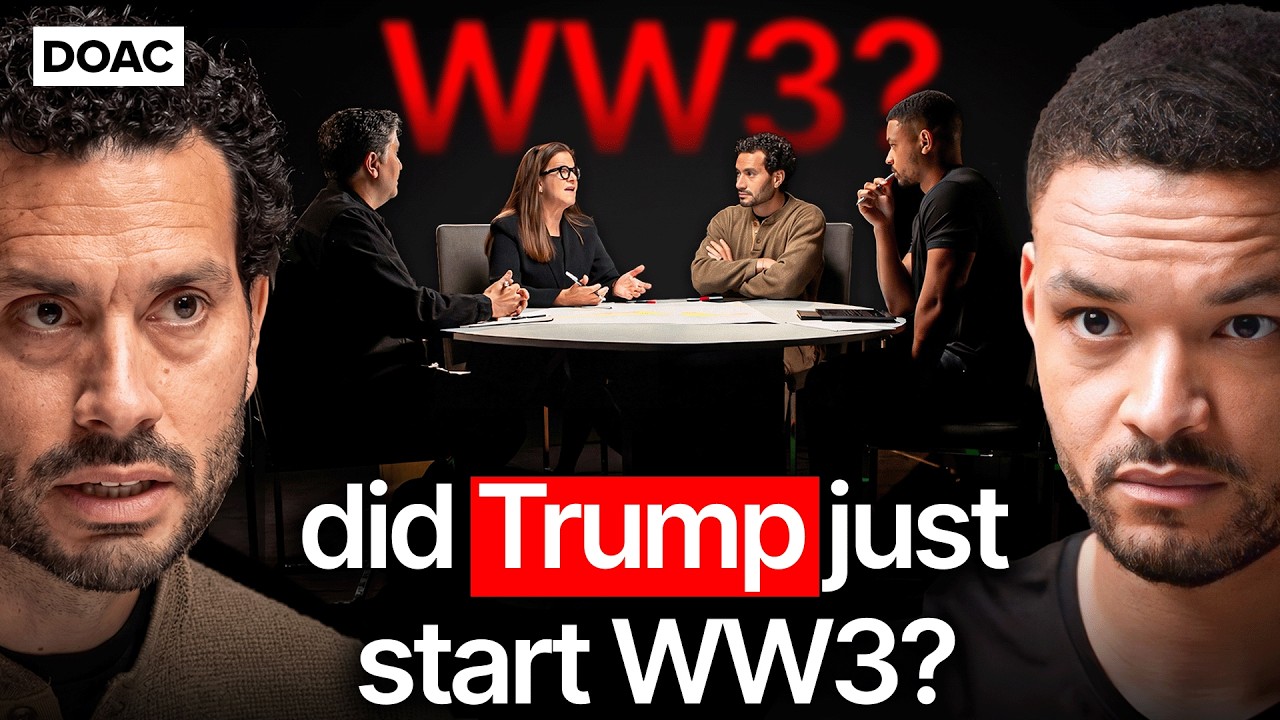
The United States and Israel carried out a decapitation strike against Iran’s top leadership, killing Supreme Leader Khamenei and much of the regime’s hierarchy, marking the most dramatic escalation in the 47-year conflict between the US and the Islamic Republic. The roundtable brings together three experts to assess whether this was a strategic masterstroke or a dangerous miscalculation that could reshape the global order.
The Deep Roots of US-Iran Hostility
The 1979 Iranian Revolution overthrew the Shah, a US-backed monarch who had ruled since 1941, and replaced him with Ayatollah Khomeini, who built a theocratic regime ideologically committed to opposing America. The revolution unified leftists, Islamists, and moderates under Khomeini’s promise to end Western dependence and the Shah’s authoritarian rule, which had modernized Iran but at the cost of civil liberties and with enormous wealth inequality.
The US and UK had been meddling in Iran for decades before that: in 1953, the CIA and MI6 orchestrated Operation TPAJAX to overthrow Prime Minister Mossadegh after he nationalized Iran’s oil industry, an event that planted deep anti-Western resentment. The Shah’s secret police, trained with American and Israeli help, used torture and surveillance, which Khomeini later exploited as proof of US-backed tyranny.
Since 1979, Iran has been a “black box” for Western intelligence: no US embassy, minimal diplomatic contact, and a closed society. The regime built its identity around opposition to America, funding proxy groups like Hezbollah, Hamas, and the Houthis, and chanting “death to America” as a core ideological commitment unmatched by any other state adversary.
Why Strike Now? Competing Explanations
The Trump administration justified the strike as preventing Iran from obtaining nuclear weapons, but the 2025 ODNI threat assessment stated Iran was unlikely to pursue nuclear weapons and was instead focused on biological and chemical weapons research. Iran had enriched uranium to 60% purity, a short technical step from weapons-grade 90%, but the official intelligence consensus was that they were not building a bomb.
Andrew Bustamante argues the strike contradicts all three major US national security documents: the ODNI threat assessment, the 2026 National Defense Strategy, and the White House National Security Strategy, none of which prioritized Iran. He sees the action as a distraction from domestic failures, a cheap win after losses, and an effort to project strength before midterm elections.
Annie Jacobsen sees it as a top-down presidential decision driven by Trump’s personality and desire for legacy, noting that official defense documents now read like hymns to Trump personally rather than institutional strategy. She also points to the October 7, 2023 Hamas attack as a turning point that convinced the administration Iran’s proxy network posed an intolerable threat.
Benjamin R. argues the strike exploited a genuine window of opportunity: Iran’s proxies were weakened after the June 2025 war, the regime was at its lowest domestic credibility after killing up to 30,000 protesters in January 2026, and Iran’s relationships with Russia and China had not yet solidified into a true alliance. He believes the president saw this as the last best chance to resolve a 47-year conflict.
The Intelligence Question: Who Really Knew What
Bustamante challenges the narrative that the CIA provided the intelligence for the strike, noting the agency has been gutted, defunded, and marginalized under Trump. He argues that 65% of CIA intelligence now comes from foreign allies and that Israel, not the US, had the most reliable human intelligence network inside Iran.
Israel’s intelligence dominance in Iran comes from its access to Iranian cell phone networks and biometric tagging capabilities that the US lacks. Bustamante suggests Israel could be selectively feeding intelligence to steer US military action toward Israeli objectives.
The panel discusses “circular reporting,” where a single unverified source gets amplified across media, making it nearly impossible to know what is true. The host describes being flooded by thousands of bot DMs after posting about Iran, pushing identical narratives, which made him question his own information environment.
The Domino Effect: Normalizing Decapitation Strikes
The strike violates international law protecting heads of state and sets a precedent that Bustamante argues will be used by other regimes. He warns that China now has justification to assassinate Taiwan’s leader, Russia can target Zelensky, and any authoritarian can claim the US proved such actions are legitimate.
The panel draws a distinction between the Venezuela operation, where Maduro was captured alive (a “CEO swap”), and Iran, where the leadership was killed (a “company restructuring”). The Venezuela raid in January 2026 saw 150 US special operations forces extract Maduro from a heavily fortified base, an operation that already shattered norms.
Benjamin argues Khamenei was a legitimate combatant because he authorized, funded, and directed attacks on Americans, making him functionally a military commander. Bustamante counters that this logic would make every head of state a legal target, eroding the last guardrails against interstate assassination.
Iran’s Military Capacity and the War of Attrition
Iran has the largest military in the Middle East with the biggest stockpile of missiles, drones, and air defenses, split between the national army (which defends borders) and the Islamic Revolutionary Guard Corps (an ideological force protecting the revolution and running proxy networks). The IRGC answers only to the supreme leader.
After the June 2025 war, Israel estimated it destroyed half of Iran’s missile launchers and stockpiles. Current estimates suggest Iran can sustain its current rate of fire for two to three weeks before depletion. However, the US used B-2 bombers to destroy Iran’s underground “missile cities,” which are the deeply buried facilities that only bunker buster bombs can reach.
Iran’s strategy is “burden sharing”: it cannot strike the US mainland effectively, so it attacks US allies and partners in the region, hitting Dubai, Saudi Arabia, Bahrain, Qatar, and the UAE. The goal is to make the pain widespread enough that Arab states pressure the US to stop. Iran is also the “breadbasket” of the Middle East, producing food that oil-rich Gulf states depend on, giving it economic leverage.
The cost asymmetry favors Iran: cheap Shahed drones cost a fraction of the interceptors needed to destroy them, with interceptor-to-missile cost ratios estimated at 10:1 to 25:1. The US has begun copying Iran’s cheap drone technology.
Scenarios for How This Ends
The panel estimates three to four weeks of active kinetic conflict, followed by years of low-level warfare through proxy cells, terrorist attacks, and covert operations. Hezbollah sleeper cells in the West could be activated at any time.
Possible outcomes include: (1) regime collapse and a democratic transition led by Iran’s highly educated, Western-leaning population; (2) a power vacuum filled by China and Russia, creating a strengthened Iran aligned against the US; (3) a slow fracturing of the IRGC with defections and internal collapse; or (4) a new authoritarian regime that is even more hostile.
Benjamin notes that 80% of Iran’s 90 million people were born after 1979 and know only this regime, and polls consistently show they want something different. However, Bustamante is skeptical, pointing to failed nation-building in Iraq and Afghanistan as cautionary examples.
The panel warns that even if the regime falls, the next leaders will be marked men targeted for assassination by Israel and potentially Arab states, creating a cycle of instability.
The Nuclear Dimension
The panel is divided on whether the strike increases the risk of nuclear war. Bustamante says it absolutely does, pointing to France deploying air-launched nuclear warheads across Europe two days after the Iran strike as evidence of escalating nuclear posturing. Jacobsen and Benjamin argue the real nuclear risks come from Russia and North Korea, not Iran, which does not have nuclear weapons.
North Korea serves as both a cautionary tale and a model: the Clinton administration accepted North Korea’s promise not to develop nuclear weapons, and North Korea now has thermonuclear warheads capable of striking the US. The panel agrees Iran had every incentive to follow the same path.
There is an unspoken rule that nuclear weapons guarantee regime survival: the US will not directly attack a nuclear-armed state. This creates a perverse incentive for rogue states to accelerate nuclear programs.
The Surveillance State and AI
The panel discusses the Pentagon’s dispute with Anthropic, which refused to allow its AI to be used for autonomous weapons or mass surveillance of US citizens. The Defense Secretary threatened to cancel Anthropic’s $200 million contract and brand it a “supply chain risk,” raising concerns that the administration will use military action as justification for expanding domestic surveillance.
Bustamante warns that a Hezbollah attack on US soil could be used as an opportunity to legalize mass surveillance systems that are already technically feasible but currently require purchasing data from companies like Apple rather than direct government access.
AI war game simulations at King’s College London found that AI models playing nuclear-armed leaders consistently escalated to nuclear threats, with Anthropic’s Claude recommending nuclear strikes in 64% of scenarios. The panel sees this as evidence that AI in military decision-making is extraordinarily dangerous.
China is developing AI 10 times more aggressively than the US, already using autonomous weapons and mass surveillance domestically. The panel argues the US feels compelled to match China’s AI capabilities despite the risks.
The Shifting World Order
The panel agrees the unipolar world where the US was the sole superpower is ending, replaced by a “strongman multipolar world” where authoritarian behavior is normalized and respected. The US is no longer leading but mimicking other powers’ tactics.
The UK’s exclusion from pre-strike planning, despite the “special relationship,” signals a broader abandonment of traditional allies. The US refused to share Diego Garcia basing rights with the UK, and Keir Starmer was clearly not briefed before the attack.
Trump’s personal motivations include legacy-building, a desire for the Nobel Peace Prize, and the Trump brand. The panel notes he has talked about taking Greenland, a “friendly takeover” of Cuba, and building a Trump casino in Tehran, suggesting personal branding drives policy.
The panel worries most about who comes after Trump: if he normalizes authoritarian governance, the next president will inherit expanded powers and public acceptance of strongman tactics, potentially leading to an even darker period.
What the Panelists Would Tell the Average Person
Bustamante is leaving the United States for Costa Rica because he does not want his children raised in a country that is afraid, angry, or constantly compromising democratic principles. He wants them to grow up as global citizens who value every human life.
Jacobsen advises reading widely across conflicting sources, having uncomfortable conversations, and resisting the algorithmic pressure to fit into ideological camps. She emphasizes that cognitive dissonance is uncomfortable but necessary for intellectual honesty.
Benjamin stresses empathy: you do not have to like the other side, but you must be able to see the world through their eyes before acting. He also highlights the Taiwan semiconductor vulnerability: 90% of advanced chips come from one island, and a Chinese blockade rather than an invasion could cripple the West’s technological infrastructure with no quick fix.
All three panelists agree that the midterm elections represent the most immediate way for Americans to reassert control over the direction of the country, but express deep pessimism about the trajectory of the next decade.