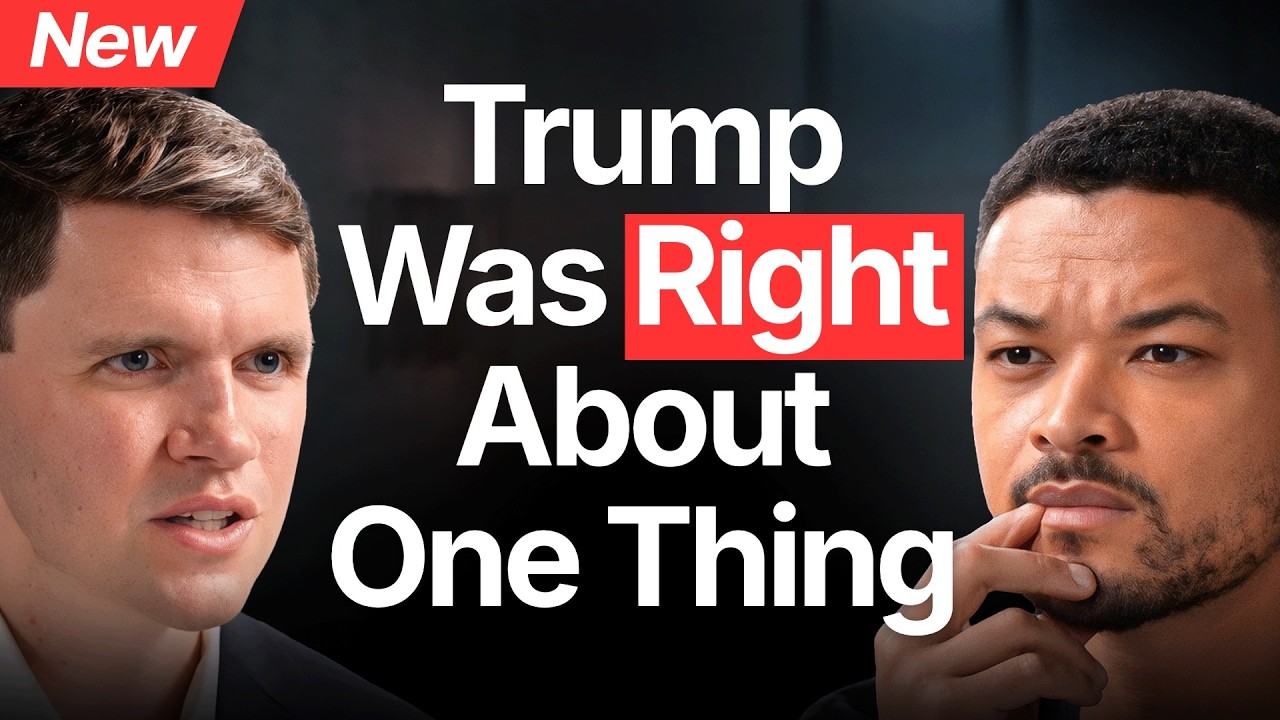
James Talarico, an eighth-generation Texan and current state representative, is running as a Democrat for the U.S. Senate in Texas — a seat Democrats have not won since 1988. A former public school teacher and current seminarian, he frames his candidacy as a ministry of “loving thy neighbor through public policy,” rooted in a childhood shaped by his single mother’s escape from an abusive marriage and the steady love of his adoptive father. The conversation spans his diagnosis of a political system captured by corporate power, his economic agenda to reverse five decades of upward wealth transfer, his approach to AI and automation, immigration, the war in Iran, and the role of faith in sustaining public service.
Personal formation and the roots of public service
Talarico was born to a teenage mother, a preacher’s daughter, who fled an abusive, alcoholic husband when he was an infant — packing their belongings into a Ford Escort and raising him in a closet-converted nursery in East Austin.
His mother modeled “fighting spirit” and service despite working overtime; she volunteered at his school, church, and community, teaching him to stand up to bullies and fight for those you love.
His adoptive father, Mark Talarico, gave him his name, raised him as his own, and embodies the integrity Talarico aspires to: “honest and cares about other people, does what’s right when even when no one is watching.”
Early ambition: voted “most likely to become president” in high school; inspired by history teachers who kept him on track, he wanted to teach social studies to do the same for others.
He considered leaving politics after four legislative terms to attend seminary full-time; his pastor reframed a campaign as a form of ministry — giving hope, bringing people together, helping them see the image of God in each other — which reconciled his two vocations.
Political philosophy: systemic corruption over personality
The core problem is not individual politicians but a system whose incentives — big money (Citizens United), gerrymandering, two-party duopoly, media ecosystems — “incentivize extremism and corruption by design.”
Politicians are rational actors trying to get re-elected; the question is what incentives the system puts before them. Replacing one officeholder without fixing the system yields the same result.
He self-imposes a two-term limit (12 years max in the Senate) to avoid the trap where office and identity merge, leading to self-preservation, selling out values, and susceptibility to corruption.
He identifies as a legislator, not an executive: his skill is building coalitions and passing bipartisan bills (60 in the Texas House on housing, healthcare, early education, teacher pay, property taxes) rather than unilateral decision-making.
For 2028, his criterion for any presidential candidate is whether they prioritize comprehensive political reform — getting big money out, banning gerrymandering, overhauling the Supreme Court — because without systemic repair, no issue progress is possible.
Economic diagnosis: from shared growth to crony capitalism
1950s–60s: largest, strongest middle class in history; government invested in education, healthcare, homes, highways; productivity and innovation flourished alongside shared prosperity.
1971 Powell Memo: corporate lawyer (later Supreme Court justice) laid out a blueprint for business to dismantle the New Deal/Great Society — unite corporate spending, buy politicians in both parties, elevate corporate voices in media, appoint sympathetic judges.
Since the late 1970s: trickle-down economics, tax cuts for the top, stagnant wages, systematic attacks on education and healthcare. Middle-class share of aggregate income fell from 62% (1970) to 42% today; upper-income share rose from 29% to over 50%.
“We don’t have capitalism. We have crony capitalism” — gains go to those who buy access and politicians. Dr. King’s framing: “socialism for the rich, rugged individualism for the poor” (e.g., Wall Street bailouts vs. no relief for nurses, teachers, single moms).
Three men (Musk, Zuckerberg, Bezos) now own more wealth than the entire middle class. One in five Texas children live in poverty while a Texan becomes the world’s first trillionaire — “a spiritual sickness.”
The tax code is rigged: carried interest loophole, capital gains preferences, write-offs for private jets and mega-yachts. Collecting only what the top 1% already owe would raise ~$172B/year — enough to end U.S. poverty.
Wealth concentration is self-reinforcing: billionaires fund campaigns (e.g., a Pennsylvania billionaire gave the Texas governor $12M to pass a private-school voucher scheme that drains underfunded public schools — Texas ranks 43rd in per-student funding — and subsidizes wealthy families already in private schools).
Economic agenda: unrigging the system
Raise the minimum wage; expand overtime pay so workers benefit from the wealth they create.
Rebuild labor unions — the destruction of the middle class tracks the destruction of organized labor; this empowers workers to negotiate pay, benefits, conditions without government micromanagement.
Tackle the debt crisis: household debt (medical, student, credit card) at all-time highs; national debt — both are “moral emergencies.”
Expand the child tax credit (cut child poverty in half before it expired); invest in higher education at GI Bill scale; support new families so they can afford homes and children.
Break up healthcare monopolies (e.g., CVS owning a major PBM, a major insurer, and the largest pharmacy chain) to restore competition and lower prices; the 2023 federal bill’s healthcare cuts are projected to cause 51,000 needless deaths annually.
Fund all of this by making the wealthiest pay their fair share — close loopholes, explore wealth taxes, tax not just income but assets. Federal action is essential because states cannot solve this alone (capital and people move; Texas has 0% state income tax).
“Pro-business” usually means pro-big-business (e.g., taxpayers subsidize Walmart via Medicaid because it doesn’t provide adequate healthcare). He wants an economy where Tesla’s workers also share in the prosperity they generate.
AI and automation: regulation before disruption
Competing reactions: excitement about curing diseases, anxiety that leaders have their “head in the sand” — Congress has been MIA as AI develops dangerously fast (e.g., OpenAI hack).
Three regulatory priorities if in the Senate:
Protect workers and the economy: AI should improve jobs, reduce hours, increase leisure — not just replace humans.
Protect children: social media preyed on kids (self-harm, depression); AI chatbots have already helped children harm themselves. Regulation must prevent a repeat.
Protect democracy: deepfakes in campaigns (already seen in his Texas race) erode shared reality; even digital natives can’t distinguish AI from truth. Disclosure requirements and guardrails are urgent.
Historical parallel: Manhattan Project, space race, internet — all public-private partnerships where the public set rules. AI is being built by a handful of for-profit CEOs without public input. “We cannot let AI or robotics become yet another arena where billionaires write the rules for the rest of us.”
On Musk’s prediction of a billion humanoid robots: reject the false choice between safety and human jobs. Airplanes fly themselves but still have trained pilots. Human supervisors for 18-wheelers on Texas highways. An “AI dividend” — tax AI companies, redistribute gains, fund entrepreneurship grants for the “CEOs in their garage, not on their mega-yacht.”
Expert warning: “five trillionaires and 30% unemployment.” The economy is for people, not people for the economy. Elected officials must “get in the game” now, learning from the social media failure of regulating after the fact.
Immigration: security and humanity as complements, not trade-offs
Biden administration failed on the border: chaos in border communities (his mother is from Laredo). Trump was right about the failure but replaced one extremism with another — masked men, unmarked vehicles, kidnapping people off streets, deporting long-term small-business owners, detaining 5-year-olds.
Most Texans/Americans want both: secure border (knowing who enters is not racist) AND legal pathways for hardworking immigrants who strengthen the economy. These are not mutually exclusive.
As a teacher, he taught DACA students (“Dreamers”) who loved this country profoundly. He supports comprehensive reform: border security + pathway to citizenship for undocumented people brought as children and those here for years/decades.
Iran war: checks and balances, diplomacy, moral clarity
The war was entered with hubris — belief that toppling Iran’s leadership would be quick — ignoring war-game predictions that Iran would close the Strait of Hormuz.
Current disaster: no clear military objectives, objectives shifting, legislative branch subservient to executive (parties coordinating across branches, defeating the Founders’ design of ambition countering ambition).
As senator, he would use the power of the purse: withhold funding until the administration articulates clear objectives and an exit strategy. Restore checks and balances through bipartisan congressional engagement.
Ultimate path: regional partnerships, free passage through the Strait, nuclear diplomacy (the JCPOA was working; invasion lost ground). Economic leverage remains.
Moral stakes: 19-year-old Texan Isabella Gonzalez died in a Jordan air strike — a patriot and hero, but her sacrifice must not be mistaken for acceptance of a forever war without strategy.
Advice to Trump: humility, convene bipartisan congressional leadership, rebuild alienated alliances — “when you get in a jam, you need your friends.”
Faith as the soil of public service
Lifelong Christian (Baptist heritage; same church since age 2). Grandfather and pastor taught the two great commandments: love God, love neighbor (Matthew 22).
The Good Samaritan parable: the neighbor is the sworn enemy. Loving neighbor means actively caring for those most different, even those we hate — a radical teaching 2,000 years later.
Faith = trust, not just intellectual belief. Analogy: learning to swim — “don’t fight the water… let the water hold on to you.” Faith is relaxing into a deeper reality rather than controlling everything.
Seminary (started at 31, during legislative service) was about obeying the first commandment (love God) after burning out on the second alone. The two commandments sustain each other: inner life (prayer) and outer life (action) prevent burnout and self-centeredness respectively.
He inherits the Christian tradition as a gift passed through generations; acknowledges institutional corruption (abuse, greed) but warns against discarding the “baby with the bathwater” — traditions carry beauty, truth, love that each generation must reclaim.
Opponent Ken Paxton: accountability as love
Paxton (Republican AG, his likely general-election opponent) is “one of the most corrupt politicians in America”: indicted for investment fraud (defrauding his own friends), reported to FBI by his own staff, impeached by his own party, infamous personal conduct.
“Ken Paxton is a child of God. He is my brother in Christ. It doesn’t mean there’s not accountability. Love requires accountability.” Analogy: taking car keys from a drunk friend — feels aggressive, done out of love for them and everyone else.
He would “grab the keys”: urge Paxton to get his own house in order before telling others how to live. Defeating him protects Texans and, paradoxically, may give Paxton a chance to re-evaluate.
Campaign and closing vision
Texas-scale challenge: 18M voters, 20 media markets, two time zones, once a nation. 59,000 volunteers, 1M+ donors, many praying. Polls show a narrow lead but “the only poll that matters is election day.” Musk has committed millions to defeat him — “if you’re speaking truth to power… you’re always the underdog.”
The empowering message: stop asking “how will this politician be different?” The system traps everyone. Focus on systemic reform — a mass movement of working people across divisions forcing change. “Until we transform that system, you’re not going to see anything change.”
Biggest challenge: winning Texas. Working to fix it by campaigning like they’re five points down, building a broad coalition, and asking for thoughts and prayers regardless of politics.