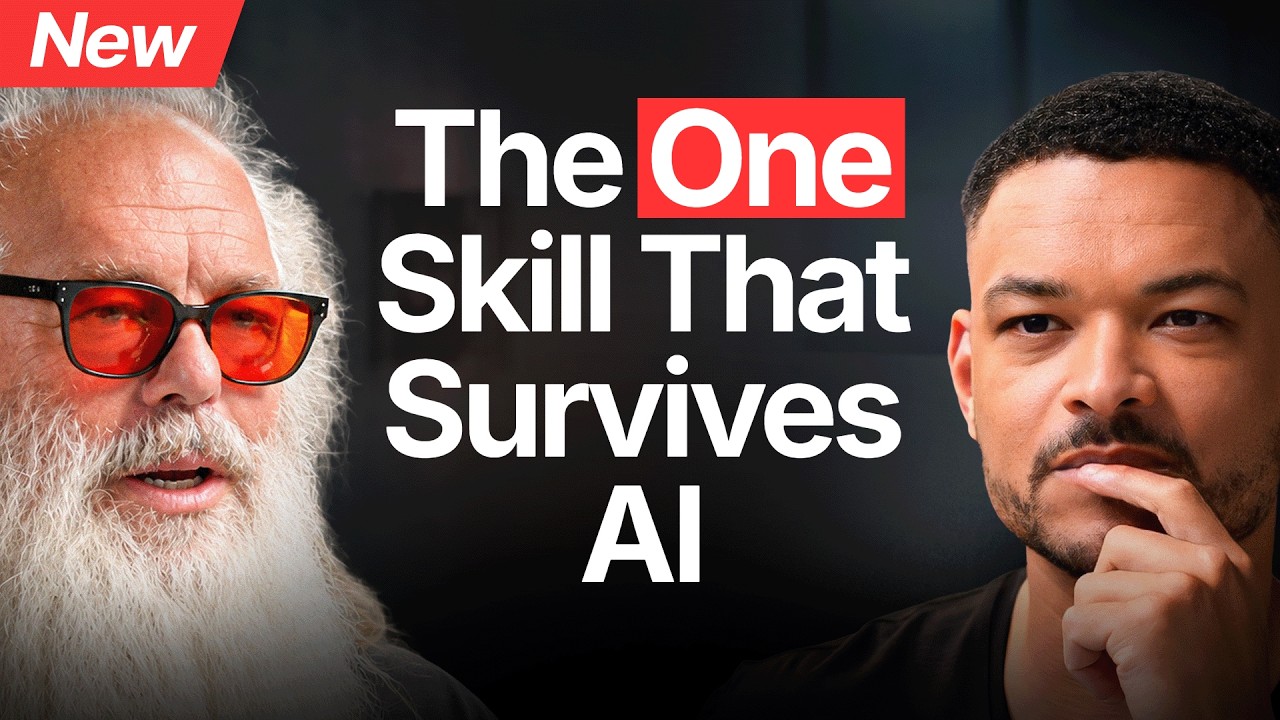
Rick Rubin, legendary music producer behind artists like Jay-Z, Kanye West, Johnny Cash, Red Hot Chili Peppers, and Adele, shares his philosophy that creativity is not a skill reserved for the few but a birthright beaten out of us by institutions, and that the only path to great work is following an internal compass — even when it’s indefensible, risky, or commercially irrational — because the work itself is an offering, not a product.
The “Indefensible” Principle: Why Reason Is a Tiny Sliver of Decision-Making
Rubin defines “indefensible” as a positive creative necessity: taking things to an extreme you cannot justify with logic, because reason covers only a sliver of how real decisions get made; the rest comes from intuition or a sense of being guided by a creative force he calls God.
He illustrates this with the “vibe coding” meme: a random internet image of him became associated with a new coding paradigm, hundreds of people sent it to him, and instead of dismissing it, he felt an energetic invitation, wrote a joke tweet (“tools will come, tools will go, only the vibe coder remains”), which got 1.5M views, then wrote an entire book (The Way of Code) adapting the Tao Te Ching for vibe coding — all without a rational plan, simply answering a call.
Labels make you smaller; the more successful you become, the narrower you get if you cling to your business card. Saying no to invitations because “it’s not my job” is how you miss the next evolution.
The best art is often challenging at first — revolutionary works have no context, so they alienate before they illuminate. If you make something you think everyone will love, it’s “too easy.” The goal is to make your favorite thing, even if half the audience hates it.
Risk Beats “More of the Same”: The Lincoln Park and Radiohead Examples
Lincoln Park could have made a fourth rap-rock album guaranteed to sell; instead they risked a new sound, lost half their audience, gained new listeners, and built a longer career — while the genre itself was dying.
Radiohead’s Kid A alienated Rubin on first listen; years later it became his favorite Radiohead album. The near-term metrics (sales, radio play) are a shorter game; the long game is making work so personal it’s a diary entry no one can tell you is “wrong.”
Rubin never considers near-term incentives, label pressure, or market fit. “We’re making things forever.” If the work is truly personal, commercial failure doesn’t invalidate it — it just means the audience hasn’t caught up, or never will, and that’s fine.
How “99 Problems” Was Made — And Why the Label President Said It’d Never Be a Single
Jay-Z asked 10 favorite producers for one track each for The Black Album (planned as his retirement album). Rubin made the “99 Problems” beat; Jay wrote the verses in his head in 20-30 minutes, mumbling in the back of the room, then recorded three takes with different cadences like a saxophonist soloing, picked the second, and repeated for each verse.
Chris Rock suggested the “99 Problems” hook (flipping Ice-T’s original); Rubin suggested making it about actual problems, not women.
The Def Jam president (Rubin’s former label) said: “Great album track, never a single — doesn’t sound like radio.” That was the old logic: make things that sound like everything else on radio. Because it didn’t, when it hit radio it had massive impact.
System of a Down’s “Sugar” was rejected by KROQ’s Kevin Weatherly: “We will never play this band.” One year later: #1 most requested. Two weeks before this interview: sold out 80,000 seats in Paris, two nights straight.
The pattern: make what you love, take it to an indefensible extreme, never ask “will they like it?” or “where does it fit?” — and sometimes it works on a historic scale.
Transcendental Meditation: The Grounding Practice Since Age 14
Rubin learned TM at 14; it changed him. He stopped in college, restarted in his 20s in California, and the first session back felt like “a big part of who I am” despite a 5-year gap — confirming Maharishi’s claim that each meditation is a deposit in the bank.
Practice: silent mantra, 20 minutes twice daily (morning, pre-dinner), learned from a teacher, never spoken aloud. He meditated with Tom Petty, Johnny Cash, Red Hot Chili Peppers before sessions.
The mechanism: lets go of ordinary concerns, reveals depth beneath surface. “You see beyond the surface. The things on the surface are not so interesting. I’m interested in the depth.”
Proof it works: the contrast of stopping and returning. The only metric is internal — does it deepen your connection to what lights you up?
Creativity Is Beaten Out of Us — Not Innate, But Recoverable
“We go to school, we’re taught to follow rules. The rules are not there to help us. The rules are there to control us. We’re not taught to be free creative thinkers.”
Everyone is creative. Believing “I’m not creative” is bad information lodged early (e.g., “you can’t sing”). The culture’s “creative vs. non-creative” label is a simplification that shuts people down.
Comparison is the trap: “Michael Jackson is better at being Michael Jackson. Prince is better at being Prince.” There is no competition between artists — only who has a better diary entry.
The goal: get to “this pizza tastes better to me” — simple, internal, non-comparative knowing. Most people don’t trust themselves because the world indoctrinates self-doubt; the few who appear overconfident are usually masking insecurity.
The “Lazy Workaholic” and the Anti-Deadline Philosophy
Rubin calls himself a lazy workaholic: most days he’d rather do nothing, but he schedules, shows up, and does the work.
He avoids deadlines until the work is ~90% done and the code is cracked. Deadlines before that force premature finishing and kill exploration.
The creative process has four phases: Seed (try many things, no timeline), Experimentation (see what seeds want to become), Crafting (trim and shape), Finishing/Editorial (final polish). Only in the last phase can you set a timeline — because only then do you know what you’re making.
This applies to life: seed, experiment, craft, finish. Living this way makes you an artist regardless of occupation.
Quitting Is the Prerequisite for Starting: The Ace of Spades Story
Jay-Z made Cristal famous in hip-hop; the company head insulted hip-hop drinkers. Jay immediately cut ties — not to start a competitor, but because “I’m not going to have anything to do with them anymore.”
Almost instantly, someone approached him with a champagne brand (Ace of Spades) — all they had was a gold bottle Jay loved. He didn’t seek it; the universe filled the vacuum he created by doing the right thing.
Society glamorizes starting, demonizes quitting. But you can’t start big without quitting what’s misaligned. “You create that vacuum. The good thing you’re looking for can come in to fill it.”
Relationships, jobs, identities: if it’s life-and-death misaligned, hit the reset button. You don’t need money — move somewhere cheap, start a new game. The prison is the story you tell yourself.
The Depressive Episode at 33: When the Rug Was Pulled
At 33, after years of unbroken success, Rubin’s mentor at his label was politically ousted. The new head called: “I don’t like your agreement. Let’s talk when you’re back.” That single call triggered panic attacks, insomnia, physical illness, a sense of dying — “shot with a poison arrow.”
He had no musculature for instability; his identity was fused with “everything always works.” Therapy 5 days/week, antidepressants, years to recover. Even after the business problem resolved, the damage persisted.
Gift: it gave him deeper empathy for artists who live in that fragility. Before, he felt like Superman; after, more rooted in reality — “still believe in magic, but I don’t feel like Superman anymore. I feel tired.”
He wouldn’t erase it: every event, positive and negative, brought him here. It forced a more realistic view without losing wonder.
What Makes Great Artists: Point of View, Work Ethic, Fearlessness
Jay-Z: writes entirely in his head, no notes, complex verses memorized after 20-30 minutes of looping the beat. Process is unique — not better, just his. Danger: taking others’ advice as universal law.
Kanye: totally fearless in art (and life). Risk and greatness go hand in hand — “it’s only through the risk that the greatness is shown.” Walking a tightrope; eggs get broken.
Eminem: obsessive practice — writes constantly, 99% never seen, “I just want to be good.” Like an athlete training in the off-season.
Common thread: ordinary people who made a decision. Distinctive point of view (seeing a layer others miss) + relentless work ethic. Not born great — cultivated.
How to Cultivate Your Own Point of View
Stop consuming only business/self-help. Go to museums, read great literature (if 3 people recommend it, read it), watch greatest films, read ancient wisdom (Tao Te Ching, Jung). Old books > new books.
Tao Te Ching lesson: “The soft overcomes the hard.” Non-action is often best action. Napoleon made people bring emergencies back in two weeks — 99% resolved themselves.
Jung: archetypes, dreams, synchronicity — closer to how the world actually works than math/science. Science updates; inner knowing (who you’re drawn to, what repels you) is more reliable for life decisions.
Rationality is overrated. The rational world is tiny. Trust the antenna — but if you’ve spent decades not trusting yourself, the antenna is rusty. Use it daily.
AI and Creativity: Tool, Not Replacement
AI is a powerful tool (like fire, printing press, internet) — can be used for good or bad. But it has no point of view; it aggregates existing ideas. Ask it the same question days apart, get different answers — no consistent “way of seeing.”
It could generate 10,000 tracks; you might like 5%. Useful as a crate-digging sampler: AI plays in background, you catch a clip, build something new. But end-to-end replacement of the artist? Unlikely — what we want from artists is point of view.
AI as prompt-assistant: Wes Anderson storyboards every frame; Hitchcock drew the whole movie. The creativity is in the prompt (the vision), not the execution. AI lowers barrier to entry — more people can express creativity. That’s beautiful.
Distinction remains the same: great art changes your life, moves you, you return to it. Rubin liked an AI song on Spotify — until he learned it was AI. Then it lost resonance. Human relatability, story, “me too” connection matters.
Warhol screen-printed; Rembrandt had studio assistants. Execution ≠ ideation. The art is in the vision. AI’s ideation? Unproven.
Artists Who Changed Rick: Johnny Cash, Tom Petty, Adele
Johnny Cash: humble, quiet, brilliant, spiritual. Didn’t offer opinions unless asked. “My life was really improved getting to spend so much time with someone so inspiring.”
Tom Petty: ultimate craftsman (like Paul McCartney). Everything in time, in tune, every vocal word intelligible. Worked 2.5 years on Wildflowers — no hurry, just progress. Taught patience, not perfectionism (which is fear-based procrastination).
Adele: anomaly in pop — writes her own songs, deeply personal. You feel it’s her. Shakira same. Contrast with manufactured pop where teams write, singer delivers.
The Jay-Z Documentary: Revealing the Poet Behind the Billionaire
After a 6-part Paul McCartney doc (focused on musicianship, not Beatlemania), Rubin wanted to show Jay-Z as lyricist/poet — not businessman. Jay is misunderstood; the depth of his writing is astounding but invisible.
Jay initially said “I like it, not saying yes.” A year later, Rubin called (urged by a mutual friend), Jay said yes. The result: intimate, unconventional filming (black-and-white, off angles) — feels like spying on a personal conversation. Jay never shows this side publicly.
Safety and trust enabled the vulnerability.
The Creative Act and the 78 “Areas of Thought” Coincidence
Book took 8 years. Originally 63 areas, grew to 83-84. Rubin wanted 78 (tarot cards, “good numbers” like 108, 144). Collaborator Neil said “you’re insane, it’s done.”
Next day, assistant Dylan put sections in order — there were exactly 78. No one deleted anything. “Nobody knows” how. Rubin: “Someday Neil will find four chapters and not mention it.”
Final Philosophy: Be True, Work Hard, Protect the Process
Don’t listen to anyone. Be true to yourself. Work hard. Never give up. Don’t put undue pressure on your art — structure life so art is free to be the dream version. Hopefully the dream version takes over.
The creative process is pure and delicate. Thinking about “what happens next” (sales, reception) collapses the house of cards. In the studio, if someone says “this could be a single,” Rubin shuts it down: “We’re making the best thing we can make. An offering to God.”
Realization (a few years ago, on a lifeguard chair in Hawaii): “We’re making it as an offering to God. Numbers are insignificant. This is our best, out of love and gratitude.”
Purpose: self-expression. “I am here. This is how I see the world. Show me how you see it.” Copying success isn’t self-expression — it’s a different game.
Consciousness may be God dividing itself to understand itself through each of us. Art is how consciousness explores itself.
Closing: Gratitude and Family
Last call: would thank his wife (15 years, ~3 nights apart) and child — “bringing so much light.” Fatherhood: seeing the world through a child’s wonder reminds you what creativity is at essence — before anyone tells you what you can’t do.
“People are amazing. Talk to anyone. It’s interesting. People are interesting if you just slow down and really listen.”